
GREEN SAUCE Let's stay for a while in Frankfurt, where there is another interesting regional product from the European list – traditional green sauce (Frankfurter Grüne Soße). It is made from seven herbs. The seeds of these herbs can be brought as a gift along with the recipe. The photo shows borage. Also included in the sauce are chervil, garden cress, parsley, salad burnet, sorrel, and chives.
GARDENS AND ORCHARDS Since we are talking about the gifts of gardens and orchards, it is worth noting that almost two dozen vegetables and fruits, or rather the regions where they are cultivated, have the EU quality label in Germany. Among them is this onion with the sonorous name Höri Bülle from Lake Constance, several asparagus-growing areas – Abensberg, Bornheim, and Schrobenhausen – as well as potatoes from the Lüneburg Heath (Lüneburger Heidekartoffeln).
LINSEED OIL Linseed oil is considered a very important health product due to its high content of valuable polyunsaturated omega-3 and omega-6 fatty acids. One of the traditional production regions in Germany is Lausitz (Lausitz), also known as Lusatia. Lusatian linseed oil (Lausitzer Leinöl) is not only on the list of Saxony's delicacies but has also received the EU regional quality label.
MARZIPAN FROM LÜBECK At the end of the selection – sweets for dessert. Let's start with marzipan treats, which in Germany are traditionally produced in Lübeck (Lübecker Marzipan). Such a sweet key was prepared here for the opening of the Hanseatic Museum, which Angela Merkel attended. The recipe for marzipan came to Europe from the East. It was admired by Thomas Aquinas and Boccaccio. The secrets of its preparation were brought to Lübeck, of course, by Hanseatic merchants.
AACHEN PRINTEN Say "Aachen," think "printen" (Aachener Printen). It is believed that they appeared in this ancient German city in the 15th century, and the secret of their preparation was brought here by coppersmiths from neighboring regions located in present-day Belgium. These cookies are considered a traditional Christmas treat, but they are produced and sold here all year round.
NUREMBERG GINGERBREAD Many different types of gingerbread are made in Germany, but besides Aachener Printen, only one other type has its geographical name registered in the European Union – Nuremberg gingerbread (Nürnberger Lebkuchen). It is first mentioned at the end of the 14th century. In 1487, before the Feast of the Ascension, Emperor Frederick III handed out such gingerbread cookies with his profile to children, which is also recorded in chronicles.
DRESDEN STOLLEN The Christmas cake from Dresden (Dresdner Christstollen) is also a geographical indication registered in the European Union. These cakes are handmade at local enterprises that are part of a special association. The first written mention dates from 1474, but it referred to a Lenten pastry. The pope allowed the Saxons to use butter for its preparation in 1491.
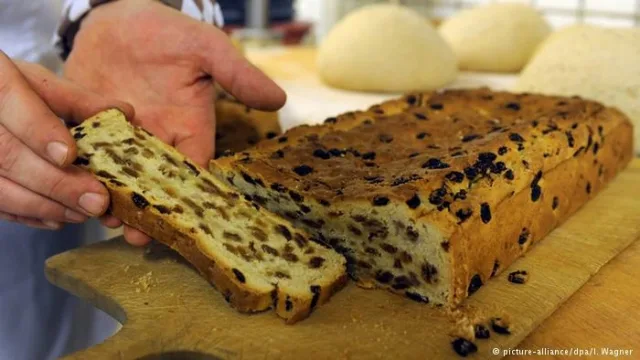 BREMEN CAKE This German city is famous not only for its musicians but also for its Bremen cake (Bremer Klaben) – a local variant of stollen. It is made from a heavy yeast dough, generously adding raisins and dried fruit in a one-to-one ratio. Cardamom, lemon zest, vanilla, and almonds are also mandatory ingredients. Stollens are rolled by hand, while special molds are used for Bremen cakes.
BAUMKUCHEN FROM SALZWEDEL Such cakes are baked in many places in Germany – layer by layer on a rotating spit. The cross-section resembles tree rings, hence the name Baumkuchen, literally "tree cake." The first German recipe was recorded in 1450. In the Middle Ages, it was served at patrician weddings. The EU list includes the cake baked in the town of Salzwedel (Salzwedeler Baumkuchen).