
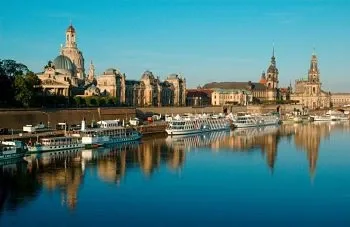
Cultural Heritage of Dresden on the Banks of the Elbe
Thanks to it, cities grew wealthy, Wittenberg introduced the world to the Reformation, and floods often influenced the outcome of federal elections. But, as the magazine Deutschland.de notes, first and foremost it should be said that the river served as the German-German border for many years.
“The river sets trade and ideas in motion,” says Ludwig Güttler. His office in the historic center of Dresden is literally a few steps from the Elbe embankment. He heads the Society for the Support of the Frauenkirche, which is also nearby. The church was built here not by chance; the Elbe itself indicated its location. People always preferred to settle on this small elevation near the river. “This place has an attractive force.” True, after the bombing of Dresden at the end of World War II, the “place of power” remained a gaping wound for a long time. In the 1970s, Güttler was a trumpeter in the Dresden Philharmonic Orchestra, and on his way to rehearsals he constantly passed a mountain of rubble. And then he began an advertising campaign to support the restoration of the church. Under the GDR, his plan was impossible, but when the turning point came, he understood: “Now or never!”
However, many more years had to pass before the “new” Frauenkirche rose from the ruins in 2005. Today the church has once again become the central part of the historic center ensemble. From the office window, streams of tourists from all over the world can be seen – after all, the Frauenkirche can be considered the most successful restoration project of a historical monument, which serves as a symbol of overcoming war and destruction.
Not all the stories told by the Elbe had such a good ending as the story of Dresden’s cultural heritage. The economy on the eastern bank had difficulty adapting to the conditions of a united Germany. West German enterprises were far ahead technologically, and moreover, it was unprepared for competition in the open global market. Only a few large enterprises survived. One of them is located about 30 km downstream – the State Porcelain Manufactory in Meissen.
The Meissen manufactory has old traditions – its history begins in 1710. The company’s commercial director, Tillmann Blaschke, even serves mineral water to guests in porcelain mugs. The fact that Meissen safely survived the years of the turning point is also explained by tradition. “In our case, it’s about artistic craftsmanship, and therefore there was no strong divide between East and West here,” says Blaschke.
However, there is another circumstance that distinguishes Meissen from other historical manufactories of the GDR, and this circumstance is closely linked to the career of Liane Werner. The current head of the manufactory came here in 1987 immediately after graduating from the Higher School of Economics in East Berlin. It was the only university in the GDR where one could study foreign trade. She chose the specialty herself, “because it provided the opportunity to travel abroad.” In the GDR, the Meissen manufactory was seen as a source of foreign currency earnings. Therefore, it was allowed to independently conduct trade negotiations with foreign buyers. Accordingly, the enterprise was better prepared for the conditions of competition in the free market. “In 1990, practically nothing changed for us,” Werner summarizes.
Nevertheless, it cannot be said that the manufactory, owned by the state of Saxony, has gone through the last 25 years without upheavals. “German table culture has changed,” says commercial director Blaschke. Porcelain dinner sets for festive occasions are no longer placed on the table in every home. Therefore, Meissen has expanded its line to include fashionable items, jewelry, interior details, and aims to establish itself in growing markets. In May 2015, Blaschke opened a new flagship store in Shanghai.
But let’s return from Asia back to the Elbe, this time to Torgau. There in 1945, the famous photo was taken of Soviet and American soldiers shaking hands on the destroyed bridge over the Elbe. True, this peaceful mood, well captured by the photographer, soon ceased to be relevant. After the creation of the GDR in 1949, the state border ran along the Elbe. In 1961, the Berlin Wall was built, and the river turned into a veritable death strip.
The term “victims of the wall” reminds us that people were once shot here while trying to swim across the Elbe or overcome border installations. “The border along the Elbe ran from Lütkenwisch/Schnackenburg to Boizenburg/Lauenburg and was 94 kilometers long. The same length was the metal grating installed in front of the dike on the GDR side,” writes Uwe Rada in his book ‘The Elbe.’ ‘At the same time, from the right bank, people could hear the noise of water, the splash of waves, but they could not see any of it.’”
In Wittenberg, at the 214th kilometer of the river, an exhibition ‘House of History’ is open, which tells about everyday life in the GDR, including ‘Trabants’ and ‘Sandmännchen.’ A small piece of ‘Ostalgie.’ There are few visitors in the museum this morning, and the streets are quiet in general. As if the city is gathering strength for a big anniversary. In 2017, it will be 500 years since Martin Luther nailed his 95 theses to the door of the Castle Church. The entire church, including the portal, is surrounded by scaffolding; restoration work is underway. On the tower there is a poster: ‘We are preserving the World Cultural Heritage – you be patient too!’”
Read the continuation of the article:
ALONG THE ELBE: the second part of the journey