
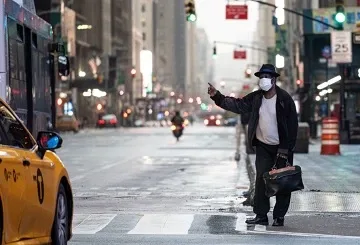
A lonely passenger on a New York street
Office closures, mandatory mask-wearing, restrictions on restaurant operations, and much more have created a completely new urban landscape worldwide – likely for a long time. According to the Population Division of the UN Department of Economic and Social Affairs, 57% of humanity, or nearly four billion people, live in cities.
But, as BBC notes, this is a relatively recent phenomenon. Urbanites first equaled rural dwellers in number in Britain in the middle of the 19th century. During the Spanish flu pandemic of 1918-1919, only 14% of the world's population lived in cities.
The current pandemic is the first catastrophe of this scale in the urban era. It has forced city authorities everywhere to become more vigilant in terms of both health protection and overall security. To find out what this has led to, the investigations department of the influential British magazine The Economist prepared the "Safe Cities Index 2021."
Economist experts have conducted this work every two years since 2015. They evaluate 60 cities worldwide based on 76 indicators, including infrastructure, digital life, personal safety, environment, and health. In 2021, the index included for the first time the state of prevention and mortality rates from coronavirus.
The current analysis, like previous ones, demonstrates a link between safety and the level of trust and mutual support, the involvement of all citizens in public life, and low corruption.
Correspondents spoke with residents of megacities recognized as the safest to find out how pandemic-related measures helped their cities become safer, more inclusive, and quickly adaptable to changing circumstances. We also asked what visitors will need to consider when travel becomes possible again.
Copenhagen
The Danish capital scored 82.4 points out of 100 and took first place in the Economist ranking, displacing Tokyo, which had consistently been a leader. The main reason is a good environmental condition (use of renewable energy, clean air, safe waste disposal, plenty of greenery).
This also positively impacted the fight against Covid-19. The last restrictions in Copenhagen were lifted in September 2021. "Numerous parks, squares, and waterfronts were very popular during the pandemic. Citizens walked, snacked on the go, and enjoyed the fresh air," says Asbjørn Overgaard, head of the non-profit organization Copenhagen Capacity.
The city authorities provided residents with "Coronavirus Guidelines," installed clear markings everywhere for social distancing, organized mass free coronavirus testing for both locals and visitors, and continuous wastewater testing for the virus, allowing quick identification of disease hotspots.
The character of most Copenhageners, like all residents of the country, includes a trait called by the Danish word samfundssind (which might be called "civic-mindedness") – collectivism, trust in each other and the authorities, and the ability to act together and responsibly. It is no coincidence that Denmark also has one of the lowest levels of corruption in the world.
Toronto
Canada's largest city ranked second in the index thanks to high scores in infrastructure and environment. Ethnic and cultural communities interact well with each other, and people are characterized by tolerance, solidarity, and social responsibility, especially evident in their attitude toward vaccination.
According to Toronto resident Farida Talaat, the city developed special vaccination programs for specific population groups. For example, the Homebound Sprint Vaccination plan helps those who cannot leave home due to health reasons, and the Black Scientists' Task Force on Vaccine Equity assists non-white citizens.
In terms of overall safety, Toronto's strengths are its tolerance and multiculturalism. "It's completely normal here if someone wasn't born in Canada," says Filipe Vernaza, who has lived in Toronto since 1998. "Ethnocultural communities don't isolate themselves in their own niches. Any group is likely to consist of people of different nationalities, sexual orientations, and faiths. In Toronto, everyone can be themselves and feel safe."
Singapore
The city ranks second in the world in digital services, healthcare, and safety infrastructure. From the first days of the pandemic, authorities leveraged these advantages by introducing a digital control system. Singapore boasts one of the highest vaccination rates in the world (80%).
Nevertheless, digital control remains due to the threat of new coronavirus strains. "Before entering any public building, everyone must scan their Trace Together token or mobile phone with the Safe Entry app," travel blogger Sam Lee told us. "This allows authorities to quickly track people who have been in contact with infected individuals and break chains of virus transmission," he says. All visitors also need to purchase a token or a phone with the app.
Remote work has become standard practice, which, as Sam Lee notes, helped ease urban transport. Access to tourist attractions and shopping malls is limited. Compliance with preventive norms in public places is monitored by special people – "social distancing ambassadors." Violators face substantial fines.
Recently, the mobile app Space Out Tool was launched, operating on the same principle as traffic jam information. With it, anyone can find out in advance whether a place they plan to visit is overcrowded.
Sydney
Australia was one of the first to completely close its borders and introduce strict quarantine. This has paid off – the Covid-19 mortality rate per 100,000 population here is one of the lowest in the world. The number of vaccinated people in the state of New South Wales, whose capital is Sydney, has reached 70%. Many restrictions are expected to be lifted soon, and external borders are planned to open in November.
People in Sydney are well protected not only from the pandemic but also from crime. “I have never felt as safe anywhere as I do in Sydney,” says Chloe Scorgie, founder of the Australian travel website Passport Down Under, who moved there in 2018. “I am a woman, but moving around the city alone, I have never felt the slightest threat.”
Ranking fourth overall, Sydney leads in the use of digital technology for safety. This includes protecting personal data, preventing cyberattacks, combating online harassment and threats, and implementing the “Smart City” framework strategy. This involves, for example, installing tiny sensors in trash bins, streetlights, and park benches to determine usage frequency and better plan urban services.
Reduced lighting and video cameras will simultaneously ensure safety during dark hours and save electricity. In southern Sydney, “chill-out hubs” have appeared – outdoor spaces where one can sit in soft light, access the internet, and charge gadgets.
Tokyo
Dropping from first to fifth place this year, Japan's capital retained its leadership in healthcare – population coverage with medical care, effectiveness of anti-Covid measures, life expectancy, mental health, and Covid-19 mortality. The number of deaths spiked during the Olympic Games but quickly returned to previous levels. The number of vaccinated citizens reached 60%.
Against this positive trend, the Japanese government lifted the nationwide state of emergency at the end of September and announced a gradual easing of quarantine measures. Instead, authorities are trying to encourage the use of vaccination passports when visiting medical facilities and social events, and to incentivize businesses to offer discounts and coupons to their holders.
Tokyo has high scores in urban transport development, road safety, and pedestrian amenities. The city traditionally favors walking short distances. Tokyoites actively participate in crime prevention by creating neighborhood watch groups.
“Lost and found counters at train stations are never empty, and bicycle locks are almost unnecessary,” says Sena Chan, a Tokyo resident and founder of Global Youth Review magazine.
Once she forgot a shopping bag in the city center and found it in the same spot, with a friendly note inside. “The centuries-old culture of collectivism, respect, and care for each other makes Tokyo the safest city I know,” she says.
What about others?
The top ten of the Economist ranking also includes Amsterdam, Wellington, Hong Kong, Melbourne, and Stockholm. The safest major US city is New York (11th place), in mainland China – Shanghai (30th), in Latin America – Santiago (33rd), in Africa – Johannesburg (47th). The list is closed by Pakistan's Karachi and Myanmar's Yangon.