
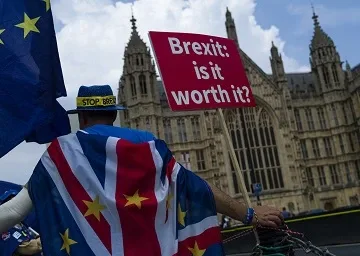
Many Britons' dreams after the country left the EU were shattered by trade barriers
As BBC reminds us, Britons voted for Brexit by 52% to 48% in June 2016. And then they argued among themselves for a long time about what it should actually be: soft, hard, semi-soft. They changed prime ministers twice, re-elected parliament twice, and finally in January 2020 Boris Johnson signed the divorce agreement with the EU after 45 years of "cohabitation."
For almost a year everything remained as it was, and the transition period ended only on New Year's Eve – exactly one year ago. And even then not completely. A partial delay is still in effect, and many serious trade restrictions will only come into force this year.
In addition to the concessions, the purity of the historical experiment (after all, no country had ever left the EU before) was disrupted by the Covid epidemic, lockdowns and the corona crisis. And not much time has passed – just a year. However, the first conclusions about how Brexit affected the lives of Britons, their incomes and freedoms have already been drawn. Here they are.
Britain faces shortages
After Brexit, Britain faced shortages of the most unexpected things. Supermarkets periodically run out of mineral water, salad, or cheese. There is a shortage of building materials and spare parts, and the labor market is in a complete mess: no cooks, no waiters, no seasonal workers in the fields.
No wonder – Britain left the single European market on January 1, 2021, and barriers that did not exist before arose on the path of goods, services and labor. This undermined trade and the economy, because before Brexit, Great Britain imported all of this without any restrictions.
For example, half of all food in Britain is imported, and 60% of all imports before Brexit came from Europe. And not by bread alone: overall, the EU at the time of the divorce was Britain's main trading partner, accounting for 53% of imports and 44% of exports.
Here is just one example: the fuel crisis. In the fall, queues formed at British gas stations, and then both gasoline and diesel disappeared altogether. There was a shortage of drivers because Europeans left after Brexit, having lost the right to work.
On the other side of the English Channel, in continental Europe, there was no shortage at that time. Moreover, gasoline did not even run out in Northern Ireland, which, of course, left the EU as part of Great Britain, but got stuck customs-wise in the European Union with the consent of Boris Johnson (more on that below).
According to a recent YouGov poll, 6-8% of Italians, Spaniards and Danes have faced food shortages in supermarkets in recent weeks. Among Britons, as many as 56% have.
Britons have become poorer
Brexit sent the UK economy into a knockdown. Even official analysts agree with this. According to government experts from the Office for Budget Responsibility, in the medium term Britain will lose about 4% of economic growth. Non-government forecasts are even gloomier: minus 6-7%. The nation is getting richer, but not as fast as it could have. For two main reasons.
The first is described above – a reduction in imports of goods, capital and labor due to leaving the single European market. Cheap Spanish salad or Polish nails, inexpensive Romanian nurse, Italian pizzaiolo or Greek hairdresser – all this is in the past.
The second reason is a reduction in exports. The EU single market gave Britons access to the pockets of half a billion potential customers, from Bulgaria and Germany to Cyprus and Portugal, as if they lived on the next street. Now there is a wall of duties, taxes and formalities between them.
Brexit trade barriers cost Britain almost 13 billion pounds, or about 16% of its previous trade turnover, according to the CER research institute. It came to this conclusion by comparing Britain's success with how its conditional twin – a group of countries whose economic growth and trade dynamics were close to Britain's before the referendum and during the transition period – is doing. The experiment made it possible to isolate the effect of Brexit from the problems caused by the pandemic, which equally affected the entire Old World.
Instead of a dividend – a tax increase
The economic damage is obvious, but it is far from the apocalypse that Brexit opponents warned about. Now they (not without reason) argue that not all ties with the EU have been severed yet, and many trade barriers will only be erected in 2022. However, the economy was never the main argument for leaving the EU. Boris Johnson's campaign was run under the banners of sovereignty: political and financial. And one of its main arguments was the refusal to pay membership fees to the European Union.
The current prime minister promised to use the saved money to finance the national health service NHS. However, in the end, his finance minister announced that citizens and businesses should chip in for these purposes – taxes will be raised on them from April. The government expects to raise an additional about 30 billion pounds by 2025. This estimate is almost identical to the consensus forecast of Britain's losses from Brexit over this period.
Victory over immigration
Where Brexit has been successful is in limiting immigration. The total number of arrivals has dropped sharply, because Europeans can no longer just come and live in the country – they need to find a job within three months, and not just any job, but a high-paying one. And even though due to Brexit the number of illegal migrants crossing the English Channel in rubber boats has increased, and crops are rotting in the fields and there is no one to drive trucks, overall one of the main demands of supporters of ending free movement has been fulfilled – the border is locked.
True, there are two problems. The first is that exceptions have to be made. Home Office agreed to issue temporary visas to drivers and slaughterers, because it turned out there was no one to slaughter pigs, butcher poultry, and deliver goods to stores by truck. Due to a shortage of labor, Britain for the first time in decades was unable to raise and slaughter its own turkeys for Christmas – they had to be imported from Poland and France.
True, it turned out that the expelled Europeans are in no hurry to return. They have enough work on the continent, salaries are comparable, and there is less red tape. As a result, demand for 5,000 temporary visas for poultry farms was half that, for 5,000 driver visas only a couple of hundred applicants were found, and out of 800 needed slaughterers, only a couple of dozen were attracted.
The second problem is the EU's response. The British not only closed their market to immigrants, but also lost their own freedom of movement and the right to work wherever they please in any of the 27 EU countries. As a result, an English architect can no longer build in Germany, and a model cannot pop over for a couple of days for a shoot in Italy. They need a work permit, which is long and expensive. More than a hundred musicians in an open letter accused the authorities of having "shamefully betrayed" an industry that brings Britain more than 100 billion pounds a year.
Unity of the Kingdom or Unification of Ireland
Brexit threatened not only Britain's income, but also the unity of the kingdom. Of the four nations that make it up, only England and Wales are still holding together. In Scotland and Northern Ireland, Brexit awakened centrifugal forces.
Johnson came to power three years after the referendum thanks to a promise to finally negotiate the terms of the divorce with the EU. His predecessor Theresa May could not do this for a long time because she did not know how to solve the main issue – the Irish one.
The fact is that part of the island – Northern Ireland – is part of the United Kingdom. It was turbulent there for a long time, and the agreement that ended the bloodshed presupposes the absence of a border with Ireland, which is in the EU.
While Britain was an EU member, there were no problems. Brexit brought back the border, and the only question was where it would be. To avoid erecting barriers on the island, either the whole of Great Britain had to remain in the customs union, or a customs border had to be drawn by sea between Northern Ireland and the rest of Great Britain.
Theresa May refused the first option because it contradicts the spirit of Brexit, and the second because it involves erecting borders within the country. She was sure that no British prime minister would ever agree to that.
Boris Johnson had a different opinion. He agreed to draw a border within the country and signed an agreement with the EU on these terms. He presented the agreement as a breakthrough, won the election with it, and declared that Brexit was successfully completed.
However, it soon became clear that the EU was not joking. The agreement Johnson signed required customs clearance of goods within Great Britain, contrary to Johnson's solemn promises that there would never be any checks. The result – long wrangling with the EU, an attempt to revise the just-signed agreement, failure, the defection of chief negotiator David Frost, and a partial capitulation in negotiations.
Meanwhile, the Irish, following the Scots, increasingly desire a divorce from England. According to recent polls, in Northern Ireland 67% believe that Brexit has brought the reunification of the island closer, and 53% that a referendum on this will take place in the next 10 years. In the European south, 62% support unification with Northern Ireland.
Britain's Place in the World
Brexit was proclaimed as liberation from the shackles of the European Union in order to restore Britain's leading trade and diplomatic role in the world. What happened?
In trade, Britain failed to conclude a single advantageous deal with other countries that would at least minimally compensate for the loss of access to its nearest, and moreover the richest and most populous market in the world – the European one. The trade agreements signed during this time were either an exact copy of European ones or a capitulation to inevitability. If earlier Britain concluded trade unions on behalf of the second economy in the world with half a billion highly paid population, now its emissaries travel the world on behalf of 66 million people on the outskirts of Europe.
As a result, new trade deals are full of concessions that Britain would never have made before. Therefore, British farmers cannot read the recently signed agreements with Australia and New Zealand without tears and anxiety for the future. New Zealand farmers are preparing to flood the British market with their world-famous premium products. British livestock breeders expected something different from Brexit.
And the main foreign trade prize of Brexit – free trade with the United States – is not even being discussed. America is warm towards its ally and former mother country, but Ireland is no less revered, as President Joe Biden has repeatedly reminded. Until the aforementioned Irish question is resolved, a trade deal with the US is impossible. And even after that, it is unlikely to be profitable, again for the aforementioned reasons. The American economy is more than seven times larger than the British, and in trade negotiations, size matters.
The divorce from the EU also changed Britain's role in world politics. It is still a nuclear power and one of the five permanent members of the UN Security Council. However, now it is more an ally of the English-speaking but distant US and Australia, whose main threats are in Asia. And on the European front, Britain's voice is growing quieter.
Domestic Politics
If on the world stage things are not good, maybe Brexit brought dividends in domestic politics?
Initially – undoubtedly. He turned a journalist and mayor, Johnson, into a prime minister with a sweeping majority in parliament. However, voters are gradually losing interest in reports of imaginary victories on the European front and are increasingly paying attention to domestic affairs. And here Boris Johnson has serious problems. Covid, scandals, tax hikes, inflation, lost elections.
Even those who voted for leaving the EU are losing faith. A recent poll showed that for the first time since the referendum victory, a majority of Eurosceptics are dissatisfied with Johnson. In the summer of 2019, 74% were satisfied, when the pandemic hit – 86%. And now – only 38%. And among those who voted against Brexit, it is even several times lower.
The strategy of permanent Brexit and endless battle with an external enemy in the form of the EU is yielding fewer and fewer points on the domestic front. And the losses from reduced trade, on the contrary, hit household incomes and swell the ranks of the dissatisfied.
What next?
The economic consequences of Brexit are only beginning to take effect. In the coming year, new trade barriers will appear, which will inevitably reduce the incomes of British businesses and the population.
“A year has passed, and the damage from Brexit to the British economy is becoming more and more obvious,” writes Anand Menon, head of the research center The UK in a Changing Europe, one of the leading experts on this issue. “However, contrary to Johnson’s claims, many details of Brexit, as well as the final extent of damage or benefit, are far from clear.”
Partly the picture is blurred by Covid, partly by the postponement of many trade restrictions. But this is temporary.
“The impact of the pandemic will relatively quickly fade away, but the consequences of Brexit will not. And in some areas, such as trade and migration, they will only worsen over time,” warn economists at The UK in a Changing Europe.
Boris Johnson led his party to a convincing victory in the 2019 election thanks to the promise to complete Brexit – “Get Brexit Done.” “Brexit is far from complete,” Anand Menon summed up the results of Britain’s first year of free sailing. The most interesting is yet to come.