
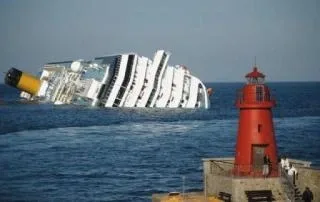
The ultra-modern Costa Concordia turned out to be much easier to sink than the legendary Titanic
Major cruise ship owners solemnly assure that their liners are equipped with the most advanced technical equipment, whose capabilities almost reduce the probability of a disaster to zero. And statistics seem to confirm their words.
Thus, Anatoly Zadorozhny, a leading expert in maritime safety and a member of the board of the Association of Sea Captains of Odessa, a deep-sea captain, says that disasters of liners of this class occur once every 25 years. The last high-profile case occurred in 1986 with the motor ship Mikhail Lermontov, chartered by the British travel firm Charter Travel Co., Ltd., off the coast of New Zealand. Then one person died, and the remaining 737 were saved. At the time of this writing, the Costa Concordia disaster had claimed 17 lives.
Technology on the verge of fantasy
It would seem that the technical sophistication of modern passenger liners should inspire a sense of complete security. Even independent experts, in no way affiliated with the shipowning companies, unanimously state that there are no questions about the technology. According to specialists from the Department of Instruments and Systems for Orientation, Stabilization and Navigation of Bauman Moscow State Technical University, "all modern ships are equipped with classic navigation systems (magnetic compasses), gyroscopic instruments, inertial navigation systems, gyroplatforms that allow determining the ship's coordinate system with high accuracy and linking it to the terrestrial coordinate system. In addition, navigation surveillance radar devices are installed, which constantly interact with radio beacons located along the coast, as well as satellite navigation systems GPS, connected to various satellites.
Floating hotels are equipped with echo sounding stations not only for vertical but also for lateral scanning, which provide a three-dimensional profile of the bottom." All sensors work in a complex. This unified navigation system is called the integrated bridge. Information is displayed on a chart plotter (electronic chart). Navigation charts are loaded into this system, displaying the point of the World Ocean where the liner is located at a given moment. The error is no more than 5-10 meters.
Moreover, as Vice Admiral in Reserve Vladimir Pepelyaev, head of the project of the Center for the Development of Marine Technologies of the Design Bureau Kompas, told Itogi, "the ship's control system, in addition to the integrated bridge, also includes a subsystem for controlling all mechanical means and a subsystem for ensuring ship safety (explosion and fire safety, internal condition, monitoring of water ingress in case of flooding, and so on)." Even if a failure occurs in the integrated bridge, all instruments will continue to operate individually. In the worst case, there are good old pilot charts.
The reliability of modern navigation systems is considered very high. However, despite all this, the Costa Concordia was lost. At which exact link did such a powerful chain give way?
To yaw
Experts interviewed by Itogi say that the captain's main mistake was precisely his unconditional trust in the notorious "integrated bridge." It is unknown whether the reef on which the Costa Concordia ran aground was actually marked on the electronic chart, or whether the watch officer did not know that near a rocky shore the GPS system can have an error of up to 50 meters. Specifically, the crew is blamed for the fact that the watch service did not conduct visual monitoring of the ship's movement. As Vladimir Pepelyaev says, "previously it was required that when moving along the coast, the captain be on the bridge and personally control the course not only by instruments but also visually."
Now the captain is not obliged to stay on the bridge. Moreover, on a cruise liner, he traditionally also performs representative functions. It is sometimes considered mandatory for the captain to dine with first-class passengers, which, as the latter claim, occurred on the Costa Concordia.
But the captain is generally not needed on the bridge. A navigating officer or even a watch seaman with binoculars in hand is enough to monitor the situation. It was precisely this that, apparently, was not done when the Costa Concordia crept up to the ill-fated reef. Otherwise, the tragedy would not have occurred, because, judging by weather reports, visibility at the time of the collision was about 10 kilometers, and waves were less than half a meter.
There is another version of the disaster. The liner could have been in autopilot mode (the shipboard analog of autopilot) on a pre-planned course. In coastal zones, even crews of small yachts do not allow themselves to do this. The fact is that "in autopilot mode, the ship experiences noticeable yawing," explains Vladimir Pepelyaev. "The integrated data processing system, taking into account the influence of the external environment, gives large deviations—up to two degrees." Even if the captain knew about the reef and plotted a route bypassing the dangerous place, the autopilot could easily have brought the ship onto it due to yawing.
If one of the described versions of the catastrophe is confirmed, or after decoding the "black boxes" the investigators release some similar scenario of their own, it is obvious that the captain or the watch officer will be blamed. Everything will be attributed to negligence, the disaster will be called an isolated incident, the public will calm down, and sea cruises will still be considered a comfortable and safe vacation. This is convenient for everyone, especially for the owners of shipping companies.
However, there is an assumption that the Costa Concordia disaster is far from an accident, but merely a logical result of a certain chain of patterns that the cruise industry had been unconsciously following for years. The major accident may have become a kind of signal that it is time to change the approach to ensuring navigational safety, and for passengers to think about what they can expect when entrusting their lives to, essentially, an iron tub stuffed to the brim with electronics.
Not Everyone Will Survive
It turns out that modern cruise liners have a number of inherent problems that owning companies keep silent about. The main one relates to the means and methods of rescuing passengers and crew. The editor-in-chief of the magazine 'Morskoy Byulleten' (Marine Bulletin), former sailor Mikhail Voitenko, notes: 'Nothing new has been invented in this matter since the Titanic. So passengers must realize that if a cruise liner gets into an accident somewhere far out at sea, in stormy conditions, and if the ship begins to list quickly like the Costa Concordia, the death toll could be in the hundreds or even thousands.'
In essence, lifeboats and rafts were the most reliable means of rescue, and they still are. On every modern ship, the number of seats in lifeboats must be at least twice the number of passengers and crew, and with inflatable rafts, the capacity is several times greater. But these rescue means have a major drawback: even in rough seas, it is difficult for an ordinary person to climb into a lifeboat swinging over the side. An unpleasant surprise awaits when the boat is lowered. Most of them, even in a three-point storm, will simply be smashed against the ship's side, and people will end up in the open sea.
But what is the problem? Can't the maritime industry in the 21st century come up with something that would ensure the safety of passengers who pay considerable money for a cruise? The price for a seven-day voyage on the Costa Concordia started at 489 euros per person for the cheapest place in an interior double cabin and went up to 4,333 euros in a first-class cabin.
Specialists tried to come up with something new, but they never created anything worthwhile, and liners meanwhile became larger and larger. There is already talk of creating 'cruisers' for 6,000-8,000 people. Mikhail Voitenko believes that in the pursuit of commercial profitability, shipowners have gone too far: instead of adding more and more decks with shops, casinos, and pools to liners, one of them should be made an evacuation deck.
'Right now, passengers are simply told that their lifeboat number 2 is in such and such place, shown where to run during an alarm,' says the expert. 'But here, in case of an alarm, an evacuation deck would be activated, where everyone must run. It should have numerous exit tubes like inflatable aircraft slides, which are automatically deployed and lead to the lifeboats.'
Instead of modernizing rescue systems, ship-owning companies several years ago put forward the concept that a passenger ship should have such a reserve of buoyancy that it would stay afloat in any accident. 'This concept is rather strange,' Voitenko remarks. 'Creating an unsinkable ship is unrealistic. If a medium-sized container ship slams into a liner at good speed, it will cut it in two, along with all its unsinkability.'
To avoid this, experts believe, one should not fully rely on modern navigation equipment, remembering the old-time methods. Mikhail Voitenko insists: 'It was precisely the overload of modern navigation systems that influenced the fate of the Costa Concordia. If the crew had navigated the ship as was done 20-30 years ago, it would not have run aground. If Titanic was doomed by the lack of radio and electronic navigation aids, then for modern ships, on the contrary, the threat is the dominance of modern equipment.'
On modern liners equipped with electronic charting, the crew does not feel the ship, but perceives it as an electronic game console, the difference being that in the event of a computer error, you can start the game over, but at sea there will be no such chance. Some specialists believe that on passenger liners, the autopilot system should be dismantled altogether. The crew should steer in manual mode and not lose contact with the ship. Especially when there are several thousand passengers on board.
And perhaps the most important and most frightening: if a serious accident occurs at sea, today no one is able to accurately assess either the damage to the ship or the complexity of the rescue operation. The reason is a huge number of factors, ranging from wind strength, wave height, to the scenario in which the ship sinks. It may submerge on an even keel – horizontally, it may list, it may sink for several hours or go under in a matter of minutes.
Modern standards for conducting a rescue operation, according to experts, are a fiction and a mere formality. All drills are carried out on the assumption that the crippled liner is on an even keel in calm weather. And depending on the number of passengers and the size of the ship, from 30 minutes to an hour is allocated to get everyone out, into the lifeboats, and lower them into the water.
Is it even worth mentioning that such a standard has nothing to do with reality? And yet we, the current passengers of superliners, just like a hundred years ago, board our cyclopean 'Titanics' without sensing any danger signal. Such is human nature that size is of decisive importance. It was so, it is so, and it will be so...
Vladimir KRYUCHKOV. 