
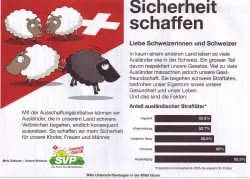
The issue of immigration and foreigners is a sore spot for the Swiss. The number of foreigners, not counting thousands of asylum seekers and illegal immigrants, exceeds one and a half million, or over 20% of the nearly eight million population. Today, every fourth Swiss citizen was born outside the country. And in Geneva, with its international organizations, foreigners make up more than 37% of the population, and if counting dual citizens, almost half. Switzerland ranks among the top countries in the world in terms of the number of immigrants.
Meanwhile, Switzerland has strict legislation regarding the residence of foreigners and the granting of citizenship. Excluding a small number of cases of so-called extraordinary naturalization, where individuals have special merits, a citizenship applicant must have lived in the country for at least 12 years. Each canton has its own practice, but everywhere the applicant's dossier is examined by executive authorities at the cantonal and then federal level. Then, in the absence of reasoned objections, the decision is made by the cantonal government or parliament. The entire process takes at least two years.
The majority of foreigners live with an annually renewable residence permit of category "B". Each time, they must documentarily confirm a source of steady income. The same document is issued to students, who are required to leave the country upon graduation. Persons working under contract in any organization also have the right only to such a residence permit and only for the duration of the contract. After eight years, a foreigner with a stable income may apply for a category "C" residence permit, which gives its holder all the rights of a citizen except the right to vote, and which must be renewed every five years. The country also has strict "registration" rules: when moving to another canton, a foreigner must re-register with the local population office. It even got to the point that the Swiss themselves, say residents of Geneva or Basel, did not have the right to get a job, for example, in the canton of Schwyz. This has been criticized repeatedly by human rights organizations.
However, now Swiss nationalists from the People's Party wanted to further tighten legislation. They proposed that any commune decide on granting citizenship to a candidate by secret ballot at meetings. De facto, such a practice was introduced in a number of German-speaking communes, but the federal court struck it down as unconstitutional, since rejected applicants could not appeal such a decision in court. The nationalists, on the other hand, claimed that this would allow citizens to directly decide who can live nearby. But the majority of parties and the government opposed the proposal, which contradicts the European Convention on Human Rights and makes the question of naturalization dependent on personal biases, such as judging by the applicant's surname or appearance.
It must be acknowledged that the large influx of immigrants has created serious integration problems, especially in the German-speaking cantons, where most newcomers are settled. Many of them prefer to live in national communities, following their own traditions, sometimes contradicting Swiss law. The majority of crimes are committed by immigrants. In recent months, the country has been shaken by several cases of gang rapes and murders committed in schools by children "from the former Yugoslavia" (this euphemism is used to refer to Kosovo Albanians or Bosnian Muslims). The People's Party advocates the adoption of a law on the deportation of foreigners guilty of violent crimes.
The majority of the population also rejected another People's Party initiative - "Sovereignty of the People without Government Propaganda," which proposed limiting the government's right to participate in political campaigns requiring a popular vote. Currently, the government sends each voter a brochure with the question being voted on, data on it, and an outline of its view on the issue. Each of the seven ministers speaks in support of the common position regardless of the viewpoint of the party from which he was elected to the government.