
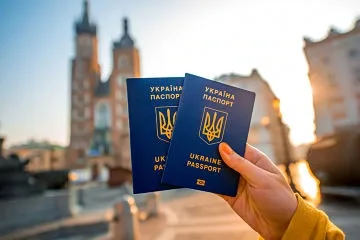
The visa-free regime with European countries opens new opportunities for Ukrainians
As noted in its publication by EurasiaNet.org, visa-free travel is in line with other reforms in the European Union. Polish authorities, seeking to overcome labor shortages in the country, are stimulating the legalization of labor migrants, primarily Ukrainians, for whom the employment regime will be further liberalized from the new year. Opportunities for employment of Ukrainian citizens are gradually expanding in other EU countries as well. Yes, for employment or education in the European Union, one still has to obtain appropriate visas. But visa-free travel provides an opportunity to orient oneself on the ground, which allows for more successful placement.
In the first three months of visa-free travel – from June 11 to September 11 – 5 million 799 thousand 360 Ukrainians (or 14.5% of the country's 40-million population) traveled to the EU. The total number of citizens who traveled using biometric passports, which entitle them to visa-free travel, amounted to 1,413,178 people. Of these, only 235,795 (0.6% of the population) used visa-free travel. Thus, even the majority of biometric passport holders also had visas.
These figures demonstrate that there was no 'Iron Curtain' between Ukraine and the European Union even before the visa-free regime. But thanks to the visa-free regime, Ukrainians get the opportunity to plan visits to the EU as an ordinary trip.
Rumors that at the entrance to the European Union Ukrainians would be required to strictly comply with all rules, such as having 50 to 100 euros for each day of stay, have not been confirmed over the past five months. The attitude towards entrants is loyal, the number of refusals is minimal, and they are usually associated either with past violations that led to a ban on entry into the EU, or with vague answers to the question about the purpose of the visit. Those who have poor knowledge of foreign languages are advised to print out in English (or in the language of the country through which they intend to enter the visa-free zone) answers to standard questions: where, for what purpose, to whom, etc. Such a printout can be submitted along with the passport if necessary.
Under the visa-free agreement, Ukrainians are granted the right to a 90-day stay in 34 states within every six months. You can find out the number of already used and remaining days of visa-free travel in the current half-year using an online calculator and instructions for it.
Many Ukrainians go to the European Union for employment or study. This is possible, and legally, although the visa-free regime itself does not grant the right to paid work. But the visa-free regime allows volunteering with accommodation and meals, as well as training for a future profession, as well as any training that fits within the 90-day period.
But legal work at a European enterprise, even within the permitted 90 days, will require additional documents. The most loyal attitude towards employment of Ukrainians is in Poland. Nevertheless, even there it is necessary to obtain a work permit, which, firstly, guarantees against deportation with a subsequent ban on entry, and, secondly, provides some legal protection. Work related to a business trip to an EU country from a foreign enterprise, including from another EU country where a work visa has already been issued, also requires a special visa, the so-called 'van der Elst visa', which must be obtained in advance, two to three weeks before, at the consulate of the country to which the trip is planned. However, such visas are usually issued without much trouble.
Despite these restrictions, within 90 days of stay in the EU, you can accomplish a lot. For example, study the demand for your specialty, find a suitable place and negotiate with an employer, take short-term courses, pass exams. Information brochures on education and legal employment in EU countries are available online. A lot of useful information about opportunities and prohibitions can be found on the website 'Open Europe'.
Vitaliy Makhinko, leader of the independent trade union 'Labor Solidarity', which deals with the protection of the rights of Ukrainian workers in Poland, noted in an interview with EurasiaNet.org that as a result of the introduction of the visa-free regime, 'intermediaries for employment, as well as dealers who illegally traded documents for obtaining work visas, began to disappear. Ukrainians can go to Poland and find work themselves. Fears that visa-free travel would increase the number of illegal immigrants have not materialized.' Makhinko says that all specialties are in demand, especially in Poland, 'it is not like before, when only builders and seasonal workers were needed.'
But he also notes that not everything is smooth: 'We receive from three to eight appeals daily that require action. Ukrainian institutions that should protect the interests of citizens do not fulfill their functions. For example, during a strike of builders in Warsaw, the consul, instead of supporting us, demanded that the strikers disperse, threatening to call the Polish police and border service to arrest and deport them. Polish law enforcement officers are also not eager to solve the problems of Ukrainian workers. Lack of language skills is also an acute issue for Ukrainians. It often happens that highly qualified specialists cannot realize themselves due to lack of language knowledge.'
Thus, the introduction of the visa-free regime with the European Union has not radically changed anything. This resembles the phrase of Ilya Ilf: 'In science fiction novels, the main thing was radio. With it, the happiness of mankind was expected. Here radio exists, but happiness does not.' The visa-free regime, like radio, only opens up new opportunities that need to be learned to use properly.