
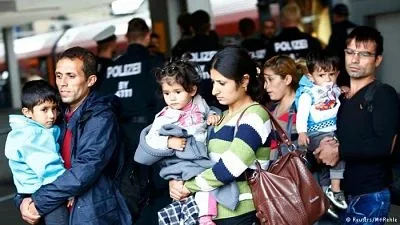
This unprecedented crisis has not only created new problems but also exacerbated old contradictions among the member states of the Dublin Agreement regarding the distribution of refugees from global hot spots.
Who, how many, and why should accept refugees – the EU is now further than ever from a solidary solution to this problem. Which countries are most affected by the crisis? What impact would the introduction of a mandatory quantitative scheme for receiving and placing migrants have on EU countries? Is Europe really threatened with "death" from a new "invasion of barbarians"?
The portal Swissinfo.ch published a series of illustrative interactive charts and infographics that can serve as a source of balanced and independent information for reflection. We offer readers a shortened version of the material.
The current year, 2015, will surely go down in history as a period of unprecedented migration crisis on the southern and southeastern borders of Europe. Never before have the flows of forced migrants striving to reach European countries at any cost been so numerous. As of September 2015, almost 350,000 people reached Europe via the Mediterranean Sea, an increase of 60% compared to the same period in 2014.
According to the Office of the United Nations High Commissioner for Refugees (UNHCR), the vast majority of these people are so-called "persons in need of protection and assistance." First and foremost, these are forced migrants who have left regions with particularly unstable military-political situations, including Afghanistan, Syria, where a civil war is ongoing, and Eritrea, a country with a harsh dictatorial regime.
In total, over the past year, more than 660,000 refugees have been registered in Europe who have submitted official applications for asylum. The last time Europe faced such numbers of forced migrants was in the mid-1990s during the war in Yugoslavia. At the same time, the refugee situation can vary greatly depending on the country.
While Germany expects the arrival of up to 800,000 refugees by the end of the year – which would be four times more than in 2014 – the Swiss Federal Secretariat for Migration (SfM) expects that in 2015, 29,000 applications for refugee status will be submitted in Switzerland (in 2014, this figure was at 23,770 applications). For comparison: for example, in 1991 and 1999, about 40,000 applications for asylum were submitted in Switzerland.
It is hardly a coincidence that the most "popular" route among refugees seeking to reach Europe has become the Balkan route. In recent months, Europe's maritime borders have become largely impenetrable for illegal migration. Therefore, the Balkan route remains the only real alternative, even though the EU continues to invest significant resources in strengthening border controls on its land borders.
For example, the European exclave of Ceuta is already separated from Morocco by an 8-km-long barbed wire fence. Turkey is separated from Greece by a border fortification system 12.5 km long, and from Bulgaria by an "anti-migration wall" no less than 30 km long.
According to the international journalistic consortium "The Migrants Files", the construction of such fortifications has already cost 77 million euros. Everyone understands that no fences can stop the flows of refugees, nevertheless, in recent months several European countries have announced their intention to tighten border controls and continue building fortifications on their borders.
Different countries approach the problem of refugee flows differently. Germany, for example, opened its borders (though later, in accordance with the Schengen Agreement, introduced temporary border controls on its southern borders) and appealed to other countries to show solidarity. In addition, Berlin temporarily suspended the procedure of readmission (deportation) of refugees from Syria to countries that, according to the Dublin procedure, were formally their first countries of entry into the EU.
Thus, however, Germany called into question the Dublin Agreement itself, under which Italy and Greece should have dealt with the refugees. However, Germany decided to temporarily turn a blind eye to the Dublin Agreement, which is quite symbolic, since this country was in first place in Europe in 2014 in terms of the number of deported refugees (second place was Switzerland).
Eastern European countries, for their part, demonstrate intransigence. Hungary, for example, to whose territory thousands of refugees arrive each week, has in recent days made efforts to completely close its borders. In addition, Hungarian authorities have effectively blocked refugees at train stations.
Slovakia expressed readiness to accept refugees – but only those of Christian faith. Bulgaria has sharply tightened its border control regime in recent days. In addition, Hungary plans to build a wall along its border with Serbia of 175 km. Bulgaria intends to build additional fortifications 130 km long along its border with Turkey.
In Switzerland, the national-conservative Swiss People's Party (SVP/UDC), the country's strongest party, is demanding that the army be deployed to strengthen border controls. In the canton of Ticino, the conservative party "Lega dei Ticinesi" ("League of Ticinese Citizens") has called for a complete closure of the Swiss-Italian border. All these and many other similar events are being sharply criticized by human rights organizations.
Statistics, however, show that proposals to "deport everyone" and "close borders" do not always come from countries that are truly seriously affected by the problem of refugees and forced migrants.
Faced with a real migration chaos, the European Union in recent years has been actively seeking at least some solution that would suit all EU members, be fair, adequate and designed for at least the medium term. Meanwhile, hundreds of refugees end up in Hungary without help, money, or prospects. As practice shows, Eastern European countries are not very popular among forced migrants, while the most preferred ones are, by a wide margin, Germany and then Sweden.
Many refugees make great efforts to avoid being "on the radar" of the authorities of these countries, because otherwise they would immediately become subject to the Dublin Agreement on the country of first entry. A whole group of EU countries led by Germany, meanwhile, is increasingly demanding a radical revision of the very foundations of Dublin legislation and the creation of a more modern and fair scheme for the distribution of refugees among the signatory countries. Thus, this issue directly affects Switzerland as well.
There is a proposal to introduce a system of fixed quotas based on indicators such as the country's GDP, population size and unemployment rate. There is also talk of a possible introduction of a system of sanctions against countries that refuse to comply with the new scheme.
The chances of being recognized as a person "in need of special assistance and protection" vary depending on the European country, primarily because each country has its own approach, its own scales and criteria. In 2014, almost every second refugee (47%) received a positive decision on asylum applications. Compared to 2013, this represents an increase of 12 percentage points.
Switzerland, according to Eurostat data, is among the countries with one of the highest quotas (70.5%) of positive decisions on applications for asylum or recognition as "temporarily admitted". The leader is Bulgaria (94.1%), and the list is closed by Hungary (9.4%), since the vast majority of refugees trying to enter this country are from Kosovo, which is officially considered a "safe country".
In European countries, the refugee problem is leading to serious economic, political and social difficulties; many states are simply unable to manage the flow of forced migrants. Xenophobic sentiments are also growing.
However, we should not forget that currently, according to UNHCR data, 86% of all refugees worldwide live in developing countries, not in Europe. In Lebanon, for example, refugees already make up 25% of the country's total population, a percentage that exceeds the corresponding Swedish figure by 12 times. In recent years, the number of Syrian refugees alone who have settled in neighboring countries has reached 4 million people. As statistics show, the main flow of forced migrants does not even reach Europe.
Duke-Kwan NGUYEN, Stefania SUMMERMATTER.
Translation by Igor PETROV.