
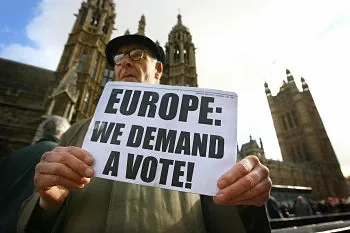
Starting with the Romans, Vikings, and Normans and ending with the latest wave of immigration from Eastern European countries, Britain has always had a constant flow of people throughout its history. Why has immigration become one of the cornerstones of disputes with Europe, not to mention that several generations of politicians have broken their teeth and ruined their careers over it?
On April 20, 1968, Conservative MP Enoch Powell delivered a speech that is still used by both the far right and the far left, because the problem of “outsiders” continues to concern people with diametrically opposed political views.
“We are simply insane, utterly insane as a nation, if we allow 50,000 dependents to join our ranks every year. It is as if we are all collectively adding fuel to the funeral pyre of our nation,” Powell declared almost 50 years ago.
“Mass immigration has made our country completely unrecognizable. Many Britons do not want it to be passed on to our children and grandchildren in this form,” said UKIP leader Nigel Farage last year.
The difference between Powell and Farage is only that while in the late 1960s Britain could independently decide on immigration control, by the mid-2010s it had largely ceded that right to Brussels.
After all political parties in the country realized that ignoring the immigration issue was no longer possible, they faced a nearly unsolvable problem: how to promise the people something they cannot control? Some concluded that the only cure for this headache could be the “guillotine” – leaving the EU.
In 2014, net immigration to Britain reached 318,000 people. 178,000 came from the EU, of which more than 82,000 from “new Europe” countries, most of whom are not skilled labor and, in the opinion of many ordinary people, place an unbearable burden on education, healthcare, and social security systems. Opponents of the EU principle granting citizens the right to live and work in any country argue that this rule appeared when the EU was much smaller and the GDP of its member states did not differ so greatly.
The non-governmental organization MigrationWatch UK believes that income inequality between EU countries creates an incentive for residents of poorer countries to move to Britain (for example, Britain's GDP is five times that of Bulgaria) – an incentive that did not exist during the signing of the Treaty of Rome and the establishment of the right to free movement of labor in the distant 1950s.
Conservative British newspaper Daily Telegraph's politics editor Philip Johnston noted four years ago that for the first time in the history of the British Isles since William the Conqueror (1066), population growth is primarily driven by immigration. The situation is not as catastrophic as it might seem, given that immigrants (defined as people born abroad whose parents were not British citizens) make up only about 13% of the country's population.
The Immigration Act of 1971 created an illusion of consensus between Westminster and part of society opposed to immigrants, by abolishing the automatic right of residents of Commonwealth countries to live and work in the United Kingdom. Exceptions were made for those who could prove that their direct ancestors were British citizens.
Let us set aside the humanity or reactionary nature of this legislation for a moment. Let us consider solely how well it achieved its goal: reducing mass immigration to Britain. The answer is quite clear: until the mid-1990s, immigration ceased to be the most acute issue in domestic politics, remaining at a modest level of 50,000 people per year. The Conservative Party's 1987 election manifesto stated that “immigration is now at its lowest level since 1962. Tough but fair immigration rules are vital for harmonious relations between ethnic groups within the country.”
In 2005, the Conservative election manifesto words were completely different: “We must achieve effective control over immigration in the interests of all Britons, both old and new. We have lost control of our borders and must regain it.”
It would be completely wrong to blame all immigration problems on Labour and its last leaders – Tony Blair and Gordon Brown. However, as BBC political commentator Nick Robinson noted: “The cause of many immigration problems was a single decision, made almost without public debate at 10 Downing Street, and seemingly without careful thought. And yet, in 50 or 100 years, historians will be fully justified in saying it was one of the most significant since World War II. It was based on good intentions, false assumptions, and very, very erroneous forecasts.”
It all began with the fall of the Berlin Wall and the rapid and large-scale expansion of the European Union. The then Conservative government welcomed the prospect of EU enlargement. There is an opinion that a significant role was played by the desire to weaken Brussels' dominance through an influx of new blood. Cabinet Secretary under John Major, Gus O'Donnell, recalled that the then Prime Minister said he wanted to see “a wider Europe, not a deeper (integrated) Europe.”
However, no discussion ever took place about the impact that a one-time influx of such a large number of people could have. Tony Blair, the Labour leader who succeeded Major as prime minister, also very actively advocated for EU enlargement. His wish came true in 2004. In its effort to welcome new comrades to the European club, Britain went much further than Germany, France, or Italy. Blair's cabinet decreed that from the very first day of EU membership, Poles, Slovaks, and all others have the right to live and work in Britain, just like any other EU citizens. At the same time, most other 'old' Europeans imposed a seven-year moratorium on them.
Britain's generosity was explained by the cabinet's belief that the number of Poles willing to trade their homeland for life in the United Kingdom would not exceed 17,000 per year. They were off by about ten times, and not in the direction of a decrease. Tony Blair's economic adviser Jonathan Portes compiled a report commissioned by the government, which stated that immigrants would have an exceptionally positive impact on the British economy, and moreover, there wouldn't be too many of them. The report was received with great enthusiasm, especially since at that time the country's economy was booming, and there was an urgent need for an influx of labor.
The government never tired of repeating that immigration is good. And for those Britons whose salaries were somewhat above average, the benefits were obvious: they suddenly ceased to be hostages of highly paid English construction workers and got the opportunity to hire cheaper but fully qualified plumbers and painters from Eastern Europe. Small shops opened in many neighborhoods, appetizingly fragrant with sausages previously unseen in the country. Polish or Slovak nannies and cleaners were much cheaper than their local counterparts, and did just as good a job.
However, for other segments of society, immigration turned out to be an entirely different matter: people began to fear for their jobs, they did not like the changing ethnic landscape of their cities, and they were frightened by what they saw as a threat to their national identity. At the same time, politicians somehow failed to realize that when making such an important decision, it would have been wise to consult the people.
David Blunkett, who served as Home Secretary in Blair's cabinet, admitted in an interview with the BBC: 'Yes, we did not specifically discuss with the public what was happening, partly because we feared a rise in racist sentiment, but I am not going to apologize. If we had banned them from coming legally, they would have come illegally anyway and still worked, but not paid taxes.'
After two election defeats, Labour admitted they were a little bit wrong. Former Home Secretary from the opposition, and now one of the candidates for leadership of the Labour Party, Yvette Cooper, agreed that a different approach should have been taken: 'Yes, we should have listened more carefully to voters' concerns and addressed them. We should have understood that people fear for their jobs, fear wage cuts, and talked about the problem more actively and widely, instead of completely ignoring it on the pretext that only right-wing parties fear immigration.'
One can argue about whether Labour made a mistake, but the fact is that it cannot be corrected now. In any case, all those who came to Britain immediately after the first EU enlargement and stayed will not go anywhere. The government has no legal means to forcibly deport legal immigrants, contrary to all international, European and domestic laws.
The Conservatives tried to set quotas on legal immigration and somehow reduce the number of illegal immigrants. However, a major problem arose with legal immigration: one of the fundamental rights of EU citizens (sorry for the repetition, but it all stems from this) is the right to reside, work, and receive social benefits in any EU country. Incidentally, about 2.5 million Britons currently living on the continent make full use of this right. Attempts to impose restrictions on these rights provoke active resistance from other European leaders.
If immigration from the EU cannot be controlled, at least for now, then to meet its own quotas, the government had to sharply tighten its attitude toward students and skilled labor from other countries. In 2013, Britain introduced stricter rules for issuing student visas and mandatory interviews for applicants. The result? The number of applications fell by almost half.
But then universities sharply objected, claiming they were being deprived of legitimate income (foreign students pay much more for tuition than the local population). Professor Mark Spearing, vice-chancellor of the University of Southampton, believes this could also harm the reputation of higher education in Britain, which is one of the country's most prestigious exports: 'Such a policy is causing us enormous damage. Potential students say they get the impression that they are not welcome in Britain.'
A recent public opinion poll showed that almost 47% of Britons think immigration is harmful to the economy. 31% believe it is beneficial to the economy. However, half of those who acknowledge that foreign labor benefits the country still want it reduced.
Demand always creates supply. When anti-immigrant sentiments in society swell into a large and painful abscess, a politician always appears ready to raise them on a shield. The leader of UKIP, Nigel Farage, has taken the helm of anti-immigrant sentiment. In every speech, he must inevitably take a swipe at immigrants. If his words are to be believed, Farage is firmly convinced that immigration must be reduced, even if the country becomes poorer as a result and people’s lives worsen. “There are things in society,” he said in an interview with the BBC, “that are more important than money. Quality of life, an overcrowded Britain, a shortage of social housing, youth unemployment—all these are real problems, and reducing immigration will help solve them.”
Now do you understand the vicious circle in which Westminster has trapped itself? In fact, there is only one question: how great is the desire of other European leaders to keep Britain as a member of the EU? Are they willing to compromise on principles? And to what extent will the British believe that staying in a reformed European Union is more beneficial to them than going it alone?