
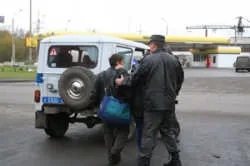
Due to the crisis and laws, foreign workers have to return home
“Whole trainloads are leaving. Planes are flying off. Migrants are returning home,” FMS head Konstantin Romodanovsky told journalists on New Year’s Eve. As IA Rosbalt notes, he then refused to link the mass departure of migrants to the crisis, citing the traditional outflow during the New Year holidays. But by mid-January, the FMS press service reported that the agency was not observing the return of foreign workers to Russia. The migration service believes that due to the crisis, there will be no big influx of seasonal workers this coming spring.
Meanwhile, the authorities are doing everything to free up jobs for Russians who have lost their jobs. In particular, in January the validity period of the Russian government’s resolution banning foreigners from working in retail trade was extended. The order of the Ministry of Health and Social Development on the distribution of foreign labor quotas by region has not yet been published. Recall that back in October 2008, the Russian government had prepared a document to increase the quota for labor migrants to 3.9 million people for 2009. By December, the quota was reduced to 1.7 million people (the level of 2007), but was never broken down by region. And Russian President Dmitry Medvedev, at a meeting with plenipotentiary representatives in the federal districts on January 21, called for a more careful approach to attracting foreign labor in light of the situation on the Russian labor market.
At the same time, foreigners prefer to work in Russia illegally – due to the complexities of migration legislation. The first victims of Russian justice in 2008 were British specialists from TNK-BP, who had problems with work permits. In July, BP was forced to recall to England all technical specialists working in Russia (148 people). The former president of the oil giant, Robert Dudley, spent the first half of 2008 solving problems with visas and the migration service, but at the end of the year he gave up running the company.
Foreigners began coming to Russia en masse back in the era of Peter the Great’s reforms. Germans and Dutch – associates of the reformer tsar – were not cheap labor (for heavy physical work there were serfs and workers), but German peasants, who can be called the first guest workers, happily went to develop the Volga black earth lands. French teachers educated noble children. Italian architects built palaces. The best musicians of Europe performed in Russian theaters.
Soviet power did not need foreign labor, as it returned to total serfdom for peasants, driving them into collective farms. And the labor migration of workers to the numerous construction sites of socialism was carried out by the Main Directorate of Convoy Troops of the NKVD on the orders of the Communist Party. At the same time, the consent of the holders of a “ticket to Magadan” to migrate to a shock construction site was not asked.
In modern Russia, labor migrants appeared in the late 1990s. Residents of the former Soviet republics of Central Asia – Tajikistan and Uzbekistan, as well as people from Moldova, Ukraine and Belarus, came to Russia to earn money. The economies of these newly formed countries had stopped working, and in the former metropolis, after the 1998 crisis, the situation gradually began to improve. Migrants gained a strong foothold in construction, housing and communal services, agriculture and industry. The numerous construction sites of Moscow, St. Petersburg and other major Russian cities were flooded with people from CIS countries. They were ready to work for low pay, eat modestly and live right on construction sites, just to send some money home from time to time.
Over time, the funds sent by labor migrants became a substantial part of these countries' GDP. According to the Association of Moldovan Banks, labor migrants transfer about $900 million annually to the country (a third of the country's GDP). At the same time, Moldovan bankers note that 55% of workers go to Russia to earn money (1 million people), but only 40% of them trust official payment systems to transfer money. Tajiks and Uzbeks, according to local bankers, transfer about 10% of GDP to their homeland. According to Kazakh media, between 1.5 and 3 million Uzbeks leave the country annually to work abroad (the authorities of Uzbekistan carefully pretend that there is no labor migration from the country, so there are no official data). The authorities of Tajikistan cite a figure of 1 million people leaving the country annually to work.
The crisis has made its own adjustments to the labor migration process. There is no official statistics on the decline in the number of guest workers, but electronic payment systems have already noticed a reduction in transfers to CIS countries. “There is a decrease in the growth rate of transfer volumes through the CONTACT system, but we cannot say exactly by how much right now,” the press service of the bank – operator of the International Money Transfer System told Rosbalt.
Given that migrants cannot find work at home, some of them stay in Russia and turn to crime. According to the head of the Main Internal Affairs Directorate for St. Petersburg and Leningrad Region, Vladislav Piotrovsky, in 2008 the number of crimes committed by migrants increased by 25% in the northern capital. This year, the ranks of ethnic criminal groups may be joined by yesterday's construction workers. At the same time, the Russian state does nothing to solve the problems of labor migrants, but only tries to “squeeze” them out of the country. They will be able to return to earn money in Russia only after the crisis, when they are again in demand on construction sites.