
Day One
I came to Berlin to see Petr, my good friend, who had been working in Germany for a long time and was quite familiar with the situation. Besides, he even lent me money for the visa and departure. And that's a considerable sum – a whole 1,000 marks. For me – it was astronomical. Plus, he guaranteed to pay for my housing and food until I could live on my own. And I, in turn, promised to become his work partner until we get caught. By that time, I was very knowledgeable about construction work, could do a lot, and my professional level far exceeded my friend's skills. In short, we shook hands, and 'the process began.'
Even from the bus window, I spotted Petr by his clothes – they clearly stood out from the overall picture of greeters and send-offs, and by the nervousness he simply radiated with his entire appearance. This nervousness, caused by the illegality of his situation, inexplicably immediately transferred to me, and has been haunting me ever since.
My very first steps on German soil brought me down from the clouds where I had been during all the preparation for departure. Like – Europe, freedom, big money, castles in the air. All this vanished as soon as we left the central bus station and almost ran to the U-Bahn (subway) station. My friend walked far ahead of me, so I wouldn't compromise him with my appearance. I admit, I really looked stunning then. Just think of the huge checked bag over my shoulder, the kind used only by our 'shuttle traders' and Vietnamese merchants in Berlin. And although I don't really look like a 'local' Vietnamese, I felt calmer than my comrade – my visa was just starting, while he had already forgotten when his ended.
But my peace was overshadowed by the constant fear that he could be 'nailed' at any moment – and what would I do then in a huge foreign city without a single acquaintance, or at least a phone number where I could get help. Moreover, I was already so confused that I didn't even remember where the bus station was to at least have the chance to return home. And my knowledge of German boiled down to just 'Hände hoch!', 'Zurück!', 'Auf Wiedersehen!', 'Arbeiten', 'Schnell!' and 'Gut!'. As a child, I loved watching war movies...
At the moment of transferring from U-Bahn to S-Bahn (commuter train), in the area of Zoologischer Garten station, Petr got lost in three corners, and we spent a full hour wandering just two steps from the stop we needed, until we finally reached our goal. It's understandable – the evening in central Berlin is so mesmerizing with millions of lights, crowds of people, and a certain 'looseness' unique to it, that you sometimes lose your sense of direction if you've only been there a few times. What can I say about myself, a Ukrainian provincial, who completely 'lost his mind' from all this splendor, and obediently followed my guide like a sheep on a string, constantly stopping at luxurious shop windows and gaping in amazement.
That same evening, Petya called all his acquaintances to find out if there was any work for me. At the time I arrived, he had work for another two weeks and didn't want to lose it. But since there was no additional spot there, we decided to send me into 'free swimming' from the very first day. I wasn't going to sit idle for two weeks – I didn't come for a vacation! And the visa wasn't eternal, and with it you feel a bit calmer – there's always a chance to 'get off the hook,' even on a construction site. And debts need to be repaid sometime. So we called everyone, but only heard: 'No need for people right now!' After about ten attempts, spending about twenty marks on calls, we finally got what we wanted. Some 'Yugo' (Yugoslav foreman) had an emergency and urgently needed someone to redo the defective work done by one of the Russians when installing drywall. For two or three days.
Petya told his interlocutor in a firm and confident voice that I was a very big specialist in drywall, had vast experience, and there would be no problems with me – like, I wasn't new to Berlin and knew all the ropes. But I had never even seen this drywall before! 'What did you think?' – after hanging up, Petya asked, hiding a smirk. 'Who would take you without such advertising? It's always like this: if there's work, you have to do it, even if you're a complete duffer. Welcome to Berlin, buddy!'
With these words, he handed me a piece of paper with the name of the station where I was to wait for our contact the next morning. We spent the rest of the evening with a map, on which Petya marked transfer stations and the route numbers I needed. He had explained the mechanism of buying travel tickets from machines on the way from the bus station, but I had already forgotten everything (too many events for one day), but it was awkward to make myself look like an idiot, and I desperately wanted to sleep – after all, two days on the road...
Day Two
Wake-up at five in the morning, frantic pace of morning routine, lightning-fast breakfast on the go, and at 5:40 I was already boarding the S-Bahn, whose stop was a fifteen-minute brisk walk from the house. Petya had left twenty minutes earlier in the opposite direction. He also had to be at work at seven, but after the train he still had a forty-minute walk to his destination. If you're late, you lose your job. So it's better to be there half an hour early. Anything can happen – for example, railway repairs, and instead of the train, buses run along its route.
I arrived at the meeting place. There were still about forty minutes until the appointed time. Seven o'clock. Seven ten, seven fifteen, and I kept waiting. At half past seven, when I had already decided for myself "Apparently it's not meant to be!" and took a step toward the train going in the opposite direction, a question sounded softly from behind, almost right over my ear: "You from Petrukha?" I was so startled I couldn't even answer, just nodded affirmatively. "Then let's go!" said a quiet voice. As I later learned, the owner of that voice was indeed nicknamed "Tikhiy" (Quiet).
The "object," that is, the construction site where I was to work, was about two hundred meters from the metro station. Along the way, Tikhiy asked me a few professional questions and, convinced that my level of knowledge completely failed to match the telephone advertisement, simply waved his hand. I thought it would be worse. Finding out that I was only on my second day in Berlin, he was genuinely surprised at my quick employment. Of course, there is reason to be surprised – most "illegals" find their first job no earlier than two or three weeks. Then Tikhiy quickly explained that on the construction site you could only speak in German, Yugoslav, or Polish. In extreme cases, Ukrainian, and under no circumstances Russian! If possible, don't talk at all. And especially, don't open your mouth in the presence of a German Bauleiter (foreman). He knows anyway that you are an illegal, but there's no need to remind him unnecessarily. That way the German sleeps more peacefully; otherwise, he will have nightmares about paying a fine for using your slave labor. And that ruins his mood for the whole day, and you are guaranteed to face nitpicking about the quality of your work.
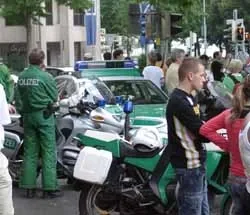
Having entered the building under construction, we headed into one of the offices of the future workspace, filled to the ceiling with metal doors and drywall sheets. In the corner of the office, under stacks of doors, a pathetic semblance of a changing room had been set up – two nails in the wall and a piece of plaster on the floor. Everything around was covered with a thick layer of white plaster dust. Tikhiy asked if I had work overalls, and from my puzzled look he guessed the answer. Just in case, he advised me to keep my passport with visa in my pocket, so that in case of a police raid I might have some chance to slip away – saying I was just walking around the city and got lost at the construction site. After all, I didn't have work clothes on – maybe I'd get lucky. He also advised me to frequently look out the windows, and if I noticed white-and-green police vans, to immediately "pack up and leave". But if the vans were black and the people in them were also in black uniforms, then there was no help. Those were "Kripos" – criminal police. Only professional illegals could escape them, and I shouldn't even try.
That's how my first work day began, cheerlessly, and I didn't even yet know how much I would be paid for all this. When I asked about it, Tikhiy replied that the boss himself would tell, but I shouldn't count on more than 8 marks per hour. Not count on more! I would move mountains for that money! Just think – 88 marks a day (for 11 hours of work)! That's how much in hryvnias! I celebrated too soon... After just a couple of hours of work, I wouldn't have wanted even 20 marks for half an hour.
During this time, without any equipment (elevators, cranes, etc.), we carried from the street to the seventh floor 13 sheets of plaster each weighing about 20 kg. When the wind blows, it carries you with that sheet all over the construction site – what a sail! And these "little sheets" had to be carried along already finished flights of stairs, where metal staircases and railings sparkled with cleanliness. And just try to hit something with that plaster! You'd lose your job instantly and make it much harder for others.
With the last sheet, three people had to catch me all along the seventh floor corridor – I didn't have enough strength, my legs were giving way. And ahead were still nine hours of such work! They reassured me: today the sheets we brought up were enough, but usually they have to carry 50-60 pieces a day and still manage to mount them. And on particularly "festive" days, all you do is carry plaster all day long, and someone (mostly "Yugos") yells that he's wasting time because of you and you have to work faster. But today was pure pleasure, only rework, so not much plaster would be needed, well, maybe another five sheets would have to be brought up. After these words, I completely lost my desire to move mountains and shovel money.
The most annoying thing was that while we were manually lifting the plaster upstairs, the Germans were transporting it on the elevator, and to what floor do you think? Only to the second! And they delivered it to the elevator on a special cart. Moreover, they lifted the sheet only in pairs, never alone – you could easily strain yourself! And after such "exhausting" labor, the Germans with a clear conscience went to the nearest café for coffee and returned only half an hour later, rested and ready for new labor feats.
The work day continued, and it was time to meet the Yugoslav boss. He was a huge guy, nearly two meters tall, with broad shoulders – he could carry two sheets of plaster to the tenth floor without breaking a sweat. And he makes demands on everyone, judging by himself. He doesn't care that the two of us, Tikhiy and I, together don't even weigh half as much as his bulk. If he can do it, then everyone must.
Instead of "Hello!" he barked that we had done nothing in two hours. And what was he paying us money for?! To that I timidly tried to object that I hadn't seen any money from him yet, but I had already worked hard. Only then did he notice that a new face had appeared in his team. No introduction, let alone "How are you?", but only: "How much do you want? I pay everyone 8 marks an hour." He's lying, of course. I already knew that our guys get 10-12 marks. But they are "specialists", and I was still learning, so I agreed to eight.
Until the end of the day, Tikhiy and I were fixing defects, which is why I was called here. Actually, Tikhiy was fixing defects, and I was doing 'fetch and carry' work, learning from experience along the way. I must say, very successfully. So successfully that by the end of the day I no longer asked stupid questions, which made my mentor extremely happy. And he still had to lift those 'five' sheets of plasterboard. At the end of the workday, I spent another ten minutes beating dust out of my 'civilian' clothes, but I couldn't restore their previous appearance. While we were working, plaster had thoroughly soaked my entire outfit, which I had carelessly left on a nail in the 'changing room'. My more experienced mentor had packed his everyday clothes tightly in a plastic bag, which I didn't notice. But I learned that lesson forever. Dirty clothes – that's tolerable. Things were much more serious with the cleanliness of my hair and hands. No matter how much I shook the dust out of my mane, it did absolutely nothing. I had to wash my hands in the water in which a German putty worker had washed his tools. We were lucky – the water had time to settle, and all the dirt sank to the bottom of the bucket. However, the smell of that liquid could rival the most disgusting stenches in the world. No wonder that in public transport, all seats within a five-meter radius of me were empty. There were no takers to keep me company. And my hands remained as cloudy white as before, only the dirt was spread in an even thin layer. The next day, I took a stiff hand brush and a plastic bottle of water to work.
I came home (more accurately, crawled) around ten in the evening. I couldn't feel my arms or legs, my back felt like someone had clamped it in a vise. Swallowing the dinner that Petya had thoughtfully prepared, I collapsed into bed and fell into a sweet sleep. There were just over five hours left until wake-up...
To be continued.