
Although it is the oldest public institution (it has already celebrated its 300th anniversary), it is currently going through not the best of times. Postmen are being ruthlessly laid off, because the market for traditional postal services is itself shrinking, losing out to e-mail competition. Those who remain are being trained and retrained so that they can operate modernized sorting lines and reorganized parcel services. And they increasingly look like a funny anachronism when, in uniform caps and raincoats in bad weather, having pedaled their government-issued bicycles along bucolic lanes in the morning, they have to fend off overly zealous guard dogs with umbrellas...
The post is an integral and vital element of any state's infrastructure, which in the last century stood on the conspirators' list of objects to be seized first, alongside railway stations and bridges, when they planned to take power. The delivery of text messages, as well as material valuables in the form of parcels and even containers, has not lost its significance. Although it is destined to be retooled to adapt to a customer who now has free choice, enticed by private operators' services, and prefers not to send a check in an envelope—for fear it might get lost (there are reports that a million letters fail to reach addressees every week)—but instead to do so over electronic networks. This is telling: in January 2003, Britons with Internet access sent 550 million messages by e-mail, while only 330 million stamped envelopes were entrusted to the post...
No less formidable a challenge for 'Royal Mail' (the 'Royal Mail') is the European Union's demand to liberalize this sector of the economy, and it will not be easy, if at all possible, to compete on equal terms with rivals such as UPS or Federal Express, Germany's Deutsche Post, or the Dutch TPG. And yet, if we set aside commercial vicissitudes, what does 'Royal Mail' mean in the everyday life of an ordinary Briton?
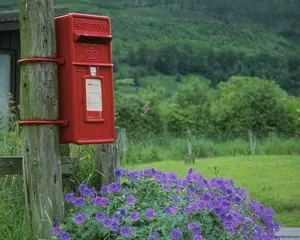
'Royal Mail' is foresight. When in June 2003 the nation that reads Mrs. Rowling's works the most was anticipating her next inevitable bestseller, namely 'Harry Potter and the Order of the Phoenix', it turned out that postmen 'with a thick bag on a strap' would not be able to promptly deliver the hefty tome to all who wanted it. The book weighed almost a kilogram, while the service regulations forbid them from lifting more than 16 kilograms at a time. Instructions, naturally, are almost sacred to law-abiding Britons. A solution was found: they decided to deliver the new book by vans. At the same time, all the impatient were notified to stay home on Saturday—the book, due to its dimensions, cannot fit into standard red post boxes, so it would be handed from hand to hand...
'Royal Mail' is pranks and PR gimmicks. A year ago, eleven-year-old Kira Colver, who decided to play in a lottery organized by the Royal Mail along with 12 million other eager citizens, turned out to be the holder of a lucky ticket. The prize was... two Jaguar cars, which, under the terms of the contest, due to Kira's minority, would go to her mother. The mother's joy was endless, for she had just wrecked her own car...
'Royal Mail' is principles and standards that are not compromised. The post office management sued the owners of an art gallery that put on public display three paintings by James Cauty, which used the composition of a well-known stamp featuring the English queen. The difference is that pacifist J. Cauty depicted Elizabeth II with a gas mask: its straps are hidden under the crown, the edges of the prints are jagged, and for greater resemblance to postal classics, they are made in different colors corresponding to the stamps' denominations and even provided with the necessary numbers. The post office holds the copyright to the stamp, which has been in circulation for over 30 years, although it is not excluded that other motives played a role—it is not for nothing that the post is called Royal...
'Royal Mail' is reliability and compassion. When in the Scottish city of Aberdeen an old-fashioned postcard was discovered in a pile of letters, sent from the Australian city of Brisbane on January 12, 1889, postal officials showed not just professional interest: who had messed up (the Australians at that time promised to deliver mail to the mother country in 41 days)? They showed humanity, following the advice of a character from the film 'White Sun of the Desert': 'Letter in an envelope, wait, don't tear it.' The message was addressed to a certain Miss Woldrop, who lived at house number 112 on Carden Place. It contained touching lines. 'I'm writing in a hurry. I've made it to Brisbane, and the holiday is going as well as can be,' reported a certain Colin. 'Thank you for the letters, both you, Miss Woldrop, and you, Gertie. I hope you are all well. I'll write in more detail in a few days, and meanwhile I congratulate you on the New Year of 1889 and wish you all the best. By the way, this postcard, as far as I know, is one of the first issued in Queensland.' Now, at the address indicated on the postcard, there is a dental clinic. The leaders of 'Royal Mail' decided to launch a nationwide campaign to find relatives of the people who lived there over 100 years ago...
To sum up: foresight, enterprise, principle, and humanity. Is that too much positivity? However, as everywhere, it is almost certainly balanced by shortcomings, which in such a troublesome business are a continuation of the virtues.