
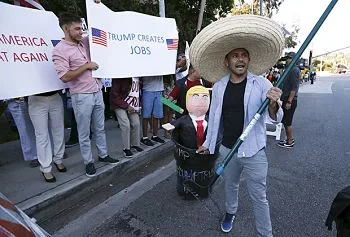
Trump's opponent before the billionaire's supporters
Read the beginning of the article:
AMERICAN "NEWCOMERS" (part 1)
Trump shuffled the deck
The main troublemaker is billionaire Donald Trump. Unlike professional politicians, he is not dependent on sponsors, speaks normal human language, and allows himself to mock Republican rivals. Moreover, Trump is not afraid to openly discuss "dangerous" topics, including the situation of racial minorities and women. The fact that he is supported by about thirty percent of the "elephants" shows how tired Americans are of cautious, politically correct, and monotonous Washington politicians.
But the Republican party leadership is at a loss. Trump shuffled their plans: he diverted press attention and discredited influential candidates. Moreover, ideologically he is not conservative or "partisan" enough. Republican bosses are frightened by Trump's statements on racial issues and migration policy, which particularly appeal to rank-and-file party members. And the reasons for this support are simple: although owners of small and medium enterprises (the main support of the "elephants") need cheap labor from newcomers, they do not like the changes in the ethnic and religious structure of the population caused by the influx of migrants.
Not long ago, overtaking blacks, Hispanics – people from Spanish-speaking countries and their descendants – became the largest minority in the US. Their total number in 2014 exceeded 55 million (in 1900 it was only 500 thousand). It is expected that by 2060, the share of Hispanics, currently 17.4 percent of the population, will rise to 28.6 percent (while the share of blacks – 13 percent in 2014 – will remain virtually unchanged). Moreover, the rapid growth of this group is determined not only by immigration but also by high birth rates. Of course, this is also reflected in the structure of the electorate. The share of Hispanics grew from 6.1 percent in the 1996 elections to 10.8 percent in 2012 (the share of whites fell from 79.2 percent to 71.1 percent over that period). By 2014, the share of Spanish speakers in the US electorate reached 11 percent, and the number of voters exceeded 25 million.
Although the highly conservative and religious Spanish speakers could support the "elephants," their anti-immigration rhetoric has led to a consistent decline in party support among representatives of this social stratum. The share of "Hispanics" who voted for the Republican presidential candidate fell from 40 percent in 2004 (when Bush was re-elected, who, oddly enough, held a very liberal position on migration issues) to 31 percent in 2008 and 27 percent in 2012, when the candidates were McCain and Romney respectively. Therefore, the party leadership is forced to frantically seek compromise solutions to, despite fierce opposition from conservative activists, support at least some aspects of immigration reform in the hope of regaining the sympathies of part of the Spanish-speaking electorate. After all, the demographic situation is such (whites are expected to lose their absolute majority in the country's population by 2044) that in the near future it will become practically impossible to win the presidential race without the votes of ethnic minorities!
This forces the Republican Party leadership to bet on candidates who could also count on the support of Hispanics – such as Jeb Bush (married to a Mexican, fluent in Spanish, known for liberal views on migration issues) and the son of Cuban immigrants, Florida conservative senator Marco Rubio. Cuban roots also belong to the much more right-wing populist senator Ted Cruz.
But Trump also created confusion here – he not only pushed aside the "manageable" candidates but also gave the entire election campaign an anti-immigrant tone. At times his rhetoric is openly racist – for example, he claimed that most of those who came from Mexico are criminals, rapists, robbers, and murderers. Trump proposes building a wall along the entire border with Mexico and starting mass deportation of illegal immigrants. And Trump promises to repeal the 14th Amendment to the Constitution, which allows citizenship to all those born in the States.
With these statements, he not only caused a storm of protests from Spanish-speaking activists but also influenced other promising candidates, who also adopted anti-immigrant slogans. In particular, Scott Walker, and after him a number of other "elephants," spoke out for the repeal of the 14th Amendment.
But overall, within the Republican Party there is no unity on migration issues. The "elephants" can be divided into two blocs with different political interests – economic and social conservatives. If the former recognize the benefits of immigrant labor and at the same time do not want to expand the powers of the federal government, the latter are mainly concerned with the cultural and ethnic aspects of immigration. Social conservatives demand tough measures, up to mass deportation of illegals, restriction of their civil rights and denial of any type of social assistance, as well as recognition of English as the state language.
In these conditions, Republican candidates are forced to maneuver between groups of their electorate and at different stages of the election campaign. During the primaries, they shift to the right to get support from party activists, and if they win the primaries, they move to the center to gain support from broader segments of the electorate, including centrists.
Trump, however, completely changed both the 'volume' and the semantic direction of the election debate, placing immigration at the center of his electoral platform and describing the situation in terms that no politician would have dared to use before him. Now other candidates are forced to formulate their positions on these issues, although previously they would have preferred to avoid them in silence.
All of this has turned into a genuine nightmare for the Republican leadership, which is tied hand and foot. On one hand, Trump has impressive support among party activists, so pushing him into the shadows within a competitive system is impossible. On the other hand, the worst-case scenario would be Trump leaving the party and subsequently positioning himself as a 'third' candidate. He would siphon off a portion of the right-wing votes, 'killing' the official Republican candidate.
Therefore, the party leadership is taking a wait-and-see position, hoping that Trump will run into a scandal, that some serious compromising material will be dug up on him, or that the electorate will simply get tired of his antics. Indeed, by the standards of American election campaigns, Trump 'popped up' too early – usually such figures do not make it to the finish line. But in this cycle, everything is unusual, and so Republican leaders are beginning to take a closer look at him – what if this is their chance?
Andrey KOROBKOV,
professor of political science
at the University of Tennessee.