
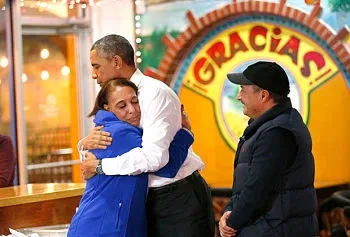
U.S. President Barack Obama hugs the owner of a Mexican restaurant in Nashville
Lenta.ru attempted to understand the differences between Republicans and Democrats on the issue of migration and how they use it in their platforms.
The United States is a country built by immigrants, and today more than 45 million people born outside the country live there. Immigrants account for about a third of population growth (statistically, a new migrant arrives in the U.S. every 32 seconds) and are seen as a crucial stimulator of economic activity, a source of both low-paid labor and highly skilled professionals. The GDP generated by immigrants is estimated at over $1.5 trillion. The total annual income of illegal immigrants alone reaches $350 billion.
And yet, issues related to the growing number of immigrants are perceived ever more painfully in the U.S. Opponents of immigration emphasize that it places a serious burden on the labor market and social systems of some states. This creates serious friction not only within society, but also between the federal government, which controls immigration policy, and state authorities forced to bear the consequences. Many see immigrants as a threat to cultural identity. Growing concerns include the possibility of infiltration by terrorists and organized crime members, intensification of technological espionage, and control over international financial flows, including migrant remittances.
The importance of ethnic, racial, and religious factors in migration policy is also growing, though American politicians and intellectuals avoid discussing them for reasons of political correctness. Therefore, when talking about ethnic migration, media figures often use the term 'illegal migration,' even if the legality issue is secondary. Opposing illegal immigration is acceptable, but opposing ethnic migration risks being labeled a xenophobe, which spells the end of a career.
In 1965, Congress passed the Immigration Reform Act, which eliminated discriminatory regional and ethnic quotas. Before this, the main criterion for desirability of a migrant was their similarity to the majority of U.S. citizens (at that time white Christians); now the priority became family reunification and encouraging the influx of highly skilled workers. At the same time, emphasis on humanitarian aspects of immigration policy and refugee issues increased. As a result, the share of Europeans in the migration flow fell from 90% to 10% over 20 years. Today, half of foreign-born U.S. residents come from Latin America, and a quarter from Asia.
The deepening socio-economic gap between the U.S. and Latin America, combined with growing demand for labor, created a powerful and predominantly illegal migrant traffic from Latin American countries (especially Mexico). At the same time, immigrants retained their linguistic identity and formed ethnoterritorial clusters. In many border states, legislative proposals were put forward demanding stricter immigration rules, cutting off illegal immigrants and their children from social benefits, and making English the official state language.
Unsurprisingly, migration issues have become increasingly central to U.S. election debates in recent decades and seem capable of significantly affecting the outcome of presidential elections.
'Donkeys' and the Migration Question
The migrant issue today means much less to Democrats than to their opponents. All major candidates speak about the need for immigration reform and policy liberalization in this area. But it's not that simple. The stumbling block for 'donkeys' is labor immigration, both legal and illegal. The Democratic Party is a coalition of organizations representing not only various minorities but also labor unions. From the latter's perspective, the willingness of immigrants to work for low pay and without social benefits slows wage growth and increases competition. Therefore, union leaders often oppose Democrats' push for liberal immigration reforms.
Meanwhile, Democrats who support immigration reform are divided into those who favor overall removal of immigration restrictions and mass legalization of illegal immigrants, and those who propose dramatically increasing quotas for highly skilled workers while sharply reducing the number arriving through family reunification.
Structural immigration reform was among Barack Obama's campaign promises in 2008, earning him support from Hispanic voters. The fact that over the next six and a half years of his presidency Obama was unable to reach an agreement with Congress on this reform led to a sharp decline in Hispanic voter turnout in the 2014 midterm elections, becoming one of the reasons for the Democratic Party's devastating defeat.
Obama's immigration concept includes both liberal and tough restrictive elements (in particular, during his presidency, more than 1.5 million illegal immigrants were deported). From the perspective of demographic policy goals and labor market needs, the 'DREAM Act' ('Development, Relief, and Education for Alien Minors' – The DREAM Act) is of particular importance. Adoption of this document would have provided an easier and faster path to permanent residence status, and potentially citizenship, for young (under 31) illegal immigrants who came to the U.S. as children and have no criminal record.
Since last year's defeat of the Democrats weakened the chances for Congress to adopt new immigration legislation, on November 20, 2014, Obama signed a radical executive order. In addition to easing the entry of highly skilled professionals into the country, this document extends to three years the deferred deportation period for 600,000 young illegal immigrants covered by the 2012 directive, and extends it to approximately 300,000 more young illegal immigrants and 3.7 million parents of immigrants – citizens or permanent residents of the United States (provided they can confirm they have been in the country since at least January 1, 2010, are not involved in serious violations of the law, agree to undergo relevant checks, and pay registration fees, duties, and taxes on all income earned during their stay in the US).
The directive not only postpones their deportation with the possibility of further extension of this new status, but also allows them to obtain work permits and Social Security cards. In a televised address, Obama stated that his directive is not an amnesty and is aimed at 'bringing out of the shadows' illegal immigrants, which is important both for improving tax collection efficiency and for ensuring law and order.
Obama's opponents believe that his directive will cause new waves of illegal immigrants seeking to give birth in the United States to children who will automatically acquire citizenship. Moreover, the presidential initiative is unfair to those who come to the country legally but often have to wait for decades for permanent status or citizenship. However, even if the next president is a Republican, it is not certain that he will repeal Obama's directive – this could cause too painful a reaction, given the rapidly growing share of the Spanish-speaking population and electorate.
Read the continuation of the article:
AMERICAN 'THOSE WHO CAME' (part 2)