
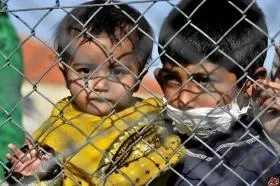
Greek government hopes to protect country from illegal migrants with a fence
Today few remember that official Greek representatives were the first Europeans to criticize Israel's plans to build a protective wall on the border with the Palestinian Authority. As Rosbalt news agency notes, now the government in Athens has been subjected to exactly the same criticism from Europe – after announcing that it intends to fence itself off from Turkey.
Alas, the dream of a "Europe without borders and barriers," proclaimed for many years by EU leaders, still remains just a dream. The fewer border obstacles remain inside the European Union and the Schengen zone, the stronger and more impregnable become the barriers erected on their external borders.
Spain and Malta send entire flotillas of border patrol boats into the sea to intercept illegal migrants from Africa, Italy allocates huge sums to the Libyan government so that Muammar Gaddafi's subordinates build refugee camps even on the distant approaches to Europe, and now Greece has decided that its external borders are too transparent for illegal immigrants.
To strengthen them, Athens decided that henceforth the 206-kilometer section of the land border with Turkey should be fenced with a protective fence three meters high. This measure, as emphasized by the country's Minister of Internal Security Christos Papoutsis, should protect Greeks not from Turks, but from refugees making their way through Turkey into the European Union.
"The border fence separating the United States from Mexico served as an example for our plan," Papoutsis explained in his speech. "Only in this way can we stop illegal migration."
The minister acknowledged that the flow of illegal migrants entering the EU began to intensify back in 2009 – from the very moment when "special measures" taken by some Southern European countries to additionally protect their borders began to take effect. "Paradoxically," the Greek minister noted, "the current difficult situation we face is proof that the Italian and Spanish border guards are doing their job excellently, and the European border agency Frontex was not created in vain."
However, for Greece, the good work of Italian and Spanish patrols turns into difficulties. Illegal migrants, mainly from Africa and the Middle East, try by hook or by crook to penetrate the "promised land" – the European Union. In the Mediterranean Sea, their flimsy kayaks are intercepted by Maltese and Spanish coast guard boats, the route to Italy via Libya is virtually closed – Muammar Gaddafi honestly repays the generous loans and small arms supplies from Italian Prime Minister Berlusconi.
However, the route through Turkey still remains more or less free and attractive for tens of thousands of refugees. Firstly, it is not as dangerous as the sea route, and secondly, to this day the border river Evros, separating Greece from Turkey, is not a serious obstacle.
As stated by Georgios Salamangas, police chief of the small town of Orestiada, located near the Turkish-Greek border, from January to the end of September last year alone, almost 50 thousand illegal refugees were arrested, and in October 2010 his subordinates detained on average 350 people daily.
Notably, Greece became the first country to ask the European Union for help in protecting its external border, when in October last year the Frontex organization was created, designed to assist EU member states in border patrol. Since then, the Evros River has been additionally "covered" by 200 employees of this organization. Their mobile groups are equipped with the latest technology and operate very effectively: since October, the number of illegal immigrants entering the EU through the Greek "gate" has halved.
Nevertheless, the Greek authorities still intend to build a fence on the border – obviously hoping not only to stop illegal migration at the moment, but also in the longer term to deter potential illegal immigrants from their section of the European border. Construction will presumably begin in the area bordering the Turkish city of Edirne, since it is here that the border runs on land for about 12 kilometers. Moreover, yielding to critics from Brussels, the Greek authorities announced that for now they intend to limit themselves to the land section and will not fence the river yet. After all, it is the 12-kilometer area near Edirne that is considered the most "transparent".
In essence, this fence is nothing but a consistent continuation of the "fencing off" of Europe, which with the help of Frontex is being implemented from Gibraltar to the Aegean Sea. Most likely, this measure will not deter thousands of illegal immigrants from trying to enter the European Union – they will simply start looking for other, not yet closed routes. Experts suggest that refugee flows will shift eastward.
Perhaps Greece will get a certain respite, which will be very timely: the country, which has not yet moved too far away from possible state bankruptcy, has in the last year become literally flooded with illegal immigrants – mainly from Afghanistan, Iraq and Somalia. Refugee camps are hopelessly overcrowded and unable to ensure even minimal sanitary standards, Christos Papoutsis emphasized, and the Greek authorities are also criticized for this by international human rights organizations.
The latter, in his words, "would better help with money, equipment and medical personnel, rather than lectures on how to observe human rights in camps designed for barely a third of the current number of illegal refugees in them."
Nevertheless, criticism from human rights advocates does not subside. Thus, the international organization Amnesty International emphasized in its statement that by building such fences, the European Union "indulges in violating its own legal principles." According to AI expert Wolfgang Grenz, Europe is turning into an "island for the rich," with no access for people fleeing persecution or horrific poverty. In his opinion, instead of fences and protective structures, Europeans should build a fair system for distributing refugees, so that countries like Greece do not experience such strong pressure simply because they lie on the route to the EU.
Obviously, the AI representative is right in this regard. To date, there is no universally accepted regulation in Europe regarding the distribution of refugees among states. However, as practice shows, refugees themselves are not eager to stay in Mediterranean EU countries like Greece or Spain – they are more attracted to the wealthy countries of Northern and Central Europe – Sweden, Denmark, Germany, France, Great Britain... The distribution camps there are not yet hopelessly overcrowded, and national legislation does not allow the expulsion of illegal immigrants without a trial, which sometimes drags on for years.