
For centuries, everyone had business with the small Maltese islands: Phoenicians, Romans, Arabs, Crusaders, Napoleon, and the English left their traces here. At the end of the 17th century, the first Russian embassy, led by Count Sheremetev, set off to Malta by order of Peter I. He returned to his homeland as a Maltese knight. Under Catherine II, ships of the Russian fleet often anchored in the harbor of Malta's capital, Valletta, named after its founder, the Grand Master of the Maltese Order, Jean de la Valletta, and guests received a warm welcome. Thus, the sunny Maltese shore has been familiar to us for more than a century. And the Russian Emperor Paul I was even elected the 70th Grand Master - the head of the Maltese Order.
There are many secrets in Malta's history. To begin with, it is still not exactly known where its name came from. Some believe it comes from the Phoenician word "malat" meaning "quiet harbor." Others believe in the Arabic trace - after all, "malta" in Arabic means "uncovered," and most of the island is indeed occupied by bare limestone. There are also those who recall the Latin word "melita" - "honey." And indeed, once especially honey-bearing bees lived in those parts.
Among the mysteries is also the Hypogeum - a cave preserved from time immemorial, carved into the rock to a depth equal to a four-story building. There, the echo for some reason responds only to a male voice.
Silent City and Window in the Rock
The Maltese islands (and besides the island of Malta there are also Gozo and Comino - each smaller than the other!) are a real open-air museum. For example, the old city of Mdina, which is called the silent city because no one lives in it, although here and there you encounter dynastic mansions of the Maltese nobility, as a whole is one large tourist attraction. From the sea, Malta looks like an impregnable fortress: its light rocky shores smoothly pass into fortifications made of the same golden stone. The Maltese knights more than once withstood the siege of the island. One of these sieges is recalled by a theatrical performance staged from time to time in these natural historical settings.
Everywhere in Malta, the abundance of churches and cathedrals catches the eye. They say there are 365 of them - the same number as the days in a year. Many of them have two clocks: some show the correct time, others the wrong time. Behind this is a belief: the devil, coming for the souls of the dead, must become confused in time and not have time to do his evil deed.
If the entire island of Malta can be driven around its perimeter in half a day (by the way, the lowest car rental prices in Europe are here), then even a month would not be enough to truly enjoy its historical and cultural monuments. This is not surprising - after all, the density of attractions per unit area on the Maltese islands is the highest in the world. Here is a unique structure - a prehistoric temple that is older than the English Stonehenge and the Egyptian pyramids. In the walls of the temple, spherical figures of ancestor women were found, which have become one of the symbols of Malta. In addition, ancient people left tracks of giant runners on which, most likely, they moved 50-ton stone blocks to the sacred hill, from which this temple was constructed.
Ancient antiquity closely neighbors modernity. It can be said that there is historical Malta and there is secular Malta, and they coexist wonderfully. On the archipelago, which today is flooded by waves of tourists, an extensive resort area has been created. At the same time, Malta is spared from those negative phenomena that often accompany concentrations of tourists. Since this is a Catholic country, some far from liberal laws have been adopted here. For example, prostitution, drugs, and nudism are prohibited.
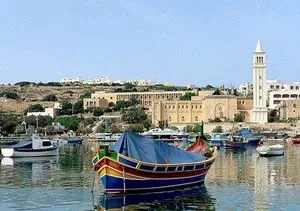
The sea on Malta is present everywhere, be it picturesque bays where colorful fishing boats "luzzu" scurry about or lie at anchor, or the Blue Grotto, which is one of the country's calling cards, or the amazing view of the Grand Harbor and the sun-yellow buildings of Valletta, opening from the bastions of the old towns Vittoriosa, Senglea, and Cospicua, and, of course, the miracle of nature - the Azure Window, which formed naturally in the rock - over a couple of million years it was eaten out by mollusks. Now through the rock you can see the sea...
Strictness Is Not a Hindrance to Studies
Over the seven thousand years of its history, Malta has been in many hands. From 1800 to 1964, it was a British colony. Is it any wonder that so much English has remained here: administrative structure, left-hand traffic, the system and standards of education, and, of course, the language.
Malta has secondary schools, colleges, and a university. The Maltese certificate of maturity and higher education diploma are equivalent to the English ones, and education prices here are two or even three times lower than in foggy Albion. The archipelago is also considered one of the safest places in Europe, which is often a decisive argument in favor of Malta when parents decide where to send their child to study.
As in England, secondary schools are divided into state schools, which are free, and private schools, which are paid. Private schools accept foreigners. It is believed that they are more prestigious and the quality of educational services is higher. Often education is carried out separately - in some schools boys study, in others girls. Teaching is conducted exclusively in English, while in state schools children study both official languages - both Maltese and English. There are about 270 private schools in Malta. It is important to note that unlike England, boarding schools (boarding schools) are extremely rare here. For example, one can name the private boarding school Diana's School or Malta Crown, but this is rather an exception to the general rule. Therefore, foreign schoolchildren are usually placed with families.
Maltese schools are very flexible when it comes to admitting foreign children. For instance, one can study under a long-term program (from grade 1 to graduation) or a short-term one (from six months to one year). The academic year is divided into three terms of three months each. Classes begin on October 1.
Parents will be interested to know that, despite all the democracy and friendliness of the staff, schools do not let students slack off. There are strict rules prohibiting, for example, smoking and drinking beer within the school walls, leaving the school grounds without a teacher's permission, and so on.
As in the UK, to continue on to university, a student must complete the A-level program and obtain something like a certificate of maturity. However, for college admission, a secondary education certificate is sometimes sufficient, and obtaining it requires two fewer years of study. With it, one can enroll in certain programs at institutions such as the Institute for International Tourism Management or the International Tourism Institute Swizerland. Both are located in Sliema. There are also prestigious colleges, such as Verdola School, but tuition there exceeds $25,000 per semester.
More and more international applicants are showing interest in studying at the University of Malta. The thing is, it is easier to get into than universities in the UK or, say, the USA. At the same time, tuition is much lower than in those countries, and educational standards are very high (the University of Malta is often compared to Cambridge and Oxford in terms of student training). Moreover, after obtaining a bachelor's degree, it is easier to apply to any university in the world to continue one's education. Many graduates of the University of Malta go on to pursue master's and doctoral degrees at Harvard, Princeton, Oxford, and Cambridge.
The University of Malta is one of the oldest educational institutions in Europe. The Jesuit Order founded it in 1592 under the name Collegium Melitense. The university soon received from the Pope the right to award academic degrees of master and doctor of philosophy and law.
Instruction is conducted in English. The university has 10 faculties and 15 specialized institutes and centers, which include 75 departments (by specialization). Study leads to bachelor's, master's, and doctoral degrees.
The educational process is based on a modular principle – one must complete 22–25 modules per year. One module is 14 lecture hours and 36 hours of independent study.
About 6,200 students study at the university, including 250 foreigners from 45 countries. Admission to the university is carried out without exams, based on secondary education documents. The university recognizes the domestic certificate of completion of full secondary school. A certificate of English proficiency (minimum TOEFL score – 550 points) is also required. If the score is lower, the applicant can enroll in the preparatory department, the Foundation Studies Course.
It was created specifically for students who wish to improve their English language skills and prepare for admission to the University of Malta. In the first term, a General English course is taught; in the second, the emphasis is on using the language for academic purposes, on written work. Depending on the faculty chosen by the student, they learn to understand subjects such as mathematics, economics, geography, and philosophy in English. When applying to Maltese universities, one can try to obtain a scholarship or a tuition discount. The university has created all conditions for students: there is a library, a reading room, computer laboratories, including Internet access.
English, Maltese Style
Malta has turned the teaching of English to foreigners into a streamlined process and made this area of educational services a thriving business. This small country has about 40 language centers, where more than 1,150 professional teachers work. More than 40,000 foreigners come to Malta "for language" every year.
The schools are very different: there are those that operate year-round, and those that are active only in the high season. Some are large, located in modern buildings, designed for a considerable number of students – such as, for example, the European Centre of English Language Studies (EC). It is located in the resort town of St. Julian's on the north coast of the country, often called the secular face of Malta. At the same time, there are small, homely schools – like B.E.L.S on the island of Gozo, where during a break one can relax in a beautiful green courtyard and even swim in a pool.
Students are offered all classic options – from General English, the academic year, preparation for Cambridge exams and TOEFL, to special programs for children. Hardly anyone would refuse to take part in a night yacht trip, go horseback riding, or enjoy stewed rabbit (the national Maltese dish) at a Rabbit Evening (Fenkata) organized on a Maltese farm...
Combined summer courses are the specialty of the well-known language center English Language Academy, located in the resort town of Sliema. Particularly popular are the programs 'English and Scuba Diving' (from 14 years) and 'English and Sailing' (from 12 years), 'English and Horseback Riding'. This school, founded in 1988 and known for its team of experienced professional teachers, is accredited by the Ministry of Education of Malta. It is one of the founders of the organization FELTOM (Federation of English Language Teaching Organizations in Malta).
Located a five-minute walk from Spinola Bay beach is the modern building of the Gateway International School of English (GISOE). As GISOE's executive director Charles Sammut said, the school is especially proud of its ability to guarantee an individual approach to each student. For this quality of service, the price of 240 euros per week (including half-board, accommodation and the course) seems what the British call value for money.
So what makes people prefer Maltese schools over, say, British or Irish ones? “The advantage of Malta,” believes Yevgenia Lintsova, a representative of one of the educational companies, “is, of course, the climate and geographical position. The hot summer and the swimming season from mid-April to the end of October make this country a wonderful place to combine study with leisure. In addition, Malta is good for those who have recently started learning the language – Maltese people speak English very clearly, loudly, with good articulation. And that is exactly what beginners need. Another plus is that Malta is more affordable in price, especially in late spring or early autumn. And finally, it is an ideal place for a family holiday – schools offer programs for both parents and children at the same time. I always especially recommend schools such as EC and Inlingua.”
Another representative of a company specializing in education abroad, for her part, believes that among Malta’s advantages is the fact that obtaining a Maltese visa is much simpler than in the case of the UK and other English-speaking countries. “In addition,” Yekaterina Abramenko told us, “during the summer holidays and Easter, many Maltese schools offer special children’s programs, including individual ones. Parents are only required to give permission for the child to travel abroad. For the rest, the school takes responsibility – from meeting at the airport to departure. On the other hand, parents can go to learn the language while bringing a small child with them: the school will find a nanny or nursery. For children over eight years old, a children’s language program will be selected.”
Malta will leave no one indifferent. If, however, by some chance you have stayed on these beautiful golden islands so long that you know everything by heart – well, you can pop over to Sicily. It’s only an hour and a half by catamaran...