
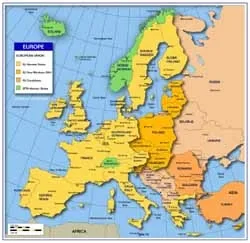
The essence is that the city decided to become the capital of all European exiles who lost their homeland and property as a result of World War II. It was in Trieste that the first congress of European refugees recently took place, bringing together Germans from Silesia and East Prussia, Greeks from northern Cyprus, Armenians expelled from Turkey, Estonian Setos, Karelian Finns, Italians who fled the Istrian peninsula... The congress chose as its motto the words «Jurisprudence, not politics,» hoping with this slogan to storm the bastions of European bureaucracy and obtain compensation for lost property. Within the European Union, a large-scale redistribution of property - 18 million exiled Europeans - could become a reality.
Euro-exiles
The congress took place in the conference center of the stock exchange building. Anyone who wished, upon reaching the top floor, could see the gentle hills with vineyards rolling in waves beyond the horizon. There began Slovenia, which is to become a springboard for the advance of refugees across Europe.
«Today we have gathered together for the first time, and there are 18 million of us. We must be heard. We will appeal not to national governments, but over their heads - to the European Union and the UN,» proclaimed at the opening of the forum the vice-president of the Istrian Union, Enrico Neami. The exiles emphasized that they are not seeking the restoration of former borders. What matters to them is to return lost property or receive financial compensation for it. However, as the congress organizers told Itogi, it is impossible today to name even an approximate amount that restoring historical justice would cost. The fact is that the organization intends to file not collective, but individual lawsuits from each of its members claiming the return of property.
For example, 80-year-old Luciano Parovel is one of the 350,000 Italians deported after the war from lands that went to Yugoslavia. Now these territories on the Istrian peninsula are divided between Slovenia and Croatia. Luciano's old house is abandoned. Trees grow through the broken roof tiles, but he is ready to return even today and start rebuilding. As long as there are property rights and money as compensation.
Perhaps the old man will be able to fulfill his dream in the near future. Italy and Slovenia have advanced the furthest in restoring the rights of former owners. The former government of Silvio Berlusconi made the protection of post-war exiles one of its key foreign policy tasks. February 10 was declared the Day of the Exiles, postage stamps dedicated to the exodus were issued, and monuments to the victims of deportations were erected throughout Italy. The Istrian Union received an annual subsidy of one and a half million euros. Today, with this money, lawyers hired by the Union lobby the interests of all European exiles at EU headquarters. Rome even threatened to veto Slovenia's entry into the European Union if no agreement on restitution was reached. Ljubljana made concessions. In particular, a law was adopted giving former owners the priority right to buy back vacant property. But Slovenia refused financial compensation. The authorities of this former Yugoslav republic, as well as Croatia, presented Italy with a counterclaim, demanding compensation for damage from the Italian occupation during World War II.
The situation, by the way, is typical for such conflicts across Europe. For the same reason, the claims of Germans who lost property in what is now the Kaliningrad region, or of Finns in Karelia, will never be satisfied. Moscow, in case of an attempt to rewrite the material results of the war, will file counterclaims against Berlin and Helsinki.
Polish veto
The exiles have a chance for compensation only when the disputed property is located in an EU member state. Although even here, it is not simple. A sharp deterioration in relations between Poland and Germany occurred immediately after the last elections in the Federal Republic of Germany. While former Chancellor Gerhard Schröder said: «We Germans know very well who started the war and who was its first victim. Therefore, there can be no question of Germany's claims for restitution against Poland,» his political opponents hold a different view. For example, during the election campaign, CSU leader Edmund Stoiber repeatedly stated the need to grant the exiles the right to return to their historical homeland, to recover lost property or receive monetary compensation there. In an interview with Itogi, a representative of the German Association of Expellees, Markus Leischner, said: «The German government and the European Union must demand that Poland and the Czech Republic resolve this issue. By all laws of civilized countries, we have the right to return to our homes.» Perhaps this demand would have remained unanswered if it had not received support from German Chancellor Angela Merkel.
The German authorities proposed a compromise solution to Poland. According to it, Warsaw should pay part of the compensation to the displaced persons, while the German government is ready to bear most of the costs. Official compensation figures have not yet been announced, but the scale of the «redistribution of property» is not hard to imagine. Silesia, from which ethnic Germans were deported after the war, accounts for approximately half of the industrial potential of modern Poland. This is primarily the mining industry, which before the war was in private hands, that is, owned by factory owners of German origin. It is clear that over the past decades, the enterprises have been modernized and rebuilt - and the same jaw crusher is not cheap. But even the minimum price of land and buildings, according to experts, will run into several tens of billions of euros.
It is not surprising that the German proposal provoked such a furious reaction from the Polish authorities that they even promised to freeze Polish-German relations. Moreover, a counterclaim was presented to Germany, also for tens of billions, for the destruction caused to Poland during the war. Since then, relations between Berlin and Warsaw have been, to put it mildly, strained. Poland categorically refuses to make any concessions. The Czech Republic, which has a similar problem with the Sudetenland once inhabited by Germans, is taking a wait-and-see stance.
War of Monuments
The real return of expellees is so far possible only in Slovenia. If only because the Istrian Italians have rights that the same Germans in Silesia are denied. The fact is that after the war, Italians with leftist convictions remained in Istria. They turned out to be the most loyal adherents of Marshal Tito, and the areas they inhabited in the 1990s were nicknamed 'red spots' by nationalists. Yugoslavia was torn apart by civil war, and only Istria refused to take sides, clinging until the very end to the myth of a single socialist homeland. The Yugoslav authorities before its collapse rewarded the Istrian Italians for their loyalty by granting them autonomous rights. Italian schools operate there, and newspapers are published in Italian.
Another matter is Silesia. There, some were victors, others vanquished. When after the war Poland's borders shifted westward, about 10 million people were forced to resettle in Germany, but a significant number of Germans remained in Silesia. The German language was officially banned, and the authorities pursued a harsh policy of 'Polonization' of the German minority. And they did it so clumsily that, according to Polish sociologist Danuta Berlinska, they sharply weakened the minority's ties with the Polish state.
For several years now, a war of monuments has been going on in Silesia, and the participants perceive what is happening far more painfully than the conflict between Moscow and Tallinn over the 'Bronze Soldier'. In the Opole Voivodeship in recent years, German monuments torn down during the time of 'people's democracy' have been revived one after another. It turns out that many obelisks were stored in barns and garages, awaiting better times. And when they came, the German minority began to erect monuments in cemeteries, near churches - with iron crosses and Hitlerian symbols. Naturally, conflicts arose. To avoid open confrontation, a commission was created in Opole that negotiates with those who were returning obelisks to public places.
Redivision of Eurohouse
There is a clear conflict that threatens unpredictable consequences for the European Union. It will obviously increase friction between old EU members and newcomers. After all, as representatives of the Seto and Karelian Finnish ethnic groups, who claim the return of property in northwestern Russia, admitted at the congress in Trieste, it is difficult for them to obtain compensation. It is another matter to demand satisfaction within the European Union. A unified Europe lives by common legal norms, and it is difficult to deny one of the categories of its citizens satisfaction of material claims.
Until now, lawsuits to the European Court of Human Rights, which has jurisdiction over cases like deprivation of property and ethnic expulsion, have been avoided through a legal formality. The court in Strasbourg can only rule after the case has been considered in a national court. In the countries from which certain ethnic groups were expelled, courts generally do not accept such claims. It is another matter if the European Parliament and the European Commission oblige all EU members to do so. A breakthrough has already occurred: Brussels, following the Italian government, has promised to fund a pan-European organization of expellees. Flushed with success, the congress participants now demand that the EU authorities adopt a framework declaration recognizing the problem and stating the need to solve it.
It is clear that the European Union's documents do not apply to Russia or Northern Cyprus. Therefore, the congress participants decided to also appeal to the UN. However, a positive decision from that organization is in the realm of fantasy. Without the support of all permanent members of the Security Council, it is impossible to adopt a resolution. And in this case, such support will not be forthcoming - Russia, for example, will certainly veto it. And it is not even that private property and rights to it are still treated without reverence here. Such a precedent would be too costly.