
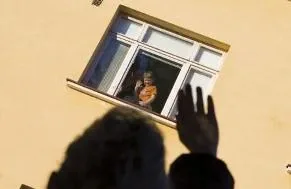
Many Russians, having started a family abroad and had children with foreign citizens, are not aware that their offspring from the very first days are under close scrutiny of the state
How did it happen that the vaunted European system, designed to protect children's rights, suddenly turned into a ruthless cyborg destroying families and warping souls?
A Matter of Everyday Life
...Prosperous Turku resembles a sedate Finnish burgher, cozily dozing under a thick blanket of snow. Rare passersby are extremely friendly to tourists; when asked for directions, they not only answer but also offer to accompany you. The Rantala family home is one of many, outwardly no different from the others. The hostess greeted us while rolling up freshly cleaned rugs – recently, guests have been frequent. Everything that happened still does not fit in Inga's head.
"No one beat him or offended him," she shares with us. "Well, there was: I spanked him when my son was stubborn, threw his underwear and T-shirt at him and told him to get ready for school." Why be surprised, it would seem? An ordinary thing... To bring some unruly rascal to his senses, sometimes it's not enough to pound your fist on the table.
But Finland is not Russia. Information about the spanking spread through the neighborhood like lightning. This amazes people unfamiliar with Finnish laws, which elevate the child to the rank of national treasure to be cherished as the apple of one's eye. The strictest control over how children are raised in the family and under what conditions they grow up is legally prescribed. To this end, a powerful social system has been created, endowed with the broadest powers.
Many Russians, having started a family abroad and had children with foreign citizens, are not aware that their offspring from the very first days are under close scrutiny of the state. In Russia, there is neither such a mechanism nor the habit of enforcing laws that prescribe children's rights. Therefore, expats from our country do not imagine that the state can watch over them not only as citizens but also as parents.
In 2008, a law was passed in Finland defining the category of persons obliged to report to social workers any violations of parental duty. These are teachers and church ministers (only if it does not concern the seal of confession). If suddenly social services receive a signal from a teacher or just an upstanding citizen that a child is being oppressed, offended, humiliated, beaten, insulted, or not cared for, officials must immediately conduct an investigation.
First, summon the parents for a conversation, warn them of the consequences, appoint consultations with a psychologist, and in urgent cases, remove the child and send him to a shelter. In this context, it becomes clear why Robert's teacher, upon hearing from him about the spanking, immediately reported it to the proper authorities. And it's not even that she was afraid to keep silent about the fact of violence against the child; she is sincerely convinced that one must act according to the law.
In Robert's case, let us repeat, the situation developed rapidly. He was sent to a shelter. So was the case deemed an emergency? According to Inga Rantala's version, Robert was taken from the family as if kidnapped: "It was February 4, my son was feeling unwell and stayed home. I left for a short time – went to school for homework. It's close by – you can see it from the window. Robert suddenly saw two people approaching the door and opened it – because it's safe here... Then everything happened quickly: they took a jumpsuit hanging on the hanger, pulled it onto my son, and led him away with them. He only insisted on taking the house keys. In case, when he returns, no one is home..."
Only after some time did Inga receive a call from social services: so and so, your child is in a shelter. Further frantic visits to officials, police, and other services yielded no results. Parents were allowed to visit Robert at the shelter twice a week for two hours and speak to him only in Finnish.
All this time, the Rantala couple tried to understand why they were deprived of their son. Today, Inga believes that the officials did this not for the allegedly existing beatings, but because the boy supposedly blurted out somewhere that at the first opportunity he would go live in Russia. Finnish human rights activist Johan Bäckman holds the same version: "All the problems of the Rantala family are because their child said, 'I will go to Russia.' Because in Finland, children are viewed as the property of the state."
It seems Robert did say something like that in the yard after a childish quarrel with another boy. But maybe he meant something completely different? The family was planning to visit grandmother in St. Petersburg soon, which by no means indicates the Rantalas' desire to move to Russia. Even if so, however, the couple saw their future life in Finland: they are paying off a loan for their house, recently renovated it, built a sauna, are trying to start their own business – a store and a café. Does one do this when thinking of leaving the country?
However, due to what happened, plans may change dramatically. Veli-Pekka, when we ask him about the events of recent weeks, only darkens his face. As a true representative of his nation, he is not great at talking. But he is a good woodworker – the kitchen furniture in the house is made by his hands. What happened has thrown him into such shock that he is ready to renounce Finnish citizenship and accept Russian citizenship, about which he made a written statement to the Russian embassy. Thus, the intervention of child protectors turned the life of an ordinary family upside down.
Lost in Translation
Until very recently, the general Finnish public had no idea what drama was unfolding in Turku. "How did you say the name of this family?" both officials and ordinary residents asked us. "Rantala? No, we haven't heard."
Such family stories are not uncommon in Finland. Statistics show that in 2009, about 11,000 children were taken from their families in Finland. This is a huge number for a country with a population of 5 million. How does the conveyor belt work? This becomes clear upon closer acquaintance with the state child protection system in Finland.
“Social workers can decide to immediately remove a child from the family if there is suspicion that his health and life are in danger. In principle, one slap is unlikely to be grounds for removal. As a rule, a whole set of factors must come together,” explains Lotta Silvennoinen, chief specialist for children’s affairs at the Finnish Ministry of Social Affairs and Health.
However, in Russian circles in Finland, a strong conviction has taken hold that officials have double standards and are much more picky about mixed families.
“Russophobia is widespread in many countries, but in the case of Inga Rantala it took a cruel form,” says Alexei Bazhenov, a businessman who has been living in Finland for about 10 years. “A Finnish woman’s child is taken away only if she is a drug addict and an alcoholic. Local women generally treat raising children as housework that needs to be divided equally every minute. My wife is Russian, we recently had a daughter, and when we come for a routine check-up, we are each asked a strange question: are you happy?”
“I can say that the problems for foreign or mixed families are the same. Unfortunately, my experience working with people from other cultures shows that they very easily go beyond the problem and turn it the other way. They say: you are touching our family because we are not Finns. It’s easiest to say that, but this path leads to a dead end,” explains Tuula Kumpumäki, executive director of the foundation “Our Common Children.”
This organization has been working with multicultural families for more than 20 years. The largest national groups in Finland now are: people from the former USSR, from Africa (formerly from Somalia, recently from Sudan), Kurds, and arrivals from Arab countries. It is clear that interethnic discrepancies do occur, but of a different kind: how to express emotions, how to raise children, what is accepted and not accepted in Finnish society.
Difficulties almost certainly arise when the mother does not know the language – and this is quite possible. For example, you can live peacefully in Helsinki only within a narrow circle: find a Russian-speaking doctor and nanny, shop in Russian-language stores, etc. By the way, one of the assumptions why social services in the case of Rantala acted immediately so decisively is the language barrier. Inga is fluent in Finnish and notes that Russian has a much wider choice for conveying nuances. Agree, it sounds different: “give a slap” and “hit on the head”. Maybe in Robert’s case, the phrase “mom slapped” in Finnish sounded too threatening: “Mom hit”. So the Finnish system reacted.
When a mother is not familiar with the surrounding society, she inevitably develops fears: she is afraid to contact the official authorities unnecessarily – what if her residence permit is not extended or other troubles arise. “Suppose at school they offer to transfer the child to a younger group so that he can do better with the language. And the mother immediately becomes wary: maybe my child is lagging behind in development? But often you can get by with a small correction before it all turns into huge problems,” says Tuula Kumpumäki. “When a child grows up, mothers also worry: he has Finnish friends, and she doesn’t know if she can let him go for a walk with them. She has no experience of her own, she doesn’t know what to expect.”
Also, concerns arise about the child protection system adopted in the Scandinavian countries. It is close to the European one, but is completely incomprehensible to newcomers. The fact is that many methods of raising a child are simply unacceptable for Scandinavia. For example, trivial punishments by Russian standards – slaps and cuffs – are categorically prohibited by law in Finland, and for more than 25 years. And no medical examination is needed: the words of the child or the testimony of other people that he was spanked are enough. It is difficult for Russians to understand this, although even among Finns there is often misunderstanding. I myself belong to the generation that was spanked. And yet, such is the norm of the law.”
You can call it whatever you want: “protection of children’s rights” or “excessive guardianship”. Yes, many Finns admit that the system is not perfect. Recently, the powers of social services have been called into question because they interfere in such a sacred space as privacy: what good is it when officials can interfere in family life at any moment?
Robert definitely felt bad in the shelter. Even worse was for another boy from a family of Russian emigrants, when he, who did not speak Finnish, was taken directly from school to a shelter because of a bruise and kept there for eight months. He later said: “It was like in prison.” His stress is so great that psychologists are working with the child.
We need to negotiate
On March 15, the misadventures of the Rantala family reached their peak. Robert ran away. He was released from the shelter to school for the first time, and he took advantage of this to dash home. The parents immediately stated: do what you want, but we will not give up our son – he will not forgive us for this...
The situation escalated. From Moscow to Turku, the Commissioner for Children's Rights under the President of the Russian Federation, Pavel Astakhov, went. Initially, as he admitted to Itogi, it was difficult to talk to Finnish officials: it turned out, for example, that they had been monitoring the Rantala family since 2006 and had compiled an impressive dossier on them (the father sometimes abused alcohol, and there were scandals in the family), with which the social workers stood firm – there could be no mistake, and we do not intend to change our decisions.
But, as Pavel Astakhov believes, by their actions the services tried to cover up their own shortcomings. In the story of this "international" family, the employees missed the main thing – the stage of prevention, offering to work with family psychologists, to resolve the situation without conflict. "The main problem in this case was that trust did not arise between the social service and the family," says Pavel Astakhov. "There was no dialogue at all! The services methodically recorded violations but did nothing. And then they didn't understand the main thing: by telling a Russian woman 'we will take away your child,' they cornered her. She is ready to throw herself under a tank! Our task is to turn that tank away..."
Judging by the latest reports from the front, the tank was successfully turned away. According to Astakhov, a "plan for the happy life of the Rantala family" has been adopted: trainings, meetings with psychologists, and so on. If the family starts implementing it before April 3, Robert will be left with his parents.
This case was worth special attention if only because right now Pavel Astakhov managed to move a whole load of issues whose resolution will help save hundreds of mixed families. "The fact is that after the collapse of the USSR, our country has not signed any agreements on mutual assistance in civil and family matters with anyone," explains Pavel Astakhov. "The main thing without which it is impossible to resolve family disputes in a civilized manner is the mutual recognition of court decisions, which such agreements imply.
For example, a case in Spain: a few years ago, spouses divorced in Russia, started new families. And suddenly in Spain, a lawsuit is filed on division of property, and the argument that the divorce was in Russia is not taken into account; the family of the Russian citizen suffers." If such agreements are signed with European countries, then, according to the children's ombudsman, the cases of Natalya Zakharova, Irina Belenkaya, and many other Russian mothers could be turned around in a new way.
At present, progress has been made on signing such agreements with France; Astakhov's recent meetings with the Finnish Minister of Justice give hope that a similar agreement will be concluded with that country as well.
...Seven-year-old Robert Rantala, after a month's absence, is finally home, studying publications about himself on the Internet with interest. He appears calm, setting up a toy railroad with his father. And only at night can he wake up: "Mom, are you here? And Dad?" He is so afraid of the shelter that he will never tell anyone that his father gave him a slap... The machine that was supposed to protect the child from adult aggression taught him something completely different – to be cunning and silent, even if things are bad at home. Because the shelter is even worse.