
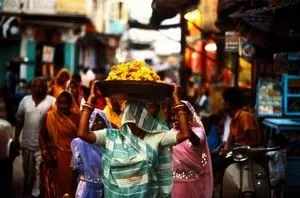
An acquaintance of mine, an Indologist, gave me a parting word before the trip:
"Forget everything you've read in books. Reading about India is pointless. You have to live through it. Like war, love, pregnancy, the birth of a child, divorce, fame, death... Now further: India will either accept you or not. She will accept you if you accept her. Never get angry in India. Even if something extremely unpleasant happens. Have you seen the cartoon 'Hedgehog in the Fog'? Well, then. When you arrive in India, say to yourself: 'I am a hedgehog. I have fallen into a river. Let the river carry me itself.' And it will carry you out. In India, be modest, relaxed, responsive, and benevolent. And then India will accept you. And if she accepts you, then you can drink water from the Ganges, kiss Calcutta cows, pet Madras vipers, snack on the streets of Bangalore, and walk barefoot through Mumbai dumps. Of course, none of this should be done. But you get me.
It's about six to six and a half hours' flight to Delhi. The time difference is two and a half hours. With all other places I know, the difference is a whole number of hours. With India, it's two and a half. Approximately. Exact time in India doesn't matter at all. Actually, just like here.
Then I noticed that Hindus become very animated when the conversation turns to something metaphysical: incarnation, samsara, the soul, the meaning of life. Just like us. Only with us do Socratic dialogues tend toward fisticuffs. Not with Hindus. Hindus are perhaps the least aggressive nation in the world. One of my Indian students, incidentally a Brahmin by birth, explained it to me roughly like this:
"You see, O teacher, we Hindus believe in incarnation. Not reincarnation, like Buddhists, but incarnation. For Buddhists, the soul wanders through samsara like a cow through Mumbai. You've sinned — nothing, it'll pass. After a reincarnation or two, I'll correct myself. For us Hindus, O teacher, it's all different. To become a human, the soul passes through ninety-six thousand incarnations, and if you, O teacher, do something bad, then, having become an animal, you will have to wait ninety-six thousand lives. So to be born human is unheard-of luck. The slightest blunder — and you're a chipmunk ninety-six thousand times. That's why we Hindus value so much the fact that we are humans. We don't fight, we don't eat meat, we don't steal. In India, by the way, O teacher, there is very little stealing.
The flight went wonderfully. I stayed at the Imperial Hotel. The hotel is luxurious. The doorman is in a turban and magnificently mustached. His mustache sweeps upward almost to his eyes. The mustachioed man gives a hussar-style sweeping salute: 'Hello, sir!' Half a dollar as a tip for the mustache. In India, you must tip. Not because they ask (they usually don't ask: they're proud), but because if you don't tip, something will happen, and even a dream book won't help. I'm far from a superstitious person, but experience is experience. Once I didn't tip a driver, and my suitcase broke. Another time I didn't tip a porter — and immediately I twisted my ankle in the bathroom. India. Tips are something like a mini-sacrifice to the Hindu pantheon. Honor and dignity are separate, tips are separate. These are different dimensions. Hindus, of course, love money, but on the whole despise it, just like us. They can haggle long and tediously over a trifle, and then make a royal gesture. Out of fifteen excursions, I forgot (truly forgot!) to pay for four. Later I remembered, but the Hindus sent an email: 'Fine, we'll gift them...'
In the morning I was at the airport to fly to Khajuraho, the very Khajuraho where the famous temples with indecent high reliefs from the Kama Sutra are. I checked in my luggage, got a boarding pass, went to the departure lounge. When everyone had already cheerfully lined up for boarding, an announcement came: 'The flight is cancelled.' That is, completely. Then there was an hour of shock. Sunday. Not a single agency phone answered. What to do? And I said to myself (I'm not joking): 'O almighty Brahma, Shiva, and Vishnu! I am a hedgehog, I have fallen into a river. Help the descendant of Afanasy Nikitin! Please!'
"Hello, sir!" came from behind me at once. "Are you Mr. Eli-sli-dra-stow?.."
"That's roughly me," I replied. It was a pleasant representative from my travel agency. We sat down in the business-class cafe and amiably and calmly discussed the situation. We decided this: instead of Khajuraho, fly (in an hour) to Varanasi (also known as Benares, the very place where they burn corpses on the banks of the Ganges), and then from Varanasi, after a day of sightseeing, fly to Khajuraho. In short, everything remained in force. That is, six of one, half a dozen of the other. Nothing was lost. The river carried the hedgehog out.
Benares-Varanasi is the heart of India. In general, one must understand that India, in terms of cultural and linguistic richness, is at least a few Europes. Indian northern Kashmir and some southern Madurai differ from each other a hundred times more than Norway from Albania. India has more than five hundred languages.
If you ask any local vendor or masseur on a Goa beach how many languages he knows, he will think and say: 'Five.' Then he will think a bit more and add: 'Or six. I haven't counted.' That's why Hindus, who all live, pardon the terminology, in a multicultural space of polyethnicity, are all very capable.
And yet Benares is the heart of India. Every Hindu dreams of being cremated on the banks of the Ganges. Cremation is expensive. By their standards, of course. Around $1.000. A real cremation, on a pyre and with sandalwood. For the poor there is an electric crematorium. Talk about the dirty Benares Ganges is nonsense. A wonderful river. Ecologically clean. No harmful industries. Lots of fish. By the way, the Ganges is only purified by the ashes of the cremated. Things used to be worse, though. The fact is that only those in whom five elements are united can be cremated: water, earth, air, fire, and atman (something like the Absolute). But in dead children, women who died suddenly during pregnancy, and those who died from a cobra bite, the five elements are not united. So they cannot be burned. A stone must be tied to their body and the body thrown into the Ganges, to be eaten by fish and crocodiles. It's clear that this doesn't make the water cleaner. But now there is a law requiring them to be cremated.
At sunset in Benares, funeral pyres are lit. You need to take a boat for two hundred rupees (about $5) and sail to the pyres. A powerful impression.
About a dozen pyres, twice the height of a man. Here again: goats, children, brahmins, flatbreads... Corpses are brought in sacks. They shout something at you. Probably: 'Make way!' Noise, din, crackling of pyres. Crimson flickering heat. Smells of sandalwood ash. I was immediately swarmed by local 'guides': they are saving money for their own cremation. One must give. There is no fear, no disgust, no shock. There is the same feeling as in the morning: everything is in everything. The most powerful episode: two steps from a pyre in which fragments of a burning body are clearly visible, lies a dog that recently gave birth, feeding a dozen puppies.
The next day at Varanasi-Benares airport, of course, after receiving boarding passes, the familiar word Canceled was heard. The flight to Khajuraho is canceled. Fog. And at Khajuraho airport there are no computers. There was only one way - 14 hours by car: in the evening and at night along a foggy road, resembling our country road, partially paved some thirty years ago.
The French have a little tale about the mythical city of Petaouchnok:
- Where is Petaouchnok? - First to the moon, then four times left.
The road to Khajuraho was much the same. It became one of the strongest memories of my life. I don't regret for a second not having flown. And you wouldn't regret it either. Yes, it was hard: the key parts of the body ached badly - the butt and the head. Because I was like a ball bouncing between the seat and the ceiling. There was a four-hour existential traffic jam in the city of Allahabad, where on a narrow two-way road, cars, ox-carts, rickshaws, motorcyclists and huge trucks lined up in five rows and moved in both directions along all five rows. I have never seen anything like it since. Moreover, clearly, some kind of order was present in all this. Sometimes, though, cars would fall into the ditch and overturn, but nobody paid attention: karma. Today you, tomorrow me.
'You Europeans,' the driver Gitesh commented cheerfully, 'drive on the right, the English on the left, and we drive both ways. India is the freest country.' 'I agree,' I said. 'In India, here, it's good. We have everything,' Gitesh continued. 'Yeah, like in Greece,' I thought. 'Except for order,' Gitesh added and laughed. Hindus, by the way, readily criticize, scold and denigrate themselves. Like us. Because both they and we are too self-confident deep down. But Hindus are ninety-six thousand times more so.
'In India,' Gitesh insisted, 'anything is possible. That is, of course, much is not allowed, but if you really want to, then it's possible. For example, you can have only two children and one wife, but many have more than two children and one wife.' 'And what about the taxes on a third child?' 'They must be paid. But if you really don't want to, you can not pay. Ha-ha-ha! Or: you must drive on the left side of the road, but if you really want to, you can drive on the right, like this - and Gitesh dashingly pulled out onto the right lane and there cut off some oncoming diamond-shaped cart with canisters, harnessed to a camel.
I cannot convey what Gitesh was doing on the road. I simply don't understand what he was doing. We joke that you can get hit from behind when overtaking in the oncoming lane. In India, all that looks like childish babble on a green lawn.
This Indian 'can't, but if needed, then can' is akin to our 'avos'. What is 'avos'? Avos is the confidence that everything will be fine. Where does it come from? I don't know. In Hindus, this confidence comes from the very spirit of Hinduism. On the night road from Varanasi to Khajuraho, winding through a web of country roads, in the swirling milk of fog, miraculously dodging some trees, sleeping cows, dumps and potholes, Gitesh and I passionately discussed Hinduism:
- Which of the Indian gods is the patron of writers? - I asked. After all, I am a philologist, even a bit of a writer somewhere... Gitesh thought. - Maybe Ganesha? - I tried to prompt. He is a half-man, half-elephant. - Yes, - Gitesh readily agreed. - Ganesha is the god of writers. Exactly. Although he is, of course, the god of luck, he also suits writers and businessmen. And doctors too... Later it turned out that the goddess of writing is still Saraswati. Although writers cannot do without Shiva, Vishnu, Kali, Krishna, Rama, etc. And Saraswati, in turn, is needed by sailors, pilots, cooks, mothers, cattle breeders, fishermen, and those who drink too much wine. That is, Russians. And in general, Saraswati is not Saraswati, but Putkari, also known as Sharada, also known as Vagishvari, also known as Brahmi, also known as Bharati... Although Bharati is not Saraswati at all, but you can, if needed, consider that Saraswati is Bharati... etc.
Understanding anything in all this is very difficult. Or rather, impossible. Any god can answer for anything or immediately "pass the buck" to another god (if he really wants to). An Indian student walks past a temple, say, Hanuman's. He needs to ask Saraswati to help him pass a Sanskrit exam successfully. The Hindu says: "Dear Hanuman, please ask Rama to tell Krishna to tell Saraswati that I need to pass the exam." Or something like that. And in all seriousness.
Another example, already not fictional. In Delhi there is Gandhi's tomb. I ask the guide:
- But you have to cremate the body and throw the ashes into the Ganges... How could you bury Gandhi in the ground?
- He was cremated and part of the ashes were thrown into the Ganges.
- And the other part?
- The other part is here. But the river is not far. So you can consider that Gandhi's ashes are in the river...
Still, Hindus are an invincible people. Like us. The Tsar Bell never rang, but you can consider that it rang, the Tsar Cannon never fired, but...
In the morning, at dawn, I finally arrived in Khajuraho. The scenes depicted on the walls of Khajuraho's temples are, of course, explicit, no denying it. A local Hindu enthusiastically explained:
- Nothing strange here. This is all kama - part of trivarga. Everyone should know how to do this. Look: this pose is called...
For a whole hour the Indian comrade enlightened me in the sense of sexual life. From shame I blushed, sweated, writhed and squirmed. And then the Hindu sexologist quite unexpectedly said:
- But don't think that all this is sex.
—
- This is not sex at all. It’s just yogis and yoginis practicing the release of magical inner energy. And sex has nothing to do with it. That is, it does, of course, but actually it isn’t here.
Wow! Again - the mysterious Indian soul. Shimmering Indian reality. Either unreal reality or real unreality. You can’t figure it out. But great.
In the hotel - confirmation of my philosophical conclusions. A small detail, but India is all in it. I wanted to open the window. The window has two frames. The inner one opens, the outer one doesn’t. It’s nailed shut. I call the attendant and ask:
- Does the window open?
- Yes, sir! - and with a regal gesture he opens the inner frame for me.
- And this one?
- And this one doesn’t open: insects.
- So why do you say the window opens?!
- Well, it does open, - and he, looking at me condescendingly as if I were mentally retarded, opened and closed the inner frame five times.
- And that one?! I yelled.
- That one doesn’t. Insects. But this one does open...
Then we had a half-hour metaphysical conversation about what it means to "open a window." I opposed dozens of dissertations, defended two myself, trained three candidates of cultural studies, but I don’t remember such an intense and fruitful scholarly discussion.
At night I dreamed of Indian temples. In my sleep I finally understood where the Cathedral of St. Basil the Blessed came from; in my opinion, it’s the most mysterious architectural structure of humanity. The most irregular and the most harmonious. I know: St. Basil’s Cathedral dreams of India. It is its subconscious.
In the morning at the airport, after getting the boarding pass, as usual, they announced that the flight to Delhi was canceled. Fog.
- We’ll take the train, - said the escort. - A few hours and you’re in Delhi.
- A few - how many? I asked.
The escort smiled tenderly, and I didn’t ask again.
The train turned out to be very good, no worse than our electric trains. It had two restrooms, so to speak, in different stylistic registers: in European style and in Indian style. So the toilet architectonics of styles in India is rich. On the train they fed us for free and not badly. I ate: nothing, I didn’t die. Because India accepted me. We rode for four hours.
I had one more dash ahead - to Jaipur, the capital of Rajasthan.
In Jaipur the sky is piercing blue. Pink-orange houses, wide streets, many cute camels. The Maharajas’ palaces are like frozen happiness. The rajas were invincible warriors (no one ever defeated them, even the British) and at the same time the greatest masters of the good life. An absolute taste for life combined with complete tolerance: in Rajasthan Muslims and Hindus live in complete harmony. The Great Mughals left here an indelible patina of harmony and peace. In Jaipur you rest your soul and body. The cuisine is amazing. To this day, at the words from the tandoor (so to speak, 'from the pot') my mouth waters involuntarily, like a cow at a piece of cardboard. If you see in any menu something like tandoori Kukkad or Jaipur ki Saan - try it. It soothes. In this tandoori is the spirit of northwestern India.
And last thing about Jaipur: in the city you should buy yourself a stone. The one that corresponds to your zodiac sign. I am Libra. Opal suits me. I bought an opal in silver (the price is about seven times lower than ours). But it’s not even about the price or the stone, but about communication. If you want to liven up a Hindu, talk to him about stones. You’ll learn a lot of interesting things.
And so I say: if you want to know yourself better, go to India. Because Hindus are 'the deep us.' You can, of course, be horrified by your own subconscious. You can frown and turn away from the sacred cow chewing cardboard. You can fastidiously walk around a naked Jain who generously does not turn on a light at night so that moths don’t burn themselves on it. You can not look at or visit toilets in Indian style. But avoiding all this means fearing the hidden depths of your own spirit. India is an intimate, prophetic dream. It is the Real Truth about life. If you don’t want to know the truth, don’t bother. Sit in a Parisian jacuzzi and think you’re already Jacques Cousteau. And if you want, fall into the River of Life like a hedgehog and pray that it carries you out. I fell, prayed, and it carried me out. Which I wish for you as well.