
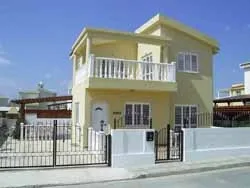
Cyprus property prices rising
As the price guide shows, the cost of houses and apartments in Cyprus continues to rise: in March inflation stood at 9.9% compared to March of the previous year, according to calculations by the BuySell Home Price Index (Cyprus). This indicator marked the sixth consecutive month of rising property prices in the “year-on-year” category. If the trend continues, by the end of 2007 property inflation will grow faster than it did by December 2006, when the BuySell Index recorded a figure of 6.6%. Compared to February 2007, property prices rose by 0.8% in March, and by 1.08% in April compared to March. The average price of a house in Cyprus in March was 94,373 Cypriot pounds (162,430 euros), in April – 95,394 Cypriot pounds (163,654 euros).
From guest to “visitor”
Citizens of third countries (which includes the republics of the former Soviet Union) who purchase property in Cyprus are entitled to obtain “visitor” status, which is renewed annually. According to the established scheme, the buyer first obtains a three-month visa (or a multiple-entry annual visa) at the Cypriot embassy. This type of visa allows you to stay on the island for three consecutive months within a six-month period, meaning that after 12 weeks of arrival you must leave the country. You can return no earlier than after the same period. In total, you can live in Cyprus for six months a year.
If that does not suit you, then you can obtain a temporary residence permit – as they say, nothing is more permanent than a temporary one! Upon arriving in Cyprus, go straight to the immigration service and submit the relevant application, attaching the necessary documents.
Primary among the attached documents is proof that you have a permanent source of income outside Cyprus. This requires a statement from one (or more) local banks showing the presence of a certain amount of money, as well as regular capital movements in that account. For one person, the annual amount must be at least 10,000 Cypriot pounds (15,000 for a married couple). If you have large accounts and property in your home country, do not hesitate to inform the Cypriot authorities – this fact will only have a positive impact on the processing of your application.
In addition, you will need medical insurance and a bank deposit (300 Cypriot pounds) – a guarantee in case you commit a crime and the authorities have to deport you.
That's all. Now you move from the “guest” category to “visitor” status. Soon you will receive your “pink slip” by mail – a renewable residence permit for six months or a year. The only thing that holders of “visitor” status are deprived of is the right to work. Also remember one important point: if you leave Cyprus for more than three months, the “pink slip” is canceled. You will have to reapply for an entry visa, then for a new residence permit. When there is one month left before the expiry of the temporary residence permit, you need to arrange its extension. Usually there are no problems.
Categories awaiting us
Well, the euphoria of moving into a new home and an unfamiliar country is already behind you. Extending the residence permit has become routine. You've long been accustomed to the name “pink slip”. This means you have reached the next stage of existence in Cyprus: you have become interested in how to turn a temporary permit into a permanent one.
And this task is easily solved. First, after seven years of successful residence in Cyprus, you have the opportunity to become a local citizen. There is one “but”: you will have the right to obtain a Cypriot passport – that is true. But only the right, and not a 100% guarantee of acquiring citizenship.
Now there is a new opportunity: after five years, you can obtain a European residence permit. You will have virtually the same rights as native residents, but remain a citizen of your own country. This residence permit must be renewed every five years.
Thus, the owner of property in Cyprus can live on the island long-term and without hassle:
* under the “visitor” category (local temporary residence permit);
* under the “permanent resident” category (European-wide temporary residence permit);
* by obtaining Cypriot citizenship;
* under Category F (local permanent residence permit).
And what is Category F? It is the most realistic opportunity to obtain a permanent residence permit in the country as soon as possible. There are a total of six categories under which foreigners permanently residing in Cyprus are classified. For property owners, Category F is the right one.
When applying for a residence permit under this category, a special stamp is placed in the applicant's foreign passport certifying the permanent residence permit. This stamp has no expiry date and is automatically renewed when the passport is replaced. For the holder of a permanent residence permit, it is enough to appear in Cyprus at least once every two years. Convenient? You bet!
Permanent residence permit for wealthy individuals
For some reason, there is a mistaken belief that only pensioners have a chance of success in this category. However, in reality, the main recipients of PR under category F are currently wealthy people who are by no means of retirement age. Incidentally, the pension of far from every country is recognized as a reliable source of income, especially if that country is not a member of the European Union. It should be noted that the Cypriot authorities interpret "guaranteed annual income" solely in terms of bank interest accrued on money deposited in a bank in Cyprus. The minimum amount that the main applicant must have in their account at a Cypriot bank should be about 200,000 Cypriot pounds. Moreover, the deposit does not necessarily have to be a term deposit, although this is preferable.
Category F is the only one under which PR is obtained for the entire family at once (the applicant, spouse, and children under 18). The mentioned amount is sufficient for two dependent family members, for example, a spouse and one child. If there are more children, additional capital is required – at least 50,000 pounds per child.
Holders of PR under category F are also not allowed to work in Cyprus. But this does not at all mean that one cannot be the owner of a company operating on the island. You can do whatever you want with your company, except one thing: you cannot hold any position in it and receive an official salary. However, dividends from profits are credited to your account as usual.
Waiting for the coveted stamp will take a little over a year, notes "Real Estate Digest". It should also be noted that a third-country national holding a Cypriot PR can enter and leave other countries only in compliance with visa requirements. Also, one should remember that one cannot stay outside Cyprus for more than two years.
The Charter of Civil Rights of Cyprus defines candidates for obtaining category F as follows: "Persons who have at their full disposal a guaranteed annual income sufficiently high to ensure a decent standard of living in Cyprus, while not needing business, commercial, or professional employment. The required annual income must be at least 3,800 Cypriot pounds for the main applicant and no less than 1,800 pounds for each dependent member of their family. The Immigration Control Commission may require additional amounts if it deems necessary."