
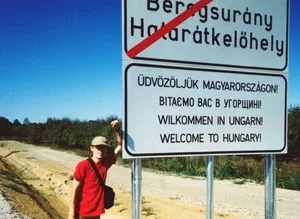
Hungarians have a special interest in their stomachs; like all Asians, they love to eat. However, the descendants of the warlike Ugric tribes no longer consider themselves Asians. They are drawn to Europe. Many associated the upcoming changes in the country with joining the European Union in 2004, primarily in economic terms, but already today this "connection" is causing indignation among some. And first of all, those who live on the border with Ukraine suffered. After all, in the autumn of 2003, Hungary introduced a visa regime, and for most Ukrainians, small business on the border lost all meaning.
Berehove (Beregszász in Hungarian) is a small Ukrainian town on the border. It is considered the informal center of the Hungarian community living in Transcarpathia (about 150 thousand people in total). Every second person knows Hungarian, and for every third it is their native language. All newspapers are published in Hungarian (the city one has a Ukrainian version), and signs are also in two languages. The forint is used in the market on par with the dollar and the hryvnia. And it is enough to look at the stickers on goods to understand that most products are brought from Hungary. In general, it is a kind of mini-Hungary on the territory of Ukraine.
Hungarians do not forget their compatriots living abroad. On the eve of national holidays, parliamentarians or journalists come here to ask how their brethren are doing. To be honest, these official visits lead to nothing; Hungarians in Ukraine live like all other citizens. True, there are some privileges. For example, a "Hungarian identity certificate for those living abroad" allows traveling around Hungary by train twice a year with a 90 percent discount, and museums can be visited completely free of charge. But do our "tourists" care about museums?
By bicycle across the border
Once a friend invited me to take a trip to Hungary. We got on our bicycles and went (the border near Berehove can be crossed on foot as well). Near the border there is a pile of garbage - mostly plastic bottles and empty cigarette packs. After all, almost everyone used to smuggle goods into Hungary before the visa regime was introduced.
Women, old and young, packed with cigarettes, stand near the border guard booth and whisper. There is fear in their eyes: will they let them through or not? Sometimes they have to stand there all day. They stuff cigarettes into stockings and wrap them around their bodies.
During the harvest season, people from all neighboring villages flocked to the border to earn money. They arrive on bicycles. They are mostly retirees, almost all of Hungarian nationality, but they were simply unlucky to find themselves on the territory of another country. Nevertheless, they believe they have every right to earn a little extra on their historical homeland.
But it turns out that the border fed the border areas on both sides. Our people offered their cheap labor, transported and sold some products in Hungary - for example, nuts and beans. That was all we could offer, apart from outright smuggling. Hungarian entrepreneurs managed to make a good fortune on the old women selling beans. It's safe to say that the magnificent cottages near the border were built mainly thanks to the old women who themselves earned no more than 5-10 hryvnias per trip. At the same time, many supermarkets were built in a short period, focusing mainly on Ukrainian consumers. From there, our people brought cheap margarine, pasta, spices, flour, and sweets. The Hungarians themselves refused to take the cheap, tasteless margarine that resembled window putty - it consists entirely of chemical ingredients. But for our market, the cheaper the product, the better. And it doesn't matter what's inside the beautiful plastic packaging.
In November 2003, the visa regime came into force. Now, to get a visa, you first need to stand in line (at the Hungarian consulate in Berehove they give out a ticket with a number), and then come back in about a month or two. For those whose trip abroad is "urgent", there is a paid service: those who have taken a place in line in advance will simply sell it to you. This business is most often done by Roma. They immediately realized: if there is a line, you can profit from it. They say the fees vary, but sometimes it can go up to $50. The visas themselves are completely free. But you need to fill out the forms in Hungarian. Here, too, you will quickly find an assistant who, for ten hryvnias, will fill everything out in no time, "right on the spot".
Apple symphony, Hungarian style
A friend and I went to Hungary to help his acquaintance harvest apples. This elderly woman is originally from Ukraine, has been living abroad for about ten years, and found herself an equally elderly Hungarian there. Pista bácsi loves Ukrainian vodka and smokes, like most of his fellow villagers, our "Pryluky" cigarettes. Pista has left the entire household (including the apple orchard) to his wife.
Magda néni curses both authorities: ours and the Hungarian one. She had suffered a lot on that side, and now she strongly sympathizes with her former compatriots. But it turned out that even in Hungary she could not escape poverty - at least by European standards. Therefore, she was always ready to accept our "smugglers" for a small fee. However, after several visits from the police and under the threat of a large fine, the woman gave up this business.
Now our people can only earn a little from her by picking apples. Harvesting is not difficult, even fun. Someone sings, someone tells jokes, everyone laughs, and the work goes by unnoticed. Ten people managed the orchard in a day. We were paid one and a half thousand forints per person (about 30 hryvnias). In addition, we were treated to a delicious lunch. For this, the hostess cooked a real bogrács goulash. And for dessert - cheap Hungarian beer, resembling carbonated water. In general, everyone was satisfied.
But the very next day, when we hired ourselves out to the first boss we came across, we were out of luck. First, we were left without lunch, given only an unwashed water tank so we wouldn't die of thirst. When the workday came to an end, the boss, a fat man, looked over the results of our labor and was displeased - saying we hadn't picked enough (even though we had agreed on even fewer crates). "Five more crates, and everything will be okay," he said. We could barely stay on our feet. But what could we do - maybe we had misunderstood something in the morning? And after an hour and a half, the owner's order was carried out. He started grumbling again. This time for a different reason: you see, the red apples had to be put in one crate, and the pink ones in another. Why didn't he say so right away? He thought we'd figure it out ourselves.
Honestly, we wanted to punch him in the face. But the matter could have turned out against us. They'd take us to the police, and then we'd have to explain who was right and who was wrong. Although, as we later learned, he had no right to hire us at all (we didn't have permission to work). We said we wouldn't redo anything else and demonstratively sat down on empty crates, waiting for payment. The man huffed and puffed, called us idlers, and finally took out his wallet, pulled out two thousand forints for the two of us: "I'm deducting a thousand for bad work." We were taken aback by such insolence. But there was nothing to be done; we took the money.
Five men and one woman
Unfortunately, in the search for earnings abroad, one most often has to forget about pride. Here is the story of 50-year-old Maria from Berehovo: "In our town, it is practically impossible to find a decent job, so I decided to try my luck in Hungary. Through acquaintances, I learned that there was a position at a pasta factory near Budapest, so I went there. It turned out to be a small private enterprise with only a few dozen employees, most of them from Ukraine. None of them had work permits, but that didn't bother the owner - he was apparently saving money by not paying taxes. Moreover, he paid such wages that Hungarians would not agree to slave away for that kind of money. But our people have nowhere to go."
We work 12 hours a day, from seven in the morning to seven in the evening, sometimes on weekends; the only exceptions are Hungarian national holidays.
Renting an apartment alone is an unaffordable luxury. So I live together with five men. And there are only two rooms - you have to make do. We pay the landlord 12,000 forints per person, even though our salary is about 70,000. For comparison, an ordinary school teacher earns at least 100,000 forints. The work is not difficult, but in the first weeks, from being unaccustomed to it, my back and legs ached terribly (after all, you have to stand all the time at the conveyor belt along which the pasta moves). In a few years, however, you can endure it and save up some money.
I tried to find other work in Budapest, but it turned out to be in vain. I even went to an employment agency, paid them 5,000 forints for their services, but none of the offered vacancies suited me or were already taken.
I also looked for a separate apartment. I responded to an ad, talked to the landlady, and was already ready to move in. But when the old Hungarian woman found out I was from Ukraine, she threw up her hands and refused: "No, that's out of the question; I will never rent a room to Ukrainians again." It turned out that our people had already been there, then left without paying for several months, and took some of her belongings with them.
Once a month I go home. The trip costs about five or six thousand forints. But the trips are necessary - I have to bring food products, which are much cheaper here: rice, buckwheat, sugar, candy, coffee. Sometimes Hungarian acquaintances order cigarettes.
So that's how I live - shuttling between two countries. And at home there's my daughter, who is studying at university, and I need to help her too. In the summer she wanted to come with me to earn some money during the holidays, but I was categorically against such a "vacation." Better let her study and not think about how to earn a piece of bread.
I live near Budapest, but I have no time to see it. In fact, my only wish is to rest and forget about work for at least a day or two. And I already dream about Hungarian pasta. If I had the chance to earn money back home, I would never have gone anywhere. A family can't survive on 200-300 hryvnias."
Marrying an adventurer
Once, Natasha worked as a nurse in a hospital. Seeing her suffering, her friends decided, as a joke, to place information about her in a newspaper of marriage ads. And a month later, a man from Hungary called Natasha, explaining that he wanted to meet immediately. Natasha first thought of refusing, but she went ahead and arranged the meeting. Why not, after all?
Jozsef rushed over in a brand-new Zhiguli car and was charmed by the Ukrainian woman at first sight. The presence of children did not bother him. After the first date, a second was arranged - this time on Hungarian territory.
Natasha hesitated whether it was worth recklessly changing her way of life and getting involved with a stranger. The Hungarian seemed somewhat strange, kind of erratic. Her girlfriends influenced her - don't miss your chance, or you'll be kicking yourself later. And although Natasha didn't have any particular feeling of love, they got married within half a year. True, it turned out to be a quite troublesome and expensive matter to obtain all the necessary documents for permanent residence. The certificates required were the most absurd; many were simply impossible to get without a bribe - all in all, it cost about a thousand dollars. But Jozsef covered all the expenses.
Natasha moved with her children to a small town a hundred kilometers from Budapest, into a private house in the middle of a huge vacant lot. And then her worst fears began to come true within just a few days of their life together. Her chosen one turned out to be a real adventurer. He would start any undertaking without thinking. Every idea, even the most absurd, he would immediately put into practice.
On his farm he grew champignons, investing almost all his money in this business. But a year later he abandoned the idea - it required too much expense and energy. Besides, he had to look for wholesale buyers. The next venture was chickens. A huge aviary was built for breeding poultry, and feed was purchased. But here too it was a fiasco - first hawks stole the chicks, then an unknown disease struck them down.
Yosif decided to go to work in Holland, because finding a job in the Hungarian hinterland was not so easy. Natasha was left alone in a foreign country, though her husband regularly sent money for living. Yosif worked in a car repair shop, sometimes even at night. In a year he saved about $10,000. With all that money he bought old equipment in Holland and transported it to Hungary. This time everything worked out, and he even managed to double the finances.
Natasha thought that their precarious financial situation had finally come to an end. But she was mistaken. Her husband managed to invest almost all the dollars in a new scam... The result was new scandals. Yosif was never at home; every day or two he would dash off in an unknown direction. Moreover, he did not establish contact with his stepsons either. Yosif left for Holland again, and Natasha for the first time considered divorce.
First of all, she needed to find a job in her profession. She had to re-validate her medical knowledge and translate her diploma. This cost 12,000 forints. She got a part-time job in a nursing home, work that was hard both physically and morally. She receives 50,000 forints, which is pitifully little by Hungarian standards.
The average salary of Hungarian public-sector employees is $250-300. Several years ago doctors staged protests against low salaries, as they earned on average $120-150. It got to the point where ambulance doctors started robbing their patients. After yet another major scandal, the government finally acknowledged that corruption flourishes due to low salaries and doubled them.
“Of course, it’s become easier now,” says Natasha. “But after paying for rent and food, almost nothing is left. So our bank account is empty. Honestly, I’ve often thought about returning to my homeland. But every time I visit my parents and see the squalor of their existence, I change my mind. And the children no longer want to return; they have friends here. Until the age of 18, social assistance is given for each child - four thousand forints. But what does that assistance mean if I pay twice as much for kindergarten? And there is no question of having our own housing.”
After living in Hungary for five years, Natasha received Hungarian citizenship. “It was nice when the mayor of our town personally congratulated me and my children on this occasion,” she says. “It’s just that at work they still treat me with prejudice. Sometimes they ask simply wild questions. For example, is it true that in Ukraine everyone, even children, are infected with radiation sickness, or that you can’t go out in the evening because of high crime. All these rumors are blown up by television.”
After the divorce, Yosif left Natasha a car and regularly pays alimony. He says he has become completely disillusioned with European women. And he went to work in Iran. There, he says, women never contradict their husbands, even incorrigible adventurers and failures...
Myths quickly dissipate
Many Hungarians are already disappointed with their country’s accession to the European Union, planned for 2004. They see that it brings no significant benefits. Wages have mostly remained the same, while prices steadily rise. “Over the past year, prices for electricity, gas, and utilities have been increased five times,” says our former compatriot. “Life here is quite difficult. The European Union has already shown itself fully. The French and Germans are the privileged class, Hungarians are the second, lower class. Only wealthy entrepreneurs benefit, while the middle class and the poor suffer. Their salaries are simply negligible compared to the millions earned by businessmen. For instance, I can only dream of my own house or apartment.”
One square meter of housing in Budapest costs from 80 to 150 thousand forints; in regional centers it averages 81 thousand; in district centers, 54 thousand. Plus the price of land, which will amount to half the cost of the house itself. And the average salary of a Hungarian is 55 thousand forints; in villages it’s half that. For utilities, you need to pay about 20 thousand monthly. The myth of Europe’s material well-being quickly dissipates among our emigrants in Hungary.
Ukrainians working in Hungary are mostly from Zakarpattia; many of them have known Hungarian since childhood. The majority of Transcarpathians do not intend to emigrate permanently; they go to build - some as craftsmen, some as apprentices - and then return after three or four months.
“It’s hard to say in a nutshell why I don’t want to live in Hungary,” says 25-year-old Shoni. “I’m Hungarian myself, but I’m used to our mentality, to Slavic openness and generosity. There is none of that there, no matter what anyone tells you. They won’t even treat you to a cup of coffee for no reason. I experienced all this myself. I was treated like a poor relative - they figured I’d come to beg. I had to work both on a construction site and in a factory. The entrepreneur happily took Ukrainians, because our team builds three houses while a Hungarian team builds one. That’s why they don’t like our people - they say you’re taking jobs away from Hungarians. But that’s not true. When I got tired of hiding from the police, who periodically showed up at the factory, I quit and left. At home I’ll earn three times less, but I’ll be next to my family, and no one here will call me a parasite or a bandit.”
And yet Hungary often helps enterprising people. Anton, a 30-year-old teacher of Ukrainian language, makes clay trinkets and sells them in Budapest. “It seems like a trifle, but in the West everything handmade is highly valued. That's why they buy from me wholesale at one small shop. And in a month they order the next batch. In one trip I can earn about $300. I couldn't even dream of such salaries in Ukraine. And the visa regime doesn't scare me, since I don't travel often.”
The work in Hungary turns out to be not sweet - with a taste of hot paprika, which Hungarians are used to adding to almost all dishes of their national cuisine. But our people, as we know, get used to everything.