
This city stubbornly resists the penetration of modern American culture. The Mississippi, on which New Orleans stands, was initially explored and claimed by the French, who also founded the city. Later, as a result of wars in the mid-18th century, New Orleans passed to the Spaniards. Then, for a short time, back to the French. All these reshuffles together produced a remarkable mixture. The French Quarter is the main attraction of New Orleans, which is built in the Spanish style.
After New York and Las Vegas, it is the third most visited city in the States. This, you know, says something, given its modest size. New Orleans became a magnet for those who like to relax, party, and live lavishly almost from the moment of its founding. Even under the French, people came here from all over the Mississippi. Under the Spaniards, of course, things were stricter, as is their wont. And after the Americans bought Louisiana from the French, the city fully upheld its reputation. And this is how it happened. The shrewd Americans, in business matters, bought New Orleans and a vast adjacent territory in 1803 from Napoleon, a complete novice in financial matters. Having promised Bonaparte $15 million for the territory that today houses 15 US states, the Americans drew up the purchase documents so cleverly that in the end France not only lost its overseas fiefdom for free, but also remained indebted to America by $900 thousand. To this day, the Louisiana Purchase is considered the most profitable real estate deal in human history.
Oh, jazz, more jazz, and much, much more jazz
What was unique to New Orleans was its open and free social atmosphere. People of different races and nations interacted with one another, creating a fusion of French, German, Spanish, Irish, and African traditions, including musical ones. Unsurprisingly, this cosmopolitan city became fertile ground for the growing jazz movement.
Moreover, New Orleans is also a port city where sailors seeking entertainment always gathered. This extremely strong demand for leisure was a necessary financial resource not only for legalized prostitution but also for entertainment music. Jazz was played right on the streets. Since there were many orchestras in the city, the ability to play loudly, 'drowning out' competitors, was considered a very important quality. The best (that is, the loudest) orchestras had the opportunity to earn other income besides occasional handouts from passersby.
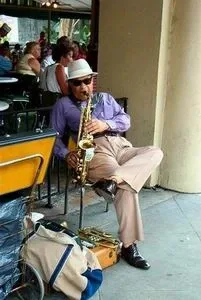
In New Orleans, there have always been a large number of private clubs, most of which sponsored or hired orchestras for various events - parties, dances, and Pole Dance - both indoors and outdoors, picnics, openings and anniversaries, birthdays. And even today, in many restaurants, cafes, bars, and simply on the streets of New Orleans, you can hear authentic, locally produced jazz. It is no wonder that Louis Armstrong was an honorary citizen of New Orleans. And, of course, the funeral processions of those times are the most famous - this tradition in the southern United States has survived to the present day. As a rule, the orchestra would line up in front of the church and lead a slow procession to the cemetery, playing solemn marches and mournful hymns. And as soon as the coffin was lowered into the grave, the tempo suddenly changed, and the mournful marches transformed into unrestrainedly
Cheerful music - ragtimes, polkas, lighthearted marches. This was justified roughly by the idea that the deceased's soul already had it hard enough, so why spoil its final journey with gloomy sounds? Such parades always attracted huge crowds, which, of course, was very important for popularizing the growing jazz. It was here that trumpeters and clarinetists demonstrated their inventiveness to the public, and drummers developed what would later become a rhythm revolution - swing.
The pure, superhuman energy of New Orleans is mixed with fragrant spices, melodious calls - and music. A city whose rhythm is set by the Mississippi River like a percussion section. It is here that world-famous jazz and blues festivals take place. Morning, afternoon, and evening - music. Non-stop music. You name it, they play it on Bourbon Street!
Fat Tuesday, or Show your tits!
In general, Bourbon Street is one of the most expensive and pretentious streets in the French Quarter. This is where the nightlife bubbles. It is home to a host of strip bars, pubs, and various establishments for every taste. The moon, as in the Sting song, can be seen over Bourbon Street, but rarely. For the street itself is quite narrow. And you won't spot any moon in the sky right away when everything around is flooded with light.
People move in a Brownian motion - and not just that, but with a drink in a plastic cup. Without stopping. This is not some sort of nightlife hub or even a human anthill; it is a nightlife conveyor belt, by American standards. The ground floor typically houses a shop, cafe, restaurant, bar, or pub. In small, cute shops you can buy everything: from Japanese fans and Italian masks, boas, to T-shirts and mugs with declarations of love for New Orleans or for all of America.
And also along Bourbon Street goes the procession of the carnival 'Mardi Gras'. It appeared in the city, like many other things, thanks to the French. They say it was first organized in 1827 by a group of students. The young people returned from Paris, where they had studied, and organized a costumed masquerade before Lent, just like the one they had seen there. And they named it the same as it was called in Paris - Mardi Gras, which in French means 'Fat Tuesday'. Officially, Mardi Gras begins on January 6, the day of Catholic Epiphany. Here and there, small celebrations, balls, and processions take place, and gradually, gaining momentum, these scattered little carnivals merge into a single boom. Here, Shrovetide turns into a true paradise for voyeurs.
To get the most precious "Mardi Gras" trophy - a coconut thrown from a parade float - you must at all costs attract the attention of the throwers. On Bourbon Street, it is customary to unbutton blouses and lift T-shirts for this purpose. And girls up to 57 years old really do undress if you throw beads at them. And shout: "Show your tits!" Beads and medallions with the image of Bacchus fly from the passing floats into the crowd, which invariably delights the spectators. Balconies of the French Quarter have been sold out for these days five years in advance. And hotel rooms are booked for "Mardi Gras" as early as August.
Local skeleton in the closet
A superstitious tourist is the ideal tourist. What other inquisitive mind so touchingly heeds the guide's words when it comes to ancient prophecies? Who selflessly performs insane rituals, bathes in ice baths, kisses the snout of a bronze pig, and carefully rubs the ears of a sacred donkey, or the back of a scarab beetle, or with trembling hands embraces the Shiva lingam? New Orleans has its own horror story. It is Voodoo. There is a large community of Haitians, and there is a cathedral where voodooists hold their religious services... Black people secretly practiced witchcraft in New Orleans ever since the first ships with slaves arrived there. There are stories of secret rites held deep in the river delta, in which a snake named Zombie was deified; there were dances, orgies, drunkenness. The recognized queen of Voodoo was Marie Laveau. She was so famous that the first thing visitors to New Orleans did was to pay a visit to Marie to have her cast spells for them. Apparently this woman was truly great, as people still constantly come to her grave. Travel agencies and private individuals alike actively sell Voodoo tours. For $20, they will take you to all the places associated with Voodoo, to haunted houses, and it will all end at the cemetery where Marie Laveau is buried. And be sure, when in New Orleans, to take a ride on the Mississippi on a real paddle steamer. Here, in a small restaurant, you can sample the oldest American cuisine. For example, take a risk and order the always-popular praline candies, seafood gumbo, or jambalaya, and all of it, of course, accompanied by a band.