
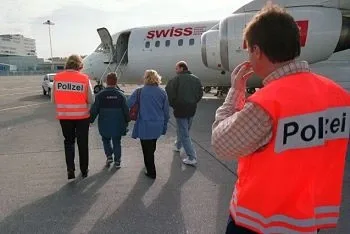
Swiss citizens will have to express their opinion once again on the issue of deporting foreigners who have broken the law.
At the end of February, Swiss citizens will, for the second time in recent years, express their opinion on the issue of deporting foreigners who have broken the law. Recall that in 2010, the Confederation's citizens approved by 52.3% of the votes a first SVP initiative called 'For the Expulsion of Foreign Criminals'. Now they are again asked to vote on almost the same topic (the new initiative's name includes the word 'effective', and a note in parentheses indicates that it concerns the entry into force of the first proposal). What are these complications about?
As noted by the publication 'Nasha Gazeta.ch', both chambers of the Confederation's parliament devoted more than one session to the issue of deporting foreigners who have committed crimes in Switzerland. This is because the bill developed on the basis of the first initiative did not please its authors, who two years later came up with a second text containing a complete list of offenses for which foreigners should be expelled from the country.
Thus, the question of whether to deport or not, by and large, has already been decided. However, the main stumbling block became the crimes for which one can lose a Swiss residence permit and be banned from entering the country for a period of 5 to 20 years. In addition, the already approved law includes a clause according to which the decision on deportation will be made taking into account the personal circumstances of foreigners born and raised in Switzerland.
In addition to murderers, robbers and other criminals, the SVP proposes to include in the list of candidates for deportation recipients of benefits who abuse the support of the Confederation's social insurance system, and in case of recurrence, deportation will also threaten the authors of slanderous disclosures, fights causing minor bodily harm, and witnesses who gave false testimony. Banks will also be expelled from the country for money laundering and some other violations of the Criminal Code and laws on foreigners and on combating drugs.
Recall that in March last year, the Swiss parliament, after lengthy debates, approved a law that the Swiss People's Party considered too lenient, threatening to again seek public support. The SVP kept its promise, and on February 28, Swiss citizens will have to 're-vote' on the deportation of foreign criminals. The entry into force of the version already approved by parliament was decided to be postponed until the referendum results are known.
According to estimates by the Federal Statistical Office (FSO), today about a thousand foreigners could be expelled from the country if the already adopted law is applied, or more than 2,000 people if the new SVP initiative comes into force. However, these figures concern only holders of residence permits of categories 'B' and 'C'. If short-term residence permits, documents for asylum seekers and other categories of foreigners are also taken into account, the ratio would be as follows: less than 4,000 deportations under the adopted law and more than 10,000 under the new SVP initiative. Moreover, candidates for expulsion in case of recurrence for less serious crimes would need to be added to the second figure (these data are not included in official statistics).
True, Socialist MP Cesla Amarelle noted in an interview with the Tribune de Genève that there is a big difference between the decision to expel a foreigner and its execution. 'There are countries that do not take back their nationals. If you want to deport a Moroccan or Algerian criminal but cannot obtain permission from the receiving country, it is impossible to expel them,' she said, emphasizing that the new SVP initiative does not solve this problem.
Nevertheless, judging by opinion poll results, the Swiss are ready to say 'yes' again to the deportation of foreign lawbreakers. Moreover, if at the end of last year 55% of the population were ready to vote for the new initiative (with 24.5% 'against' and 20.5% 'undecided'), then after the recent attacks on women in Cologne, in which migrants participated, 61% of Swiss intend to support tougher measures (with 36% 'no').
According to Confederation Justice Minister Simonetta Sommaruga, the automaticity advocated by the SVP and the fact of including less serious crimes in the list of offenses punishable by expulsion will lead to foreigners becoming second-class people in Switzerland. Almost all political parties opposed the new initiative, and the Council of States almost in full signed a joint declaration against the 'anti-democratic' text that 'risks overturning existing institutions'. Finally, law professor Hans-Ueli Vogt, himself a member of the SVP, recently spoke out against the automatic deportation of second-generation immigrants.
However, the final decision, as always, lies with the Swiss, who will have their say on February 28.