
According to a classic legend, the Japanese islands were formed when the god Izanagi descended from the heavens on a rainbow to separate the land from the waters. Drops fell from his heroic spear into the ocean, froze, and became a chain of islands. Picturesque, but incorrect. In reality, Izanagi dropped a heavily tangled ball of railways, which after careful untangling was supposed to become a network covering the entire planet. Izanagi sighed with relief and did not pick up the ball. Seaweed grew on it, stones stuck to it, and Japan came into being.
Any point in the country can be reached quickly and comfortably by train. The railways belong to many different companies, and often two points are connected by an unreasonably large number of lines from an ordinary point of view. Choosing which line and which train to take is practically impossible. Different speeds, different stops, different amenities in the cars, different prices, different schedules, different stations. In Tokyo, everything is further complicated by the fact that the railway network is intertwined with the subway network and monorail, and the hub transfer centers are some kind of cyclopean Sodoms and Gomorrahs with dozens of entrances, exits, passages, supermarkets, escalators, elevators, ticket halls.
There are as many types of trains as there are types of cars in Not-Japan. The fastest and most expensive are the Shinkansen with diverse exterior and interior design. The most advanced of them reach speeds of over 300 km/h. Having traveled by train practically all over Honshu, we never ended up in the same car. Sometimes it was an amphitheater with a glazed front section and the driver somewhere deep below, sometimes a spacious lounge with seats arranged in an arc facing the windows, sometimes the "Narita Express" connecting Tokyo with Narita International Airport and specially equipped for passengers with luggage, sometimes a double-decker super-fast luxury "Green Car", sometimes a cozy rural commuter train.
Local drivers, like all service people – taxi drivers, bus drivers, hotel employees, police officers, etc. – are in white gloves. Sitting once right behind the driver, through the glass we saw how he constantly said something into the microphone to someone invisible and far away – obviously, reporting to the dispatcher something like "30 seconds, flight normal" or "bridge over the Kanogawa River ahead". He makes precise gestures with his hand in a snow-white glove, pointing at the tunnel we are about to enter. No one sees this except us. He does it for himself. He admires himself.
Conductors are grown-up schoolboys in the same uniform, but one size larger. Ticket inspection happens in a way that could not happen in Not-Japan. Approaching a passenger, the conductor bows deeply and says a very long phrase. After punching the ticket, he bows and says another long phrase. Then he bows deeply and moves to the next one. This is repeated as many times as there are passengers in the car: fifty, so fifty, a hundred, so a hundred. We asked Shu what he says. In a double translation from Japanese to English and then to Russian, it sounds something like this:
- Good day, esteemed passenger! I allow myself an indiscretion. Would you be so kind as to show me your esteemed tickets, please, gozaimasu... Thank you, esteemed passenger! I committed an indiscretion. Have a pleasant journey, gozaimasu.
If there are three passengers in a row of three seats, he says all this to each of them. Well, fine, but what is gozaimasu?
- That cannot be translated, - Shu-san says shyly.
- Well, approximately...
- Well, it's such a word at the end, it doesn't mean anything specific, it just makes the whole phrase polite.
One more "gozaimasu": in a good restaurant, a waitress will always kneel at your table. This is not servility – it's just that it's uncomfortable for the customer to talk to her from below.
But the main sign of politeness is a bow. It is also an indicator of hierarchy. Two men meet on the street, naturally at a metro station. They look like businessmen. The young man bows three times at the waist, the older one only with his head (though low enough) and once. Everyone bows everywhere. You ask something of a passerby or a policeman, you rarely get a sensible answer (few people speak English), but they will give you bows – fervent, deep, and expressively sincere – enough for a week ahead. They even bow to the interlocutor on a mobile phone, and it's always immediately evident when someone is talking to a boss – they stand in a deeply bowed posture throughout the entire conversation.
The mobile phone is a special topic. The role it plays in local life is incomparable. Well, something like a second self. Schoolgirls turn it into a favorite doll, hanging it with costume jewelry, dressing it in special clothes, cases, hats. Concentrated young people stare at the screen for a long time, moving their lips. Praying? Once looking over the shoulder of a neighbor in the subway, I saw some endless table rapidly running across the display. Train schedule? Stock market report? Shu-san immerged into his mobile phone for any reason – to find out ticket prices, check the weather forecast.
Total surrealism – a Japanese crowd, swiftly rushing people, glued with their eyes or ears to their mobile phones.
It's hard to say what percentage of the adult population this is, but the vast majority of the Japanese people are, of course, children. More precisely, schoolchildren. They are arranged in such a way that you cannot meet one or two schoolchildren. Even in a small group, there are never fewer than a thousand of them. The Japanese manner of dressing everyone in uniform is well known. Boys are dressed in black uniforms reminiscent of conductors' uniforms with an inevitable cap on their heads. There is no place in the country that is protected from the possibility of a sudden and ruthless occupation by countless noisy hordes of little "conductors."
However, it will be more appropriate to focus not on schoolboys, but on schoolgirls. There are immeasurably more of them in clusters.
If Alfred Hitchcock lived in Japan, then of course his main horror film would be called not 'The Birds' but 'Schoolgirls'. Replacing the flocks of black crows that fill all the space of life in Hitchcock with the same flocks of predatory schoolgirls, we get a surreal and accurate image of today's Japan. Schoolgirls throughout the country wear black sailor suits with miniskirts and knee-high socks. It would be much more explicable if, on the contrary, sailors who spend long periods where there isn't a single schoolgirl for thousands of miles, drank rum out of boredom and dressed up in girls' dresses. Grandpa Freud would at least understand and forgive them. But in Japan, probably even Freud is not like ours.
And, yes, one more thing about schoolgirls (sorry). Of course, I don't want to say anything bad about them. In luxury boutiques on Ginza, we noticed young girls trying on and buying super expensive outfits. However, the buyers did not give the impression of being millionairesses. We asked Shu where these former schoolgirls got such money. Without a second's hesitation, Shu-san blurted out a phrase that he had apparently long suffered over, precise though unprovable: 'Credit card – bankrupt – they'll forgive'.
Generals are the second most numerous group of people in Japan (the first are schoolchildren, of course). Or at least, people in generals' uniforms. They are everywhere. They stand guard, protect, decorate, remind, watch, thank, meet, accompany, embody, answer, warn, observe. Generals in luxurious uniforms with aiguillettes, patches, and shiny helmets stand on all four corners of a fence inside which asphalt is being repaired. The same generals decorate the fence of a construction site. Who are they? They are merely construction site security guards.
What is this? Longing for all-powerful shoguns, memory of samurai glory? A luxurious masculine general presides over a paid bicycle parking lot. He bows to everyone. And to the bicycles too. A brilliant admiral in a high white cap picks up incorrectly fallen coins in a temple and throws them in the correct direction. Need it be said that he is in snow-white gloves? We meet a group of tourists in the mountains. The guide is, of course, a general. But (oh, the Japanese passion for harmony!) he is in camouflage.
Severe generals are stationed at subway stations. You can ask them how to get out. They don't know the language, but if you clearly pronounce the name and say where you need to go, they leave their post and accompany you all the way to the place you carelessly mentioned. Getting rid of them earlier is a waste of time: they bow and fulfill their duty to the end.
Perfectionism in everything is very Japanese. A waitress in a restaurant, setting dishes on the table, accidentally touches with the sleeve of her kimono the chopsticks placed at a certain angle. She blushes deeply, bows convincingly, and for a long time carefully restores harmony, trying to exactly recreate that divine elegance and refinement with which they, as if carelessly, as if by accident, as if inadvertently, lay on the wooden rest, those poor chopsticks.
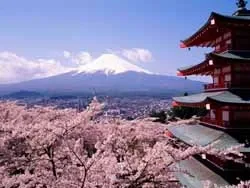
Popular postcards with a view of the snow-white peak of Fuji against a bright blue sky with a cherry blossom branch in the foreground are also truth, but not the one. The real truth is Fuji in the mist. It is no coincidence that in Hokusai's famous series 'Thirty-six Views of Mount Fuji', it is often barely visible through the mist. We were lucky: we go to Fuji on a foggy day. The weather constantly changes. Fuji appears and disappears. Sometimes the foot is visible, and the peak is dissolved in a cloud; sometimes, on the contrary, the peak floats surrounded by continuous white foam, and the base is completely absent. It looks most majestic from Lake Ashi. The most thrilling impression is flying through the fog in a cable car.
Fragments of landscape, momentarily flaring up in the midst of emptiness, trees, buildings, people, horses – nothing has a solid foundation, everything floats in the space of mist, as if painted with a brush on a white background. Perhaps this is the source of Japanese painting with its understatement, blurred contours, floating surrounded by a large clean surface of paper or silk? Is this not the source of the art of calligraphy, where a large empty background means no less than the character? Is this not the source of the magic of Japanese poetry, where the silence around a three-line poem means no less than the verse itself. 'Before you begin to write, look at how beautiful the blank sheet of paper is,' says the proverb.
Izu is a peninsula southwest of Tokyo, where people usually go for weekends or short vacations. To hike in the mountains, soak in hot mineral springs, or sunbathe on the beaches. The train runs along the coast. On one side are mountains, on the other the Pacific Ocean. Cozy towns sliding down from the mountains to the water. The long-forgotten clatter of wheels makes the landscapes outside the window achingly familiar. Gelendzhik? Sochi? Gagra? The mountain looks just like Ayu-Dag near Gurzuf. Platforms... Grandmothers with fried chickens, cucumbers in jars, gnarled apples hurry to the train. I imagined it...
The first stop is Inatori, an onsen – a hot spring. We leave our luggage simply in a booth at the station's general-cashier. On the shore, there are two large stone-lined baths – male and female. However, these are not so much baths as small pools. They are separated from each other and from the shore but open to the ocean. They are filled with running (very hot) mineral water. You need to undress completely, sit in the water, and look at the ocean and rocks. Then you can rest in a house and also look at the ocean, sliding open the shoji.
We enter the house. An attendant throws herself at our feet in a goalkeeper's dive. What is it? It turns out we stepped on the tatami without taking off our slippers. Non-Japanese savages, gozaimasu...
Kawazu - Seven Waterfalls in the Izu Mountains. We are staying in a ryokan, a small family-run village inn, simply a house with three or four rooms for rent. The room has nothing but tatami and a table as tall as a glass. We sleep on tatami, having laid out mattresses pulled from the wall. We constantly think about slippers. Here it's even more complicated: one pair for corridors, another for the toilet, and barefoot in the room. The house is empty, but if you make a mistake with footwear, the hostess will politely jump out at you.
In Kawazu, one should also sit in hot water, hike in the mountains, and admire the waterfalls. That's exactly how Yasunari Kawabata, Japan's first Nobel Prize laureate in literature, behaved here at the dawn of the 20th century. It was here, as a student in a cap, that he met a wandering dancer in a kimono and spent innocent holidays with her, about which he wrote the autobiographical story 'The Dancing Girl of Izu', known in Japan roughly like 'The Lady with the Dog' in Russia. A sculptural group depicting both heroes of the story stands at the start of the waterfall route.
When, with your tongue hanging out, you crawl to the upper waterfall somewhere in the sky, you again see the same stone couple, but this time sitting, of course. We sit down too. But no such luck. A flock of predatory schoolgirls swoops in and starts taking turns having their photos taken on Yasunari Kawabata's lap. We ask Shu how the story ended. He is extremely surprised. In Japan, stories never end: he went back to school in his cap, and she went on to dance.
Another village is simply a fishing village, not for tourists. It's Suzaki, near the city of Shimoda on the southern tip of Izu. High rocky shores of black color. Islands, islets and just rocks in the water. On the cliffs, gnarled pines resembling a large bonsai. In the water, crabs; above the paths in the rocks, giant webs with plump spiders. The roar of the ocean.
We are staying in a ryokan again. No men are seen anywhere. Probably, they are all at sea. The hostess, a small, thin woman, between 40 and 80. She brings food on trays that look more like desk drawers. She talks a lot and fast. We try to explain that we don't understand. She can't fathom how one cannot understand simple human speech. We stop resisting. Then, at every meeting, she delivers long monologues. Judging by her facial expression and gestures, on various topics. Maybe she is saying that this summer has been cold, there was little fish and shrimp, and her husband and son hardly came ashore. Or maybe that if it's cold at night, she can bring extra blankets, but we need to tell her in advance. Or maybe that she will change the yukata (home kimono) daily, even if we never put it on.
Japanese find foreign languages difficult. The phonetic difference is too great. They themselves poke fun at this weakness. They gladly tell this story: Former Prime Minister Yoshiro Mori particularly struggled with English; he couldn't even say hello. Clinton took it upon himself to fix this. He taught him to say 'How are you!' and in response 'I am fine.' Everything's fine, so to speak, to which one can reply 'Me too' (meaning 'and I', 'me too'). In the morning they meet, Mori wants to say 'How are you', but it comes out as 'Who are you'. Clinton says 'I am Hillary husband', to which Mori, to the laughter of those present, announces: 'Me too'.
We spend the last evening in Nara. Sunset from the veranda of Kasuga-taisha shrine. The shrine, as is usual, is on a mountain. Just like painters, Japanese architects value the surroundings no less than the object itself. The significance and beauty of the shrine are emphasized by the environment, the background that frames it. It is impossible to imagine a Shinto shrine squeezed into urban or rural development. The pause, silence, sea of greenery on which the shrine floats play the same role as the white paper surrounding a character.
From the veranda, far below you can see the city, beyond it mountain silhouettes in several layers. The sun will set behind these undulating lines of varying transparency. A group of TV crew has settled nearby. The sun turns crimson. Filming begins. The commentator is quietly saying something. On the wooden veranda, the heels of sunset lovers tap. Observing nature in Japan is one of the most respectable activities. Filming can no longer be done—the old wooden floor shakes and extraneous noise is heard. Filming stops. The TV crew bow to the disturbers of the peace. 'Go ahead, and we'll continue,' gozaimasu. The latter stop and bow back. The sun relentlessly moves toward the horizon. Filming resumes. But the next group's heels tap. The ritual of bows and mutual waiting repeats.
It doesn't occur to anyone to block the passage and redirect people another way. This sunset belongs to everyone and no one. It disappears behind the mountains. Now the sunset is probably being admired by sailors and fishermen in the Sea of Japan. We, the TV crew, and everyone else cannot tear ourselves away from the line of mountains against the sky, which is becoming dark lilac. The sunset has now likely also reached the Russian shores of the Sea of Japan. For some reason it seemed that there, on the coastal rocks, sits Zhanna Bichevskaya with a guitar: 'There is nowhere left to retreat, behind us is the Sea of Japan, here our Russia ends and we...'