
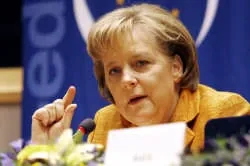
The results of the study greatly surprised German Federal Chancellor Angela Merkel
Chairman of the Turkish Community in Germany Kenan Kolat called the result of the recently published study 'Unused Potentials' a 'catastrophe.' Professor of Islamic studies Bekir Alboga called it a 'scandalous testimony to a failed integration policy.' As 'Russkaya Germaniya' writes, the 'catastrophic' and 'scandalous' nature of what happened is obvious from the perspective of the stereotypes that existed before.
First, based on deeply scientific criteria, twenty in number, they managed to prove that representatives of the Turkish diaspora lag far behind other migrants permanently residing in Germany in terms of integration, assimilation, adaptation – whatever you call merging with the native society. Second, it turns out that ethnic German resettlers from the successor states of the Soviet Union are head and shoulders above other foreigners (with the exception of EU citizens) in this very integration. Completely refuting previous data about the asociality and illiteracy of 'Aussiedlers.'
30% of the Turkish population of the Federal Republic have no school education document. And we are talking here about a third of the entire diaspora, not just about the elderly who came from villages in Eastern Anatolia half a century ago to boost Germany's economy. Unemployment among Turks is more than double the German average, the quota of non-working women is eight times higher. 93% of marriages are within the diaspora.
Completely different figures characterize the resettlers: only 3% did not finish school, 28% have higher education diplomas, only 20% of women choose a 'career' as housewives (like native residents of EU countries), practically all children without exception attend school, and girls twice as often as boys attend gymnasiums. 'People from the Soviet Union come to us already having a good education and raise their children to instill a desire to learn. This is the key to successful adaptation in society and on the German labor market,' says the head of the study, Rainer Klingholz. Moreover, the sociologist emphasizes, the resettlers show an 'increased readiness for integration.' An example of this, in particular, is the prevalence of marriages with native residents: second-generation Aussiedlers enter into such 'mixed' unions in 67% of cases.
Quite recently, in November 2008, the federal chancellor and the government commissioner for migration declared an 'almost complete' success of the National Integration Plan. Today they are not stepping far from their previous statements, leaving the component 'almost' as the main one. 'Almost a revelation' was how Maria Böhmer called the conclusion of scientists from the Berlin Institute that 'migrants in Germany are generally less educated than the native population, more often have no jobs, and practically do not participate in the country's public life.' 'We all experienced almost a shock,' admits Angela Merkel, but immediately calls to treat the negative information as a 'stimulus for the development of integration programs.' 'We cherish every resident of the country,' emphasizes the head of government. 'We cannot afford to ignore any present or future talent.'
Government attention, of course, is valuable. However, it is important that, as Rainer Klingholz states, a significant part of foreigners 'actively and consciously resist integration, and even the most expensive government programs will hardly help here.' In addition to 2.81 million Turks, half of whom were born in Germany, the sociologist includes immigrants from African and Middle Eastern countries and citizens of the former Yugoslavia among such 'fighters for self-determination.' Professor Bekir Alboga explains this phenomenon as follows: 'Representatives of these diasporas, due to national and religious traditions, have a strongly pronounced so-called illusion of return. They can live far from their homeland for generations and continue to subconsciously believe that someday they will definitely go back. They do not see the need for integration and create parallel worlds.'
The last statement should, in theory, truly frighten politicians who keep talking about the 'almost success' of the National Integration Plan and stubbornly ignore the obvious – that if people do not want to live in society, then they will not do so, no matter how much you invest in integration courses.
But for the resettlers, everything is fine. At least according to statistics, whose authors apparently have not encountered in real life the parallel worlds of Russian-speaking Berlin or Düsseldorf districts. However, 'Unused Potentials' is only the first study that included emigrants from the former USSR in migration statistics, and in the future it may become more differentiated. But already now sociologists are forced to admit: the 'Russian' diaspora with its four million people is currently the largest in Germany.