
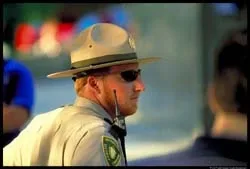
The administration asserts that last year more than a million illegal immigrants were detained at the borders of the United States. Another more than 600,000 illegal immigrants were detained in American port cities as they came off ships. Nevertheless, more than a million people annually manage to enter the United States illegally, mainly through the poorly guarded U.S.-Mexican border, which is 3,000 kilometers long.
At recent Senate hearings, U.S. Secretary of Homeland Security Michael Chertoff told American lawmakers that the situation with illegal immigration is intolerable, especially given the current threat of international terrorism: "The ability to enter our country without proper documents and permits poses a clear security threat. Constant border violations undermine the rule of law, security, and the economy of our border communities. If we do not secure the borders, we also risk the appearance of terrorists and criminals threatening our lives."
President Bush proposed increasing the number of border patrol agents and improving border security with electronic surveillance. In addition, the president decided to press American lawmakers to create a special program that would allow employers to temporarily hire foreign specialists abroad, who would be given a work entry visa for a three-year term. At the same time, employers are not entitled to fill jobs with foreigners if there are applicants among American citizens. Employers will also be required to check that the workers they hire have a temporary entry visa.
The planned procedure for hiring temporary workers is intended to enable American authorities to check incoming foreigners for any past ties to criminal or terrorist activities. The possibility of obtaining a temporary work visa should reduce the urge to illegally enter the United States. "As for the economic factors causing immigration, we can satisfy employers' need for workers by providing legal channels for hiring foreigners and strengthening border security to ensure our country's safety," said U.S. Secretary of Labor Elaine Chao, who spoke at the Senate hearings.
Regarding illegal immigrants already in the United States, the Bush administration proposes retroactively legalizing their status by granting temporary worker visas, but only after they pay a fine for past illegal entry into the country.
The bill proposed by Arizona Senator John McCain and Massachusetts Senator Edward Kennedy largely coincides with the Bush administration's proposal. However, another bill, also introduced in the Senate, allows the granting of temporary work visas only to those who enter the United States from their own country, but not to those who have already illegally entered the United States.
The McCain-Kennedy bill is supported by most American business organizations. "We currently have a labor shortage, and it will only grow as a result of economic growth on the one hand and a decrease in the number of Americans of working age on the other, as well as an increase in the number of retirees," says Tom Donohue, president of the U.S. Chamber of Commerce. "And this problem cannot be solved if we do not facilitate the entry of foreign workers into the United States."
Mark Krikorian, who heads the Washington-based Center for Immigration Studies, strongly disagrees, arguing that both legal and illegal immigration to the United States should be reduced: "Why do we need masses of uneducated, unskilled immigrants? Those who think we need them are effectively saying that our society of 300 million and our economy, stretching from the East Coast to the West Coast and occupying almost all of North America, cannot function properly without these foreigners who have not received a proper school education. But I consider this to be utterly senseless."
However, the most controversial part of the proposals by Senators McCain and Kennedy, as well as the Bush administration, is the legalization of the status of illegal immigrants already in the United States by granting them temporary work visas retroactively. Opponents of such a measure say it would effectively justify illegal actions committed in the past and amount to a kind of amnesty. That is precisely the view of Oklahoma Senator Tom Coburn: "I assure you that for the residents of my state, granting amnesty to illegal immigrants is unacceptable. If we start granting amnesty to such people, they will cross our borders illegally with even greater zeal."
But Labor Secretary Elaine Chao believes these fears are unfounded, as temporary workers will not gain any advantages when they apply for permanent residence in the United States. She notes that the U.S. administration's plan does not provide for amnesty for illegal immigrants at all.
Senator John McCain, whose state of Arizona borders the U.S.-Mexican border, reminded his colleagues that there can be no easy solution to the immigration problem. He argued that creating a grandiose border security system is impractical and ineffective. Moreover, it is simply impossible to catch and deport millions of illegal immigrants from the country. "But something must be done about illegal immigration," McCain said, "and creating work entry visas makes sense. If there is a demand for labor and we do not legalize and regulate its hiring, we will only increase the problem of illegal immigration, no matter how we strengthen border security."
Even the biggest supporters of the "guest worker" program admit that it can be successfully implemented only in cooperation with Mexico and other Latin American countries. But it must be taken into account that remittances sent home by Latin Americans working in the United States constitute the largest source of foreign currency received by the poorest states of Latin America. And representatives of the Bush administration are well aware that some Latin American countries may not want to cooperate with Washington in reducing immigration flows to the United States.
Be that as it may, the bill that will be prepared on the basis of proposals from the American administration and legislators must be approved by both houses of the United States Congress and then signed by President Bush. Only after that will it become law. But, as experts on American lawmaking believe, this entire procedure is unlikely to be completed before next year.
Michael BOWMAN.
"Voice of America"