
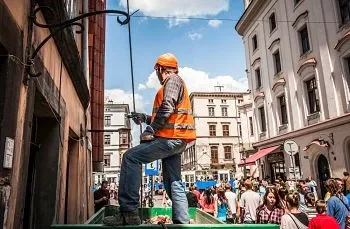
The Polish labour market suffers from a shortage of unskilled labour
The Ministry of Family, Labour and Social Policy of Poland plans to abandon, from January 2017, the declarations on entrusting work in favour of seasonal and short-term work permits. This will be done to combat widespread violations, including the illegal sale to foreigners of declarations on entrusting work, which facilitate entry into the country and under which no one subsequently works.
The planned changes in the employment of foreigners were commented on for Polskie Radio by Magdalena Swiekley, deputy director of the labour market department at the Ministry of Family, Labour and Social Policy, Cezary Kaźmierczak, a representative of the Union of Entrepreneurs and Employers, and Tomasz Dudek of the Otto Employment Agency.
Magdalena Swiekley, deputy director of the labour market department at the Ministry of Family, Labour and Social Policy of Poland, notes problems in the system of applications for employment of a foreigner, which they plan to abandon:
– Despite the fact that this mechanism was introduced to help employers, there are widespread abuses in this matter. Many companies simply trade these declarations to facilitate foreigners' entry into the country. Therefore, in order for employers to be able to hire foreigners in the future and at the same time to reduce the number of abuses, the mechanism for issuing permits will be complicated. A system of more thorough verification of what happens to a foreigner after entering the country under a declaration on entrusting work will also be launched. The employer will be required to report that the employee has started fulfilling his obligations. We also want to minimize the number of situations where employers register declarations when they have no right to employment at all.
The aim of the planned changes is an attempt to balance the labour market between Poles and foreigners, as well as to facilitate the employment of foreigners for those enterprises that have proven themselves as law-abiding employers, notes Magdalena Swiekley:
– In this way, we also want to stop the process of pushing Polish workers out of the domestic labour market by replacing them with cheaper employees from other countries, who have no idea what level of remuneration they could expect in Poland and therefore agree to heavily underpaid wages compared to Polish rates.
And yet, the main goal of the planned changes is to maintain a balance, on the one hand, between limiting abuses and monitoring the employment of foreigners, and on the other hand, simplifying procedures for those employers who already use services of employees from other countries, who do it legally, so that they can continue to legally hire foreign workers. For example, long-term permits are envisaged, which will be checked only once every three years. Of course, there will be some complications, but they will concern, first of all, those enterprises that abuse the issuance of declarations on entrusting work to foreign citizens.
Cezary Kaźmierczak from the Union of Entrepreneurs and Employers gives his assessment of the current situation on the labour market:
– Poland suffers from a shortage of unskilled labour. Poles simply do not want to do this. Thanks to a fortunate coincidence, Ukrainians are ready to take it on. Most of the declarations issued concern work permits for the position of farm helper. Currently, this is half a million people. Without this, Poland's agricultural sector would simply be unable to function. Poles do not want to work in this sector. I think it is a matter of relative prosperity of the state. Just as in wealthy Western countries, Polish citizens are beginning to refuse heavy physical labour, and over time the list of professions that Poles do not want to do will only expand.
Tomasz Dudek from the Otto Employment Agency says that the planned changes may negatively affect the Polish labour market in the future:
– Of course, abuses in the labour market of foreigners do occur, the practice of paid declarations for the employment of Ukrainians in Poland is quite common. It seems to me that such negative phenomena can be partially curbed. In turn, I fear that our market, as many studies say, will need 5 million able-bodied workers by 2030 and we need to figure out where to get them. According to statistics, last year we issued over 700,000 declarations for employment. The regime in which this is done is quite simple, thanks to which we can flexibly respond to the demand for labour and quickly find the right employees. I am afraid that with the introduction of the planned changes, this system will lose its flexibility.