
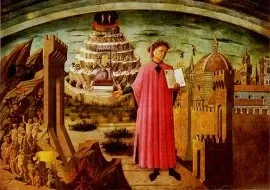
Dante Alighieri with his 'Divine Comedy'
"The Divine Comedy" is the fruit of the titanic labor of the entire second half of the poet's life. It is not for nothing that the poem begins with these very lines: "Nel mezzo del cammin di nostra vita..." (in translation from Italian into Russian – "Having passed half of my earthly life...")
The author's labor is truly unparalleled. Take for example the fact that the "Comedy" is built on the principle of symmetry. It consists of three parts ("Inferno", "Purgatorio", "Paradiso"), each of which, in turn, consists of 33 cantos. Together with the introductory canto, the total number of cantos comes to one hundred.
The poet's inclination to operate with numbers, in particular the number "three", is connected with the fact that Dante gave his work a mystical meaning. And the "three" suggested to the deeply religious reader of that era the Holy Trinity, while the number "33" referred to the earthly years of Christ's life. The "triplicity" of the poem is also embodied in its verse structure – the "Comedy" is written in terza rima – three-line stanzas with interlocking rhymes.
It is also noteworthy that at the end of each part Dante places the word "stelle", that is, in translation from Italian – "stars".
Undoubtedly, "The Divine Comedy" is the greatest example of world art, fully revealing to us a cross-section of European history, feudal society at the turn of the Early Renaissance – "Quattrocento".
The work has survived centuries, undergone many publications and translations. Famous painters and graphic artists took on illustrating the "Comedy", the most famous of which are the engravings of Gustave Doré.
Attempts at translation from Italian into Russian were made repeatedly: translations by A. Fyodorov in 1892-1894; D. Minaev (1874-1876); later ones (early 20th century) by O. Chyumina, D. Min, and N. Golovanov. But the most famous and recognized translation of Dante's "Divine Comedy" from Italian into Russian is the translation by Sergei Mikhailovich Lozinsky, for which he was awarded the State Stalin Prize in 1946.
The difficulty of translating the poem from Italian into Russian lay in the fact that, despite the strict rules of versification and the syllabic structure of Italian poetry, the work "breathes" with living speech. It abounds in folk dialects, the living language of the streets and squares of Florence.
The most recent translation from Italian into Russian of the "Divine Comedy" was carried out by Alexander Anatolyevich Ilyushin, published in 1995 by Moscow University Press. The new translation of this great work was highly appreciated in the poet's homeland, in Florence: the translator was awarded the honorary gold medal of the city. Unfortunately, in Russia the publication did not receive such resonance and an evaluation worthy of the work's level.
Prepared by the Translation Bureau "Prima Vista"