
Cadaqués
Even tiny Figueres was too spacious for his split consciousness. He fled from people to Cadaqués - a fishing village hidden among the wild rocks of the Costa Brava. And it was from there, from Cadaqués, that the artist Salvador Dalí emerged - a Surrealist, a shaker of foundations, a fierce hater of banality and ordinariness, which threatened him with belonging to the most terrible world - the world of ordinary people. People who could mistake him for his brother...
In Cadaqués, Gala appeared, without whom the phantasmagoria called Dalí's life would most likely not have come to be. She was 35, the wife of Paul Éluard and mother of Cécile. Salvador was 25, a virgin, and had a panic fear of any touch of another human body. This curse would remain with him for his entire life. Gala became the exception - she broke the spell for herself. From then on they never parted.
Figueres
When Gala appeared in Cadaqués, his father cursed Salvador. The son overcame that curse 30 years later, returning to Figueres a famous man. In 1961, he bought the building of the city's municipal theatre, which he remembered from childhood. The theatre, built in the 19th century and burned down during the Civil War, stood next to the church of Sant Pere, in which the infant Salvador had once been baptized. Or rather, both infant Salvadors.
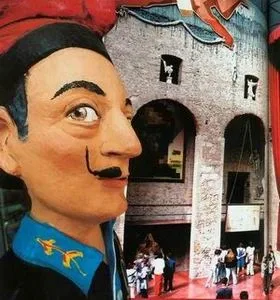
Dalí often said, "All life is a theatre," and in Figueres he created the theatre of his life. In the ruined building, the artist arranged a grand, unprecedented museum. There rose the Tower of Galatea and a huge glass dome, bright pink walls with neat rows of bread rolls appeared, which unsophisticated viewers look at in bewilderment. And above the roof, decorated with golden statues and huge eggs symbolizing life, the spire of Sant Pere is visible.
The Theatre-Museum became the artist's greatest work. In 1974, the first visitors entered - ordinary outsiders, whom Dalí feared so panically. Now the Dalí Theatre-Museum is considered the largest Surrealist object in the world, and the queue to it does not run dry even in winter.
The Theatre-Museum affects visitors in different ways: it embarrasses, surprises, amuses, makes one laugh, enchants, or frightens. Some take it seriously, as a collection of Surrealist masterpieces. Others see only a collection of phantoms of a sick imagination. Still others perceive the exhibits as funny trinkets and jokes. And no wonder: there, water pours from an upturned boat, a dead woman sits in a real Cadillac, giants hang with their heels down from the ceiling of the "Palace of the Winds", Venus is wrapped in rags, and Beethoven is drawn with octopus ink. Only children invariably remain delighted: everything here continuously changes, flows from form to form, from colour to colour, and a sofa turns out to be lips, and Gala looking at the sea turns into President Lincoln.
Dalí insisted that visitors be told nothing. And who, besides him, could explain the images he created? Some see in the meticulously painted decaying flesh a disgusting "dismemberment", while others see an image of the wholeness of the world and the wholeness of time, where all sins already carry atonement, newborns carry death, and the dying carry new life. It is no accident that there are so many clocks, hands, melting dials, eggs, and fried eggs in Dalí's paintings: his time does not move; it contains simultaneously the present, the past, and the future, life in death and death in life.
Theatre
In the theatre building, the artist spent the last years of his life. The living rooms are also open for inspection. Their furnishings go beyond a joke, a grim prank, or divine revelations. A Surrealist object could not be the home of an ordinary person; it could only be the home of Salvador Dalí. A bed adorned with horse skulls. A chandelier made of mangled aluminium forks. A Renaissance painting slashed with a table knife. A reproduction of the "Madonna" with a moustache drawn on it. This is no longer shock value, but the essence of the man who inhabited these rooms. Sensitive people feel bad there.
He spent the last five years almost never leaving his room in the Tower of Galatea. He died there in 1989. According to his will, he was buried in the Theatre-Museum, in the hall under the glass dome. Not only was his whole life a theatre, but he also made his death a theatre.
Port Lligat
They say Dalí would not have become Dalí if not for Gala. She pulled him out of Cadaqués, found him clients and placed his paintings, held his hand when he was afraid, appeared at balls in monstrous outfits he had made, provoked scandals around his name, created the Dalí Club and arranged his exhibitions. She not only tolerated his wild antics but encouraged them, supporting the rumour of a talented madman.
She was a woman made for Salvador - neither a wanton, nor an angel, nor a greedy philistine, nor a faithful muse. She felt more maternal feelings for Salvador than for her daughter Cécile. In this family, the child was Salvador, and that was why they had no children. He called her "my olive" and painted endlessly - Galarina, Leda, Galatea, Angel, bows on grey curls, sailor blouses on elderly shoulders.
Gala's real name was Elena Dyakonova. She was born in 1893 in the city of Kazan, in a joyless family with no father and six children. At 15, she fell ill with tuberculosis, and was sent to Switzerland. In a sanatorium, she met Paul Éluard, later went to Paris and married him. She invented the name Galarina for herself, sewed an emerald-green wedding dress, gave birth to a daughter and entrusted her to the care of Paul's parents.
She tried to make Paul rich and famous, then took up with Max Ernst. And then a rumour reached Paris about a brilliant Catalan artist, the recluse Dalí. Gala gathered a bohemian company and dragged it to rest in Cadaqués. From Cadaqués she returned together with Salvador. It does not matter what it was - mad love or clear-headed calculation. What difference does it make?
Dali could not live in Paris. There were too many people. He had been so frightened that even Cadaques became too big for him. In a small bay near the village of Port Lligat, six kilometers from Cadaques, he and Gala bought a shed where two brothers kept their fishing nets. They sailed there by boat because there was no road. In one corner of the shed he set up a workshop, in another he built a bed.
Probably, they were happy in their shack. Having grown rich in America, they returned to Port Lligat, bought two fishermen's huts on the very seashore and made of them a house resembling a labyrinth. They built it over many years, lived in it, filled it with the warmth and torment of their love. Now it is also a museum - the most human of all Dali museums. His workshop, library, garden with gnarled olive trees. Fresh wind bursts through the open windows, colored shadows run across the white walls, and the morning sun rays illuminate easels with unfinished paintings. Everything here is made by Dali's hands - from the entrance with bleached bones to the sculpture "The Messiah of Mackerels" in the middle of the garden.
The Muse's Castle
Neither in the Theatre-Museum nor in the House-Museum in Port Lligat is Gala's presence felt. She, with her life and passions, is all housed under the roof of a medieval castle in the village of Púbol.
Back in America, during the period of Dali's first big earnings, she declared that he should give her only jewelry or very expensive things. Since then, every year she received diamonds and Cadillacs for her birthday. In 1969, Salvador gave her a real castle. Gala set a condition: the artist would not live in the castle and could not come there without her permission. She herself would invite him to visit Púbol. And if he needed something, he would have to ask her permission in writing to come. The condition was accepted.
The castle has been documented since the 11th century; in its current form it was built in the 14th century. Dali himself furnished it according to Gala's taste, brought his paintings, placed in the garden the famous sculptures of elephants on long bird legs. Near the small pool he placed a genuine ancient Roman fountain - another gift of his. He decorated it with a dozen colorful heads of the composer Berlioz.
Gala's castle could be called a model nouveau-riche dwelling: gold taps in the bathroom finished with Carrara marble, a throne room with a gilded throne under a blue canopy with two heraldic lions on the sides, gilded ancient Egyptian columns (all these are originals - Gala could not stand fakes), red velvet curtains, sumptuous carpets, furniture with curved gilded legs. This could be called a triumph of vulgarity and banality if not for Salvador's ironic hand that ran through the rooms. He painted the ceilings, drew a burning giraffe on a medieval tapestry, attached ostrich legs (also real) to a glass table. When Gala's favorite horse died, he had it stuffed and placed it in the basement, and made a hole in the floor under the glass table. Now Gala could drink coffee while looking down at her dead horse...
She died in 1982, at the age of 88. The body was embalmed, dressed in a red silk dress and placed in a sarcophagus with a transparent lid. The sarcophagus was installed in a vaulted basement, not far from the stuffed horse. After Gala's death, Dali moved into the castle. He received the title of Marquis of Púbol, fell into a deep depression, ordered all the shutters closed and lived in darkness, not even going out into the garden. He set up a workshop for himself and painted his last paintings - after Púbol, the artist would never pick up a brush again. The first was "The Road to Púbol" with Gala soaring above the castle. On one window he painted Gala standing and waiting for him. He straightened out his papers. Drew up his will. Founded the Gala-Salvador Dali Foundation, which now owns all three museums.
Two years later, a fire broke out in his dark room from a fallen candle. He lowered Gala's sarcophagus into the crypt, sealed it with a slab, and moved to his Theatre in Figueres, where he lived for another five years with the same closed shutters. Without painting a single picture in those five years and never recovering from Gala's death, he died. Just think - this happened quite recently, in 1989...