
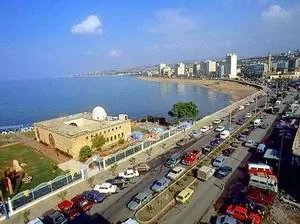
Add here the Mediterranean Sea with all its pleasures (surfing equipment, spearfishing, diving gear and yachts) and an unusual geographical feature that allows from December to April to combine sunbathing on the seashore with skiing (and the distance between the sun and the snow is just an hour's drive), and it will become clear to you: whatever you say, you will still have to go there someday. Where exactly? Haven't you guessed yet? To a small and cozy country called Lebanon.
Myth one: they shoot
And where, allow me to ask, do they not shoot and blow things up these days? Let us not, as they say, point fingers even at some European countries. So, in Lebanon, not a single foreign tourist has died in all the peaceful time, unlike, say, Egypt. The settling of scores between Lebanon and its southern neighbor actually does not go beyond the border areas.
And as for banal crime, it is simply ridiculous to talk about it after our parts. It is enough to look at an ordinary Beirut currency exchange office to make everything clear. Imagine a plywood stall with a square hole instead of the armored glass we are used to, which is equipped with a sliding tray. If the day is hot, the back door of the stall is wide open. And if you look inside, you will see foreign currencies laid out in piles, but you will not see the owner: he has run off for a minute to buy cigarettes.
Shooting in Lebanon, let me remind you, ended with the civil war - almost 15 years ago. And foreign investment immediately poured in, which has already restored everything that goes by the dull name "infrastructure", including hotels. In Beirut alone there are already more than 200, and almost a dozen have the five-star category. Among them you can see familiar international names: Holiday Inn, Marriott, Inter Continental and others.
Unfortunately, in some respects the investors overdid it: for example, they made the interior of the famous Casino du Liban more modern and luxurious. After all, this historical place was the arena of so many spy stories during the Cold War! As was the St. George Hotel on the embankment near the yacht club. The St. George is now in scaffolding. It is also being renovated. One can only hope that this former spy nest will still retain the charm of the 1960s. It is no accident that it was to Beirut, anticipating failure, that the Englishman employed by the CIA, also the famous Soviet intelligence officer Kim Philby, went, to give the KGB the opportunity to secretly take him out of there to the Soviet Union.
Myth two: they won't let you in
Yes, it must be admitted, there really was a period when in Lebanon they looked askance at a certain category of our citizens. Namely, at women of a certain age. However, the women themselves are to blame. Especially since Lebanon is part of the region where students from the former Soviet Union traditionally brought wives by the hundreds. And now former students have made a good career and entered the Lebanese establishment. Accordingly, their wives are now not just wives, but local ladies. They were, of course, not pleased that after freedom of movement came to us, the expression "Russian woman" quickly acquired a dubious connotation in Lebanon. The worried lobby of Russian wives, they say, pressed their worthy husbands to fix the situation in the simplest way: to ban the entry of unaccompanied female compatriots.
But times change, the demands of tourism development dictate their own laws. Now even the prettiest and very lonely young female citizen only needs to have a round-trip ticket with a fixed date and a hotel reservation for a visa to be stamped into her passport right at Beirut airport without question. But this, of course, is only if she is not found on the list of persons previously working in Lebanon as "nightclub and cabaret artists".
Myth three: no pyramids, no Eiffel Tower
They really are not there. But there is something better. Not to mention that Lebanon's nature itself is a beautiful attraction. It is no accident that journalists proclaimed this country the Switzerland of the Middle East. And just as Switzerland has several characters: German, French, Italian - Lebanon also represents several different worlds at once.
To one of these worlds one goes to the north of the country: through the Qadisha Gorge with its inaccessible monasteries carved into the rocks, to the legendary cedars. Some trees are almost two thousand years old; they are practically contemporaries of the biblical King Hiram. It is beautiful here always: both in the middle of a summer day and when snow falls.
For lovers of exotic things - the palace of the Druze emirs with the family's personal collection consisting of ancient weapons, classical and pre-classical gold jewelry. It is worth at least taking a look at the representatives of this unusual sect: the men have broad baggy trousers and huge mustaches in the manner of the Zaporozhian Cossacks, the women have loose dresses and enormous gauze headkerchiefs.
For lovers of historical curiosities, it is generally a real feast. Ruins of ancient cities with streets decorated with marble mosaics, palaces and temples, crusader castles. Does the word "Baalbek" say anything to you? Yes, yes, it is also here - the most grandiose temple complex in the entire Roman Empire, which in our time has been declared a cosmodrome for aliens. Because even today no one can explain how it was possible to move these slabs weighing two thousand tons. By the way, the small temple has survived almost untouched. True, the scientists called it small, so to speak, on a formal criterion. In fact, it is larger than the Parthenon. Some of its ceiling slabs have fallen and lie below. When you try to mentally lift them into the air and put them in their proper place, you break into a sweat from realizing their unrealistically gigantic weight.
And the underground cave of Jeita? Have you had the chance to see the most famous caves of other countries and continents? Well, none of the erudites like you has yet dared to say that Jeita is number two. Unanimously - number one.
Not a myth at all: have fun and eat well
The central part of Beirut (a newly rebuilt exact copy of the pre-war city), the seaside promenade, and the Christian suburb of Jounieh, overshadowed by Casino du Liban, are flooded in the evenings with a sea of lights from restaurants, clubs, and other entertainment venues. It is not easy to meet a woman in traditional Muslim attire on the streets here. And those you do see are elegant and independent.
Lebanese people love to have fun. Already from Thursday (and weekends in Lebanon, as in all of Europe, are Saturday and Sunday), finding a table at the best restaurants becomes difficult. The word “having fun” here also implies drinking good wine and tasting local cuisine - the most famous and refined in the entire Arab world. And generally inexpensive and sometimes unexpected. Such as, for example, kibbenia - raw minced meat from a young goat. And the traditional mezze appetizer alone can include up to 60 dishes, served in small portions on small plates. You can wash it down with local wine from leading winemakers: Kefraya, Chateau Musar, Ksara. French grape varieties are grown here. Besides dry wines, they make a decent dessert wine. Lebanese wines are already being exported. Of course, primarily to France - the Lebanese, so to speak, have their own historically established CIS with that country. But nevertheless, to break into the French wine market, historical ties alone, as you understand, are not enough.
One of the main winemaking regions is located near the city of Zahlé, in the Beqaa Valley. An amazing city, I must say: besides the vine, its surroundings also give birth to celebrities. The names of two of them, Omar Sharif and Shakira, are familiar to you. The parents of the famous American actor and the father of the well-known Latin American singer are from here. By the way, Shakira once admitted that she herself began dancing Arabic dances at the age of four, although no one taught her: "It's in my memory, in my blood." Go to Lebanon - and it too will forever remain in your memory.