
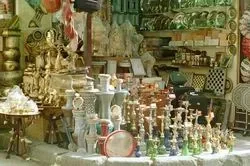
We study their customs, they adapt to our nature. The times are long gone when on the streets of Hurghada a domestic tourist could be surprised by cries like “come in, come in,” “my bunny,” “cheap,” or “for free.” The subtleties of Eastern pricing are also becoming more sophisticated for our citizens. For those who would like to systematize the cunning tricks of the Eastern bazaar, I have tried to collect the most characteristic techniques of its representatives.
Arabs indeed learn Russian surprisingly quickly. They are used to elderly women from the Siberian taiga talking to them as they would to a neighbor, without even entertaining the thought that there is a diversity of languages in the world. Therefore, an Arab knows perfectly in Russian the procedure of beckoning a customer into a shop, the numbers of counting to ten and their combinations, as well as a couple of common trade terms like “freebie,” “discount,” or “it can’t be cheaper.” In remote areas where Russian is not so popular, English will take its place, with winning phrases like good price, come look, mister, one dollar, etc.
It goes without saying that an Arab will never name the real price of his goods. The price he quotes upon first acquaintance will be 100-1,000% higher than the market price. A simple souvenir with a “real” price of $1 gets a price of $8 to $20, a book with glossy photos for $8 will fetch $50. You won’t get the truth here.
If the client is not a complete fool and intends to bargain, the haggling also follows uniform rules. He: “Okay, I’m willing to give in, name your price.” You: “Instead of 30, I’m ready to give 20.” He will say “25,” and everyone will be satisfied, although later you will realize that out of $25 you overpaid at least $20.
Never name “your price”! Let him get out of the trap he has set for himself, let him run after you and reduce the price endlessly. When you firmly put the basalt figurine of Nefertiti back on the shelf and leave the shop with an equally firm step, he will do just that - and the price will start to drop without any participation on your part. He will shout: “20! 15! 10! 5!” - and when you think you have humiliated him enough, you will turn around and, without slowing down, throw at him: “Three dollars, brother.” And for $3 you will get the Nefertiti figurine that your neighbor on the charter flight bought for $20.
You can, of course, initially say yourself: “I will buy this thing for $2, not a cent more.” Then stand and wait while that guy tries his hardest to get you into bargaining. No bargaining! Sometimes their pressure is psychologically killing (once my sister, after half an hour of pressure, herself begged me to stop haggling and agree to his price), but a white man must always remain the winner.
As a trick, the provision of supposedly free services is widely used, for which Arabs then ask for money. They grab your suitcase at the airport and run away from you, only to demand money for porter services. Once I chased such a “porter” for about ten minutes; he did not want to give me my things, demanding to be allowed to carry them to the taxi. Free tea, a souvenir “as a keepsake,” a postcard - everything will have to be paid for later. The only way to avoid this is to ask directly: “Is this free? Really free?” If an Arab, to his own ruin, replies: “Yes, it’s free,” he is caught. Mock him as you like. I will never forget how near the pyramids in Giza a poor old camel owner begged us for one pound for some worthless pebble that he, by his own admission, “gave” us. I asked him: “Is this a free gift?” “Yes,” he replied, not taking into account the cynicism of a Russian tourist. Without looking, I stuffed the stone into my pocket and quickly walked off toward the Pyramid of Mycerinus. I will never forget the astonished faces of both - the old man and the camel. Perhaps for the first time in their lives they were not allowed to cheat.
In Fez, Morocco, a Bedouin of ordinary appearance approached us. He offered to show us the ancient Jewish quarter. We politely told him that we could find the quarter ourselves without his help, since, unlike him, we knew how to navigate by map. However, the Bedouin insisted, and as his main argument said he would do it for free. Then he led us to the Jewish quarter (by some roundabout routes, since on the way back we got out much faster) and demanded money. Naive soul. We reminded him that the purchase and sale of goods/services is a transaction with the prior consent of the parties.
But not everyone in the Arab East knows this. Taxis in most countries are equipped with meters, but they “forget” to turn them on and then “roll out” a sum that makes you laugh. Sometimes the taxi driver admits the meter is broken. “Okay,” tell him, “I’ll pay you five piastres, don’t count on any more.” And the meter will miraculously quickly return to service.
Restaurant menus do not always list prices, and not because they “forgot” to print them - this is done deliberately so that after you eat, they can present a bill at their discretion. After two or three blunders on this matter, I always demand the bill in advance, and if I don’t like it, bargaining ensues (see above). After all, even if prices are listed in the price list, there is no guarantee that you won’t be asked to pay three times as much. In Syria, they ask for extra payment - for napkins, tablecloth, a piece of bread, not to mention 15% for service. No one, of course, will warn you about this in advance. To avoid unpleasant surprises, the conversation about the price should be held in advance.
Make sure you always have plenty of small bills and coins in your pocket - no one ever has change. A taxi driver, waiter, or market vendor does not keep change, and will surely keep the remainder from a large bill. Or, for instance, he might say: “I’ll bring the change now.” And leave, never to return. If he does bring something, it needs to be carefully recounted.
In Jordan, 1 dinar equals 1.000 fils. I confess I did not know this. Therefore, in a taxi, seeing the number 1.200 on the meter, I gave the driver 12 pounds. He took the money and, without saying a word, made himself scarce. Later I realized I had overpaid him exactly ten times, but his conscience nonetheless prompted the driver to leave me in blissful ignorance.
Often an Arab tries to ingratiate himself with our tourist. It turns out he studied in Moscow, or his brother is studying in Moscow, or his brother's brother studied in Moscow. Something imperceptibly connects him with Moscow, in general. Therefore, he says, embracing you and leading you into his shop: "This fake papyrus with an approximate image of the sphinx I usually sell for $100, but for you, as a brother from Moscow, I am ready to sell for 50." There will be no other such chance, it is read in his voice. Many buy, and then listlessly wander around the markets, where these sphinxes sell for $5.
Some Arabs take out from their storerooms letters and photographs of Russian women. Let us not talk about the ethical side of the issue, but I personally have seen whole albums of such photos, nude and in the most unrestrained poses, so I would advise our girls to behave more modestly, otherwise your images will later be mockingly examined by cynical types like me. Many photographs are signed: "To dear Omar from Lenochka." There are also whole letters in the Arabs' collections. Usually he gives them to me to read, pretending he does not know Russian. "Read it aloud to me so I understand," the Arab asks, handing me a crumpled, read-to-tatters letter from Lenochka, which dozens of Russian tourists read aloud to him every day. This is done, apparently, so that I might be imbued with respect for this Arab and, as a sign of that respect, buy from him a hookah or leather slippers with upturned toes.
Most of the tricks of the East are artless and ridiculously simple. They simply need to be known. Many readers will contemptuously say that we are bargaining over kopecks, that this is all trivialities of life not worth paying attention to. No, that is not so. We must not encourage theft and fraud. You give them a dollar for nothing today, a dollar tomorrow - I don't know about you, but for me these dollars are earned by hard work, and I do not intend to finance the fraud of the Arab people with my earnings. Besides, wasteful spending leaves an unpleasant aftertaste in the soul - I want to wish you, after all, to have only pleasant memories from your travels.