
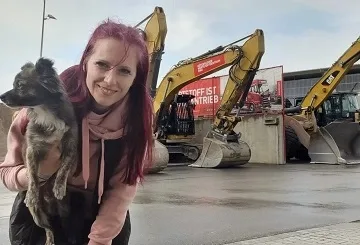
Agnes Borchers – the most famous woman in the German construction industry
"Puppi at work" – that's the nickname under which social media users know Agnes Borchers, who works at a construction company. However, her successful career as an influencer is merely a supplement to her main activity. As Deutsche Welle notes, the striking red-haired girl with a tattoo on her arm actually loves heavy machinery, especially hydraulic mining excavators.
Agnes is probably the most famous woman in the German construction industry. She shares details of her work at Hagedorn with her followers on Facebook, Instagram, and TikTok every day. Agnes received her professional education in landscape design, but she got a job in a completely different field – as a mechanic.
Excavators and trucks have fascinated her since childhood. She still never ceases to admire their power: "What masses can be lifted with this machinery! At the same time, it is equipped with electronics that require very precise control and dexterity, and then this powerful machinery can make very accurate movements – down to the centimeter!"
In the construction industry, the girl was able to realize herself. And she never stops enjoying her work. "Even driving past a project I worked on several years ago, I feel positive emotions," says Borchers, who is the face of the "Frau am Bau" campaign (which can be translated as "Woman on the Construction Site").
On the list of prohibited professions
The initiator of the "Frau am Bau" campaign was the head of the Hagedorn company, Barbara Hagedorn. Together with her husband, she runs the family business and knows that the biggest "construction site" in their industry is in personnel policy. Over the past decade, the construction sector has experienced a boom that is difficult to cover due to a shortage of skilled workers: orders are there, but there are not enough people to carry out construction contracts.
In addition, in the coming years, about a quarter of the workforce will leave the construction industry as they retire. With such a shortage of personnel, the construction sector of the German economy remains the most "male": no other area has such a low share of women. In Germany, only 13 percent of construction workers are women. And most of them work in the administrative sector or in design. That is, in the office. Workers like Agnes Borchers, who work directly on the construction site, are a rarity.
According to the Central Association of the German Construction Industry (Hauptverband der Deutschen Bauindustrie, HDB), the share of women in professions such as concrete worker, carpenter, and construction equipment driver does not exceed three percent.
The shortage of women in the construction industry is also explained by historical reasons. Until the 1990s, the profession of a construction worker was on the list of prohibited professions for women in West Germany. Too heavy physical labor, too dirty work. Meanwhile, in East Germany, women confidently operated cranes and excavators. Moreover, no one would have been surprised to see a female engineer or architect. Today, in a unified Germany, the share of women is growing in all areas of employment.
More positive examples
"Heavy and dirty" – this description is already somewhat outdated, Barbara Hagedorn is convinced. Her goal is to train more women in professions that go beyond administrative work. As part of the campaign, special advertising posters were prepared featuring women working as drivers, construction workers, and project managers. Those who want to try their hand in this field can first sit in an excavator simulator. What if they like it?
The Hagedorn company provides demolition and dismantling services for buildings and structures and is among the world leaders. Only a few months have passed since the launch of the campaign to attract women, but results are already visible: four girls have started training in technical professions, and the company's workforce has been joined by two women – an engineer and a truck driver.
More female role models and professional development – that is exactly what the participants of an industry survey initiated by Hagedorn in 2021 dream of. What problems do representatives of the construction industry face? 75 percent ranked sexism and prejudice first. Even 80 percent of the men surveyed agreed with this. And all survey participants agreed that women with the same qualifications have a harder time than men.
Women earn less on construction sites
According to the Central Association of the German Construction Industry, the wage gap between men and women reaches 25 percent. Of course, the construction boom has also improved the position of women in this field. They now earn much more than they did ten years ago. However, they still lag behind their male colleagues.
Hagedorn and 15 other construction companies have together created an association representing the interests of women in the construction sector. Bianca Weber-Leverenz became the first woman in Baden-Württemberg in 1997 to master the profession of a bricklayer. During her internship, Bianca realized that "construction is for her." And even the fact that there were no other women at the company and that there was no women's toilet on the construction site did not make her reconsider her choice.
She has always been satisfied with the relationships within the team on the construction site. "Women who can work in wind and bad weather and have their own plan are respected by men," she says. Today, Bianca holds the position of engineer, provides independent consulting, engages in scientific activities, and acts as a mentor in STEM subjects for schoolgirls and female students.
Artificial intelligence is conquering this field, perhaps more slowly than others, but it promises new opportunities for new professions. Automation of many processes, optimization and improvement of equipment efficiency, and elimination of errors caused by human factors are becoming a reality. However, most algorithms work on the "black box" principle: you never know how they make decisions.
And if the industry continues to see a shortage of women, there is a risk that the programs and machines being created will work one-sidedly, Weber-Leverenz believes. Therefore, at this stage, it is important for women to participate in all processes of the construction industry. For example, companies often use artificial intelligence for personnel recruitment, but it is based on outdated data.
Employee selection is based on analysis of data from the construction industry, where women play a minimal role. If technologies do not take into account the modern needs of the industry, then only men will still be put forward as candidates for vacancies in the construction sector.