
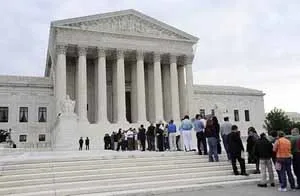
Supreme Court of the United States
The reasons for choosing Sotomayor are fairly simple. Latinos have now become the largest minority in the United States. They make up about 15% of the population and 9% of voters. In the presidential election, 68% of Latinos voted for Barack Obama and expected him to include at least one representative of this minority in his cabinet. However, for various reasons, such appointments did not follow - the appointment of Sotomayor may become a sort of 'consolation prize' for Obama's Latino supporters.
However, public opinion polls show that for Americans, the professional qualities of candidates for the Supreme Court are most important, not the details of their biography. For example, a CNN poll conducted before the nomination of Sotomayor gave the following results: for 67%, it is most important that the candidate be a professional judge, 28% would prefer to see a person with experience in executive or legislative structures, 20% a woman, 11% a Latino, 9% an African American.
In general, until about the early 1960s, presidents selected future judges from among their friends and acquaintances, at least casual ones. However, later the process of selecting candidates for the Supreme Court involved members of the White House 'inner staff,' whose employees analyze the sentiments of various groups of voters and their representatives in the echelons of power. Nevertheless, domestic political reasons have always played a significant role in the selection of judges. For example, the first US President George Washington appointed James Iredell as a judge - an influential politician from North Carolina. The choice was made because no one from that state was on the Supreme Court, and Washington decided to remedy this injustice.
At the end of the 19th century, millions of Catholics immigrated to the United States, mainly from Ireland, Italy, Germany, and Poland. This factor also played an important role in the formation of the Supreme Court - in 1898, President William McKinley appointed Catholic Joseph McKenna as a judge. This was done for purely political reasons.
In turn, President Woodrow Wilson appointed the first Jew - Louis Brandeis, Lyndon Johnson the first African American - Thurgood Marshall, Ronald Reagan the first woman - Sandra Day O'Connor.
There are several examples of presidents appointing to the Supreme Court members not of their own party (a total of 14 'non-partisans' appointed by presidents became judges). For example, in 1863, Republican Abraham Lincoln appointed to the US Supreme Court a well-known Democrat, Stephen Field. In 1940, Democrat Franklin Roosevelt made Republican Harlan F. Stone Chief Justice.
However, whatever the circumstances of their appointment, members of the US Supreme Court have always shown independence from other branches of government, including independence from the presidents who appointed them. For example, in 1902, President Theodore Roosevelt appointed Oliver Wendell Holmes to the Supreme Court. Less than two years later, when considering a crucial case, Holmes voted against the president. Earl Warren, appointed by President Dwight Eisenhower as Chief Justice, so often voted against Eisenhower that after leaving office, this president characterized his appointment of Warren as 'the biggest damn-fool mistake I ever made as president.' An even more important role was played by the position of Supreme Court members during the Watergate scandal. President Richard Nixon refused to provide the court with tape recordings made in the White House. The case went to the Supreme Court. In 1974, three of the four Supreme Court members appointed by Nixon voted against him; the fourth recused himself.
Even more strained were the relations between judges and presidents who did not appoint them. John Marshall, who headed the Supreme Court during the first third of the 19th century, belonged to a minor party that had virtually ceased to exist by the end of his legal career. However, he proved himself a man capable of causing trouble for all presidents. One of them, Andrew Jackson, once commented on a court ruling as follows: 'Marshall has made his decision; now let him enforce it.'
In total, absolutely all US presidents except four (in the 20th century, the only US head who did not get such an opportunity was Jimmy Carter) have had the opportunity to appoint Supreme Court justices. George Washington appointed the maximum number of justices - 11, Franklin Roosevelt - 9.
Kings of the Judiciary
The US Supreme Court is an extremely powerful institution, unparalleled in other democratic countries. 'The judicial Power of the United States shall be vested in one supreme Court, and in such inferior Courts as the Congress may from time to time ordain and establish,' states the US Constitution. This document also indicates that 'the Judges, both of the supreme and inferior Courts, shall hold their Offices during good Behaviour,' that 'the judicial Power shall extend to all Cases, in Law and Equity, arising under this Constitution, the Laws of the United States, and Treaties made, or which shall be made, under their Authority,' that the Supreme Court has original jurisdiction only in 'Cases affecting Ambassadors, other public Ministers and Consuls, and those in which a State shall be Party,' and that in all other Cases 'the supreme Court shall have appellate Jurisdiction, both as to Law and Fact, with such Exceptions, and under such Regulations as the Congress shall make.'
All these provisions are included in Article 3 of the US Constitution, which alone contains the enumeration of the duties and prerogatives of the Supreme Court. Nothing is said about this federal authority in any of the twenty-five amendments to the Constitution adopted over 180 years, from 1791 to 1971. The functions of the federal judiciary and the Supreme Court in particular are outlined in the constitution far less detail than the rights and functions of the legislative power exercised by Congress and the executive power exercised by the president.
Nevertheless, the Supreme Court has enormous power. Its special status is due to the fact that during the 19th century it effectively assumed the role of the highest national arbiter, vested with the right to confirm, correct or even overturn not only the rulings of lower federal courts, but also the decisions of all other federal, state and municipal authorities. Therefore, it is not surprising that various social forces in the United States seek to use the Supreme Court to protect their interests and achieve their political goals.
The US Constitution does not specifically state how many members the Supreme Court should have. Initially, Congress decided that the Supreme Court should consist of six members. Subsequently, the Court had 10 members, and sometimes its number was reduced to five. Usually, the number of Supreme Court members was determined by the requirements of its work efficiency. In one case, political motives became the decisive factor. In 1866, Congress provided for a reduction in the number of US Supreme Court members from 10 to 7 by leaving vacancies unfilled, in order to prevent President Andrew Johnson from making new judicial appointments. In 1869, after Johnson left office, the number of Supreme Court members was increased to nine, and it has remained unchanged since then. Congress has the right to change the size and composition of the Court, but has not used this rule for over a hundred years, despite the fact that the Court's workload has increased significantly.
The Supreme Court bench consists of nine justices, one of whom is its chief justice. All of them are considered irremovable and, in principle, can remain in office for life. Many American constitutional law experts claim that Congress is authorized to introduce an age limit for judges or limit their tenure to a fixed term, but so far legislators have not adopted such decisions. Therefore, new vacancies open only in the event of a judge's death or voluntary retirement. New members of the Supreme Court are nominated by the US president and confirmed by the Senate.
The US Supreme Court has made many decisions that have had a profound impact on the fate of the United States. It was the Supreme Court that established that federal laws are more important than state laws. Its verdicts were one of the reasons for the start of the Civil War in the US, the abolition of racial segregation, and the legalization of abortions.
A recent poll conducted by Quinnipiac University showed that 62% of Americans currently approve of the Supreme Court's performance.
Based on materials from Washington ProFile.