
The meaning of this statement becomes clear when you see all three countries - Vietnam, Cambodia and Laos - in a single journey. Indeed, the Vietnamese are constantly busy with work, everyone has some kind of business, everyone sells something. The inhabitants of Cambodia, the Khmer, are lazy and poor, and poverty kills their desire to work, and laziness prevents them from getting rich - a vicious circle in its purest form.
As for the Lao, Buddhist philosophy has made them absolutely indifferent to the external manifestations of life. As if neither the 19th century with its automobile and electricity, nor the 20th with computers and space flights ever existed, and the Lao person couldn't care less about the 21st century either. He is in a contemplative mood, living from sunset to dawn, from spring to spring, from rice sowing to harvest. The country has a huge number of monks: religion prescribes that every man devote at least a few years of his life to service in a monastery, and the Lao are perfectly happy with that.
Monks move slowly along the country's roads, the current carries their boats just as slowly along the Mekong, and in the evenings they sit on a hill near their monastery, seeing off another day, or at the very least beat drums to create at least some noise in this country of silence and calm.
The calm of the Lao is complemented by their small numbers. The country has a population of about 5 million people - half as many as Cambodia, and 15 times fewer than Vietnam. That is why the streets in this country are empty, there are few cities, and mountains occupy most of the territory. The Lao themselves do not particularly worry about this, content to live on a narrow strip of land along the Mekong and leaving the rest of the country to numerous mountain tribes.
Neither history, nor geography, nor even the country's mineral resources contain anything exceptional. At one time, the French government, having conquered Laos without any resistance from the local population, ordered the local governor to prepare a report on what the country had that could be of use to France. After a thorough study of the country, the governor wrote a very detailed and comprehensive document that stated the following: the population of Laos produces no goods that could be sold; there are no mineral resources in the country; there are no strategic roads, and the Mekong is completely unsuitable for large ships because it is shallow here. Historical monuments and attractions of cultural value comparable to Angkor in Cambodia or Bagan in Burma were also not found here.
Having received such a report, the French government thought hard about whether it needed Laos at all, and if so, for what purpose. The puzzled colonists remained in these reflections until 1952, when Laos was granted independence. For this reason, the country never had a large colony of Europeans, and many residents, I think, never even learned that their land belonged to France.
The capital of Laos is the city of Vientiane, standing on the Mekong in the center of the country. On the other side of the river Thailand already begins, and for communication between neighbors, the Thais built the so-called Friendship Bridge across it. The Mekong crosses the entire country from north to south, but this is still the only bridge over it - the rest of the country uses ferry crossings and feels fine.
Vientiane has relatively few tourists and relatively few attractions. Perhaps there used to be more of them, but the country's history has had too many invasions and destructions. The fact is that Laos, due to its sparse population and lack of fertile lands, rarely had the opportunity to create its own state and most often became an arena for the division of lands between neighboring, more powerful countries - Vietnam and Thailand. By the end of the 18th century, Thailand had finally secured these lands for itself, but out of boredom Vientiane rebelled several times - and each time it ended in the complete looting and burning of the city. The last time Vientiane experienced the ferocity of the Thai army was in 1828, when all houses and almost all temples were destroyed in the city, except for those that reminded the Thais of their own creations.
One of these, and to this day the most beautiful temple in the capital of Laos, remains Wat Si Saket. This oldest of Vientiane's surviving temples was spared by the Thais during their last pogrom due to a strange set of circumstances, and therefore its main feature has also been preserved - along the entire inner wall surrounding the main building of the temple stretch countless small niches, each containing two Buddha figurines. Some of them have already decayed over time, but we did not find a single one of the 2,000 niches without figurines. Several small rooms carved into the wall also house wooden, bronze, and stone Buddha figures - standing, sitting, and lying sculptures piled in disorderly heaps, and so the number of Buddhas in Wat Si Saket does not awaken religious feelings but rather stirs a strange unease. In total, there are 6,840 of them in the monastery. It occurs to me that if all these figurines were put on sale at Vientiane's main market, Talaat Sao, it would undermine the entire economy of Laos and neighboring countries.
Another imitation of Thai architecture is Haw Pha Kaew, or the Temple of the Emerald Buddha. It was once the main prayer house of the royal family, but after the communists came to power in 1975, the king “voluntarily” handed over all his property to the Lao people, and himself, also voluntarily, went into exile, and where he is now, no one knows. A museum has been founded in the Temple of the Emerald Buddha. Interestingly, one can find Buddhas of any kind in it, but there is no emerald one among them. The fact is that in 1565 the Emerald Buddha was dragged from its homeland, the city of Chiang Mai (now northern Thailand), to Vientiane, because the king of Chiang Mai inherited Laos and moved here to live. It is clear that the Thais in Chiang Mai did not like it too much that they were deprived of the most important city shrine. Nursing their anger, they waited for more than two centuries until in 1779 the Thai army arrived in Vientiane and kidnapped the Emerald Buddha. Now it stands in a temple of the same name in Thailand.
However, in the Vientiane temple one can see a bronze Buddha praying for rain, a stone Buddha from Cambodia, a marble Buddha from Mandalay (Burma), and some other useful sculptures, as well as items of royal utensils - dishes, costumes, and so on. Local Thais still come here to pray, ignoring government decrees.
Among other noteworthy temples, one should mention Wat Si Muang, the main object of worship for the townspeople. Devout Buddhists pray here to a phallic column in which lives the main spirit - the protector of the city. It was here in 1563 that the first temple of the city spirit was founded, consecrated by human sacrifice (though voluntary). At that time this column also appeared here - most likely, it was taken from some ancient nearby Khmer settlement. Residents of Vientiane come to Wat Si Muang to tell their everyday wishes, which, of course, are a piece of cake for the city spirit to fulfill. Just in case, a couple of Buddha figures were also placed here, simply for solidity. That's the kind of Buddhism...
In the city center on a small square stands the so-called “Black Pagoda” (That Dam), abandoned by people. Apparently, it was built back in the Middle Ages, but there are no entrances to it, and bushes and small trees grow everywhere from the wall. In response to tourists' questions, residents confidently answer that a dragon lives here, which saved the townspeople during one of the wars with the Thais. Well, that's a satisfactory explanation.
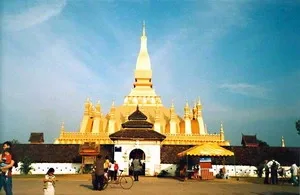
But the main religious attraction of Vientiane and all of Laos remains, without a doubt, the Great Stupa (That Luang) - a national symbol and decoration of the country's state emblem. The Lao claim that already in the 3rd century BC Buddhist missionaries founded the first stupa here, but no evidence of this fact has been found - although remains of a Khmer monastery of the 11th-13th centuries were discovered in the foundation. In the 16th century, the king of Lan Xang, as Laos was then called, ordered the construction of a gilded stupa here, which was subsequently rebuilt many times. After the destruction of the city in 1828, the stupa was abandoned by people for 70 years. Now the residence of the country's Buddhist patriarch is located here. It is impossible to describe the appearance of the stupa - it seems that it is entirely made of gold. In the morning and evening hours, against the background of the blue sky, the colors of the pagoda seem absolutely unreal. Perhaps, in all of Vientiane, one can look at nothing at all except That Luang. True, apart from the exterior, it is unlikely that you will be able to see anything - the pagoda is opened only on major national holidays.
For the rest, Vientiane remains a wonderful place to relax for those healing their nervous system. On our first evening in the city, we walked down the middle of the main city avenue to avoid the dubious Lao curbsides, and only rare cyclists overtook us. There are chronically few cars within the city limits, although according to the guidebook, their number has been increasing sharply in recent years. Instead of taxis, catching which is an unattainable dream for a wealthy tourist, the proven Thai motor rickshaws of the tuk-tuk type are used for transportation, with an open body equipped with two benches. A trip to any end of the city will not cost you more than $1, or 10 thousand Lao kip at the exchange rate of January 2003. At the airport you will have to shell out all $2. The Lao taxi driver does not speak civilized languages and does not like to bargain either - he, in general, doesn't care how much money you give him.
Catering establishments in the capital of the Lao People's Democratic Republic are just as non-pushy. In any eatery, which usually has no more than one or two tables, you will be offered noodle soup, sticky rice, and fried fish that had been apathetically swimming in the nearby Mekong that same morning. Once we recklessly sat down at one of these tables on the veranda of a small cafe, ordered two exotic soups (no menu is provided), and only then discovered that we were actually sitting in a barbershop, because a client appeared, was seated in front of a mirror, and, as if nothing had happened, they began to cut his hair. There are few exemplary restaurants in Vientiane, and most of them are located on the improvised Mekong embankment - the embankment itself resembles more of a vacant lot.
However, Vientiane may seem like a mad metropolis compared to Luang Prabang, the ancient capital of the Lan Xang kingdom and the royal residence until the 19th century. If you are lucky, Lao Aviation flights will take you from Vientiane to this town in the north of the country in half an hour, where time stopped long ago and where every building is of some value to the religion and history of Laos. UNESCO could not decide which of Luang Prabang's temples to include in the World Heritage List, so it cheated - the city itself was declared a heritage of humanity. However, apart from tourists, no one here suspects this. As several centuries ago, the inhabitants of Luang Prabang raise pigs, chickens and ducks, collect bark in the surrounding forests and grow rice and vegetables on the slopes of Phousi Hill - in the very center of the city. The line between urban and rural areas is almost completely blurred here - this applies to roads, buildings, and the occupations of local residents, which mostly boil down to producing agricultural products and then selling them at city markets.
From the airport to the town of Luang Prabang we got for a couple of dollars along an unpaved highway, where any moving object raised clouds of thick brown dust. In this same dust the town soon appeared, and we took our places in the New Luang Prabang hotel, which we had booked in advance by phone (we could not find an e-mail address in any hotel in Luang Prabang). The hotel is luxuriously located in the very heart of the city, has hot water, a shower, a TV and even a peculiar breakfast. The benefits of the central location are reinforced by the proximity of a food base: in the hotel courtyard, already in the early morning, we identified by sound a poultry house and a pigsty, whose inhabitants raised a deafening racket: Laotians, roosters, ducks and pigs. In addition, right in front of the hotel, on a vacant lot, a mountain tribes market operates every day, where representatives of the Hmong people come down from the mountains to sell their simple cotton and silk crafts, folk costumes and other souvenir products costing no more than $1 for two items. They themselves are much more colorful than their Thai and even Vietnamese counterparts, because they not only do not speak English, but in Lao they know only one word - sabaidee (hello). However, with different intonations this word forms a fairly extensive lexicon for them - with it they beckon a customer, with it they present the merits of the goods, haggle and say goodbye. Interestingly, the Hmong are considered very tough traders and terribly dislike lowering prices - which, after the Laotians, greatly surprises the European tourist. The Hmong will smile, shake their head, but will not reduce the price even by a trifle - 1,000 kip. They are stupid, but you can't tell them - they won't understand. They are not even affected by the concept of competition - we bargained for some ethnic tablecloths with an old woman until we were gray-haired, but she never lowered the price from 22,000 kip, after which we bought completely similar things from her neighbor for 20,000. Stupid.
The Hmong market is not mentioned in any guidebook, but we were very happy to have discovered it for ourselves. Even the very sight of Hmong women dressed in national attire, with black turbans on their heads, is very impressive. In the evening, when natural light fades away, the vendors light dozens of candles, and the whole street turns into a show of chiaroscuro, while the rest of the city plunges into darkness - electricity was only recently brought to Luang Prabang...
In the city, with a population of 11,000 people (seven or eight multi-storey buildings), there are 55 monasteries, most of which are still active. Therefore, the most common figure on the streets of Luang Prabang is a shaved monk in a bright orange robe. Monks move in whole groups, sail on the river in boats, and stare at tourists. European youth engage them in conversations, gesticulating desperately. According to Buddhist laws, women are not allowed to touch monks or hand them objects from hand to hand - but monks everywhere shake hands with European girls, talk animatedly and take dozens of objects from them, ignoring Buddhism.
The monasteries of Luang Prabang are painted with gold from top to bottom. The style of temple architecture resembles the pagodas of northern Thailand - low roofs descending to the ground, painted columns and windows with decorative grilles. But there is much more gold here, and against a dark background it looks especially bright. The cover of our guidebook to Laos featured the main entrance to one of the city's temples, and we could not rest until we found it and took a similar photograph. Despite the fact that the entire city can be walked from north to south in half an hour, by the evening of our first day we could barely drag our feet from fatigue, but we still had not seen all the monasteries. The largest and most famous is considered Wat Xieng Thong, which for two centuries was the main temple and burial place of the Laotian kings.
And on the second day we realized that one must move around this city sedately and unhurriedly, like all life here, like the waves of the Mekong and Khan rivers, at the confluence of which Luang Prabang is built. And just like the local monks, we sat silently and for a long time on the bank of the Khan River and watched the mountains and the plain darkening in the distance, where Laotians in their woven hats, in the company of their buffalo friends, unhurriedly plowed flooded rice fields. Or we wandered through the Hmong market, examining pagan patterns on bedspreads and the strange adornments of the saleswomen - ancient silver bracelets and old glasses found somewhere, apparently belonging to some European, and now tied as a decoration to the turban of one of the local old women. And, coming out to the Mekong, as slow as everything here, we made our way along dirt streets, while local residents, children, dogs and roosters followed us with a long, thoughtful and unhurried gaze.
Indeed, people in Luang Prabang really do not like to rush. They simply have nowhere to rush, but even when they meet a person who needs to see as many local attractions as possible in one day, they try to reason with him. It so happens that there are two notable places in the vicinity of the city: the Kuang Si waterfalls to the south and the Pak Ou caves to the north. The trip to each of them separately takes no more than an hour, and we were sure that we could cover both places in one day, so that the next morning we could, according to plan, leave back to Vientiane. However, the very first driver of the sightseeing bus dispelled our dreams. Getting out of the car in response to our insistent knocking on the glass, he cast a concentrated glance at the unambiguous inscription on his jalopy Kuang Si Waterfalls - Pak Ou Caves, calmly listened to our wishes for the next day and confidently shook his head. He said:
- Okay. Tomorrow you go see cave, next day you go see waterfall. (Good. Tomorrow you will see the caves, and the next day - the waterfall.)
- Very well, - we replied politely, - but we would like tomorrow morning to go see cave (to go see the caves), and in the afternoon with a calm soul and without haste to go see waterfall (to go see the waterfall). Can we do that?
- No, - the driver logically said.
- Why?
- Because one day you go see cave, next day you go see waterfall. (One day you see the caves, and the next day you see the waterfalls.)
- Ah, that's why, - we realized and moved on.
We walked calmly for about fifteen minutes, but then he thought and drove up to us again. He told us that he was ready to make an effort and drive a crazy distance of 60 km in one day, thus covering both the caves and the waterfalls. But we should note that he was doing this for the first and certainly the last time in his already not easy life, and he asks for this dangerous trip $20 per person. Within a minute we bargained down to $20 for the two of us, and in the morning he was already waiting for us on the side of the road in front of the hotel.
The journey itself was very colorful. Not only does the waterfall work at full strength this time of year, and the surrounding jungles delight with their primitiveness, and the caves on the banks of the Mekong are filled with thousands of Buddha figurines, and along the way there are completely wild villages of the Hmong and Khmu tribes, but also on the way back from the waterfalls our driver offered to give a lift to one of the local residents to the neighboring village. The old man, judging by his appearance and load, was collecting bark in the local forest and was very successful at it. But he had never in his life tried to open a car door, nor to sit in this machine. When he was finally seated together with his stupid bark, he rode the whole way with a blissful expression on his face, understanding absolutely nothing of what was happening. I am sure that he did not even fully grasp what he was riding on that day and how he got home. The old man was completely green, and looking at him, we realized that we had never been so far from civilization. That's the kind of place Laos is.
In the evening, Luang Prabang falls completely asleep. At the local Red Cross center, European tourists can get a massage for $2 (it really is a massage, all strictly decent, no prostitutes). And nearby, trying to brighten up his life here, one of the local Frenchmen at the restaurant of the Villa Sinxay hotel every two days puts on an evening show of the peoples of Laos, resembling a family performance with children, dogs and elderly relatives. The Frenchman's wife and his three children come on stage and begin to sing a plaintive Laotian song in different voices. Girls dressed in costumes of various tribes dance and sing simple compositions. Such recreation lifts the mood well and costs $2 per person, including unlimited fruit and desserts. At the same time, local pensioners farther away under the only streetlight in the city play pétanque - a game clearly borrowed from the French colonialists.
By the way, the Lao generally turned out to be talented compilers of French customs. In stores you can easily find a good selection of French wines, and at market stalls French baguettes are sold everywhere - long loaves that they have learned to stuff with local delicacies. As for Lao cuisine itself, besides sticky rice (klao niaw), it includes laap (spicy minced venison or buffalo meat with vegetables and sprouted rice grains), tam mak houng (papaya salad with garlic and nuts), som moo (sour pork sausage) and many kinds of soup, mostly with rice noodles. The signature dish of Luang Prabang is considered or lam - meat floating in a soup with the addition of chili, buffalo skin, hot sauces, lemongrass and sweet basil. They say they also eat raw meat here, but in restaurants they prudently did not offer it to us. At the market, however, we repeatedly saw a dead rat lying next to plucked chickens or fish skewers, also being an item of trade. We never dared to ask its price. And why would we need it?
A year before the events described, in January 2002, while in Thailand, we were once sailing along the Mekong and stared with all our eyes, enchanted, at the other bank, where lived such a mysterious, unknown to us and enigmatic Laos. What is there, we thought, behind these steep banks, behind these people who, paying no attention to us, calmly hung out fishing nets to dry? A year later we managed to visit this bank of the great river as well - it did not disappoint us. It is only a pity that after five days in Laos we again had to return to a crazy metropolis, where every minute you have to run somewhere, be late, look at your watch, forgetting that somewhere far in the east, on a hill above the flooded rice fields, people sit and silently, for a long time, listen to the rice growing...