
Before serving the food, the hostess of the table (the hostess, not a waitress) tried to introduce everyone: for that, she asked us to introduce ourselves and say at least a few words about ourselves (for example, where each of us came from). Just at our table, there were diners from four states. Each introduction was accompanied by jokes, but not long ones: everyone wanted to eat.
The food was simple, but they didn't skimp on seconds. There was no menu. We were offered what in the Soviet Union was called a "set meal." Huge dishes appeared on the table with airy, melt-in-your-mouth mashed potatoes, and next to them they placed equally large dishes with enormous steaks and generous pieces of braised turkey (for choice). There was yellow cornbread, which is usually used to stuff turkey, boiled and heavily salted green beans, and other coarsely chopped vegetables. For dessert, they brought us a huge apple pie.
According to mandatory American tradition, which unites cuisines from around the world, all the food was, as they say, "piping hot." Even the pie was still noticeably warm, and we washed it down with plain cold water. I think anyone who claims that all American food is made from oil would have immediately bitten their tongue – out of pleasure.
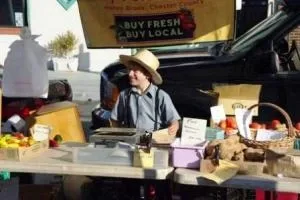
You can try products grown by the Amish not only in their country but also in all nearby cities. There are Amish specialty stores in Lancaster, Philadelphia, Baltimore, etc. (I suppose to do business there, they, of course, sometimes have to switch to a car.) Particularly famous are Amish dairy products: milk, sour cream, cottage cheese, as well as vegetables and fruits. In the harvest autumn or warm winter, the Amish sometimes set up their little markets right on the streets of Philadelphia.
I photographed this boy when I was walking one winter in the city center. His trade was brisk, despite the fact that Amish prices are usually slightly higher than in a regular supermarket. But Philadelphians know the taste of their products well and don't quibble over price. Many are surprised how they survive in the modern world of competition without using the achievements of civilization, but they not only survive, they thrive. According to official statistics from the Department of Agriculture, Amish farms are among the most productive in the country. Note, by the way, how the boy is dressed and how the city shoppers are dressed. That's what a healthy lifestyle means!
On the day we visited Amish Country, the corn had already been mowed in many places, but in some places the battle for the harvest was still ongoing. It was quite amusing to watch horses or mules pulling not only a simple harrow or plow across the field, but sometimes some huge and quite modern agricultural machine. (We saw such pictures, but I didn't manage to photograph them.) As they explained to us, the logic is this: on a machine, no matter how complex and modern it is, you can't go far, but a tractor, like a car, is a temptation for an easy path to the outside world.
Since 1960, the number of Amish in the Lancaster community alone has tripled. And this despite the fact that every year some of the younger generation leave for the big world. Some return from it later, and some stay there forever. The Amish easily compensate for these "losses" with high birth rates: they have no electricity, and under a kerosene lamp, as I understand it, you don't really read a book before bed. The average number of children in Amish families is seven. A classic seven-ya.
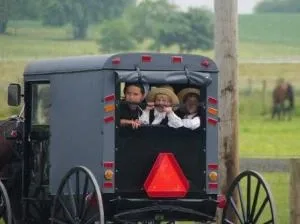 Photographing the Amish is not easy. First, they rarely stand still and never loiter idly, and most importantly, they openly try not to get into the lens, considering it also an intrusion into their private life. You can, of course, photograph anything and anyone; no one will say a word, but you won't earn a respectful, let alone grateful, look with your super camera. Not even from the women. To photograph the Amish, it's advisable to have a good telephoto lens, quick reflexes, and a little tact.
Here are a few more shots I took that day in Amish Country. In the depths of one village yard, I noticed a large, festively dressed group of men gathered, probably for some ceremonial meeting. I hadn't even stopped when, before our eyes, another tourist turned into the yard – judging by the out-of-state license plate, greedy gaze, and several cameras lying on the dashboard – probably to photograph these gentlemen up close. We stayed on the road, and I captured from a distance the "friendly" looks they gave him there.
And I spotted these brothers when they pulled up to a small shop that, like a real general store, sold various vegetables, dairy products, good Norwegian herring, and school notebooks. And while my friends stocked up on vegetables and sour cream, I did a bit of photography.
"Tom Sawyer and Huckleberry Finn." The older brother went into the store, and the younger ones were told to wait for him outside. Soon another family appeared. This time the younger ones were girls. The older brother clearly did not dare to deny the girls the pleasure of entering the store.
I photographed these doll-like children near a small roadside market where their mother was selling ears of corn and simple homemade baked goods. I never got up the courage to photograph the mother herself: she looked too disapprovingly at my camera. You never know in advance where and why you'll be refused.
And three more shots, not related to the Amish, but taken on the same day in their country. This huge paddle-wheel riverboat sailed here along the Mississippi to the hills of Lancaster. I'm joking. It's a stylized hotel at the intersection of Routes 30 and 896. And this shoe house was built for himself by some joker on the same Route 30.
What man's heart wouldn't flutter at the sight of a real Willys from '43, the very one, as the song goes: "In a beat-up pickup and with a single revolver." On a tag tied to the windshield it was written that the car was drivable and for sale, not expensive.
A buggy on the roadside next to speeding trucks is a favorite subject for photographers in Amish country, and it is the right symbol. The Amish continue to live their frozen life right in the middle of an America that never stops for a second. By the way, driving on the shoulder is an Amish privilege: pulling onto the shoulder without a valid reason is strictly prohibited in America, it is a lane for police and ambulances in case of accidents and traffic jams.
It was already getting dark when we got ready to leave. But we didn't drive east on Route 30, which we had already traveled along all day, but north toward the state's main highway: it's longer but faster, and most importantly, we wanted to cross Amish country once more, driving through places tourists usually don't visit.
There, in the north, among rolling hills and scattered farms, we stumbled upon an old cemetery. We pulled off the road, turned off the engine, and got out of the car.
That's how old Protestant cemeteries in America usually look – not only in rural areas, but also in big cities. There are no crosses. The tombstones are very modest: small flat slabs of soft limestone. On the nearest slab to the right is an inscription: Amos S. Fisher, died November 17, 1943. No date of birth, but his age is calculated to the day: 50 years, 4 months, and 28 days.
Near the corner plot stood a post with a sign. The inscription read:
MEYER PLOT. Established in 1759. Here lie Abraham S. Meyer (d. 1759) and his family. Of German descent, he arrived in these parts in 1758 and bought 100 acres of land to the north and east of this spot.
He was succeeded by eight generations of farmers who had a positive influence on the community and church, were their leaders, and at the same time makers of pumps and furniture, blacksmiths, inventors, and teachers.
Abram Hess married Caroline Meyer in 1894 and continued farming, as did his son Titus M. Hess (d. 1991), his wife Anna Haldeman, and their six children and grandchildren.
In 1976, the State Department of the Interior awarded the farm the status of a Bicentennial Family Farm. After 237 years of its existence, in 1994, the heirs donated all buildings and land to the Lancaster Farmland Trust forever.
While we were reading the inscription and I was taking photos, it started to get dark. A boy on a scooter silently dashed past us. In the silence that only happens in the countryside in the evening, we inhaled deeply the fragrant smells of American milk and manure wafting from the nearest farm.
"Milk and hay," said Ostap, as the Antelope was leaving the village at dawn, "what could be better! You always think: I'll get to this later. There will be plenty of milk and hay in my life. But in reality, it will never happen again. So know this: this was the best night of your life, my poor friends. And you didn't even notice it."
Bender's companions looked at him with respect. They were delighted by the easy life opening up before them.
From behind the nearest hill, illuminated by the setting sun, came a leisurely sound: 'clip - clop, clip - clop, clip - clop.'
Mark Krymsky.
Photo by the author.
