
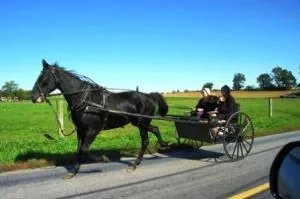
The most common animal in Amish country is the horse
Traveling through Amish country, and you can drive from one end to the other in about 30 minutes, we passed several covered wooden bridges several times. Some of them are over 150 (!) years old. The one in the photo was built in 1893. Covered wooden bridges can be found throughout New England (as the northeastern states are called). They exist in Connecticut, New Hampshire, Massachusetts, but they first appeared in Pennsylvania, and there are still more of them there than in any other state. And in Pennsylvania, the most are in Amish country – a full 28 of them. Perhaps because there are many streams and rivers running down the hills from the nearby Appalachians.
It is believed they were built covered to protect them from the weather and make them more durable. But every time you hear the amplified clip-clop of hooves from inside the bridge, it seems they were built that way just for that amplification. By the way, Americans don't say "цоканье" but "clip-clop, clip-clop, clip-clop".
Even very old, already dilapidated covered bridges, like this one painted red with barn paint, are carefully preserved by the Amish: they are another trademark of their country. In the brochure given to us during the farm tour, I read with surprise that the Amish themselves call them "kissing bridges." In Kyiv, there is also a "Kissing Bridge" over Petrovska Alley. It is interesting that different peoples have the same romantic associations with these noble structures.
It was already the end of the day when a whole cavalcade of buggies with young people rushed past us. From their open windows, quiet female laughter was distinctly audible. They were clearly heading toward the covered bridges.
Next to the red bridge stood an old, also no longer operational, water mill. Along the roads there are many mini-markets. Jars of homemade jam, honey, pickles are displayed, vegetables, ears of corn, cookies, and bread are laid out. There are no sellers anywhere. Everything has a price written on it. Put your currency down and take what you like.
In the decoration of some houses, symbols of the approaching Halloween had already begun to appear, but these were clearly not Amish houses: Halloween is a pagan holiday.
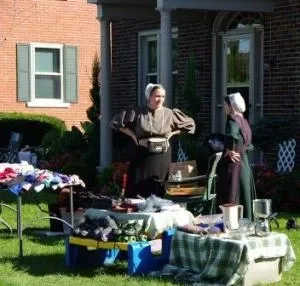 As everywhere in America, on the streets of Amish villages on weekends in good weather you can find many flea markets. Here you can cheaply buy various small items, usually not new: from birdhouses to children's clothing and roller skates (children grow up quickly, and Americans do not consider it shameful to buy worn but, of course, washed, cleaned, and ironed clothes for them).
Many villages in Amish country have unusual original names. For example, there is a hamlet "Paradise." And this is a very strange name – "Bird in Hand." The sign says it was named after some image on a swinging picture hanging in an old hotel. What that picture is and which hotel is mentioned, I think only locals understand. I forgot to ask them about it. Perhaps it is somehow connected with the American proverb "A bird in the hand is worth two in the bush," similar to the Russian "Better a titmouse in the hand than a crane in the sky."
Unexpectedly, we entered a village with a name even stranger for these puritanical places: "Intercourse." As we were later explained, the name came from its original meaning: once upon a time, two roads intersected at this place. The signs indicate that "Bird in Hand" was founded in 1734, and "Intercourse" in 1754.
While we traveled and absorbed impressions, it was time for lunch (Americans call the midday meal lunch and the evening meal dinner; they practically never use the word "supper"). And where else but here, in the land of dairy farms, should we replace the traditional American sandwich with a serving of good ice cream? In family cafes at farms, the Amish offer several types of it. Americans are big ice cream lovers and many come here specially for it. We decided to go to a large cafe at the main factory of the famous American ice cream brand "Turkey Hill." It is located a bit away from Amish country, another 15 minutes drive west along the same Route 30 in the town with the most common and proper name in America, "Columbia," which stands on the banks of the wide river with the Indian name Susquehanna.
This company appeared here, in the land of dairy farms, of course not by chance. It was founded by one Armour Frey back during the Great Depression. Before that, he began each day thoughtfully watching the sunrise over the Turkey Hill nearest his home. Then he would put several bottles of milk from the morning milking on the back seat of his old car. He was not Amish and delivered milk to neighbors – every cent counted back then.
By the way, such a business, daily delivery of fresh milk to scattered rural homes, still exists in America. Gradually, the business grew, and it was inherited by three sons, who began making ice cream and selling it across the country. That is the family. Their illuminated photograph adorns the factory lobby.
The production itself is now in an old brick building. It is a stone's throw from Turkey Hill, the very one where the company was born. On the first floor of the building there is a cafe where you can try dozens of types of the famous "Turkey Hill." For a small fee, you can go on a tour of the workshops, during which they will explain and show you the entire process of making ice cream.
We silently agreed to skip this excursion and, without delving into details, immediately got down to business. Personally, I couldn't resist and ordered three whole scoops, and they're quite large here: I started with a cold (even in taste) mint with chocolate chips, followed by blackcurrant, and didn't deny myself the plum one. And that was enough for me for the rest of the day.
After lunch, we headed to another goal of our trip – a matinee performance at the famous theater "Sight and Sound". Its huge building in a "fairy-tale" style, surrounded by giant asphalt parking lots, stands in an open field in the very heart of Amish Country. Although formally the theater has nothing to do with the Amish, it appeared here 35 years ago, apparently not by chance. All performances of this theater are based on stories and parables from the Bible. During the season from early spring to fall, only one show is staged at the theater.
This year, the theater was performing "Joseph" (in English "Joseph" – "Joseph", abbreviated "Joe"). This photo shows the playbill that was handed to us at the entrance. I scanned it later. The play was about that same Joe, who was the great-grandson of Abraham, grandson of Jacob, and son of Isaac, whom God named Israel, and from whose twelve sons came the twelve tribes of Israel. It is from Joe that the Jews descended.
In form, it was a musical with wonderful actors, music, dances, singing, costumes, sets, and lighting effects. But not only that: during the performance, real camels, sheep, donkeys, and other "ancient Egyptian" animals walked across the stage, and sometimes through the aisles. For example, when Joe was in prison, real rats (white ones, though) ran across the stage. In short, a real Taganka Theater.
I tried to take photos, but everything on stage moved so fast that nothing came of it. Those who are interested can go to YouTube, search for "Sight and Sound Joseph", and watch entire scenes from this performance.
By the way, the hall was full. We bought tickets in advance. I was surprised how the theater manages to gather so many spectators for a show that has been running for six months in such a remote area far from big cities, and on weekends the theater gives two, sometimes even three performances. In the parking lot, there were cars not only from nearby places but sometimes even from not-so-nearby states.
Continued: AMISH COUNTRY (Part 5)<\/a><\/strong>
Mark KRYMSKY.
Photo by the author.
 <\/strong>