
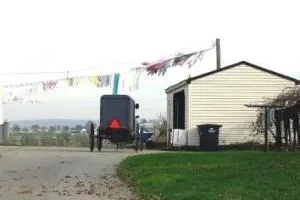
One of the Amish houses
Considering the family one of the three main life values, the Amish also pay great attention to community life. For example, if someone among the Amish needs a new house (a family forms or a fire occurs), the whole community builds it. Dozens, if not hundreds, of men gather and in one day (!) erect a large wooden house, literally turnkey. Women on that day cook food for everyone, and such a day ends with a joint meal.
We were not lucky enough to catch such a construction, but there is a wonderful American film "Witness" starring Harrison Ford. The film is set in Amish Country, and there they are collectively building a house. Amish homes, like most homes in America, are wooden or made of glulam timber. If they look brick or even stone in photos, it is only cladding: the frame and all floors are wood.
The Amish do not have nursing homes. If an elderly person who can no longer care for themselves lives in a home, a duty roster is set up and the whole community helps. As our guide told us, among the Amish there are quite wealthy people, even by American standards. This is explained by their very low expenses: they do not buy cars, do not pay for gasoline, they have no mortgages on homes. In addition, the Amish do not buy insurance.
Even for a doctor's visit, they pay cash. If someone needs a serious operation, the whole community chips in. The Amish do not buy expensive clothes, food, jewelry, cosmetics, or perfumes; they do not travel, do not go to concerts or exhibitions, of course do not drink alcohol, and most importantly, they work on their farms and in workshops from dawn to dusk.
Besides being excellent farmers, the Amish are also famous for their crafts. Their villages have many craft and souvenir shops, browsing through which is a perfectly innocent Sunday pastime. For example, there is a huge candle shop: candles are not the least important thing in an Amish household. And what candles they have! "Barn" in English means "barn" (it seems it was one once, but also in America large stores are jokingly called that).
In Amish Country there are many blacksmith shops, which is natural. They are identified by such signs and the forgotten smell of coal, which unfortunately I have not yet been able to photograph.
 The Amish are known carpenters and joiners. Here you can find a real wooden horse from our childhood and a grandmother's rocking chair from an old fairy tale. The Amish make solid, slightly old-fashioned, but genuine wooden furniture. Lovers of such furniture come here for it even from Philadelphia and New York.
Each of these stores also has a section of antique, sometimes slightly restored, furniture. In one such section, a set of 12 chairs immediately caught my eye (the other six did not make it into the frame, but stood nearby). My companions started hurrying me, so I only managed to feel a couple of them (for luck).
The Amish are also famous for their quilts, samples of which were hung in abundance right on the street in front of store entrances. Most shops are located on the first floors of houses where Amish live, in converted sheds and barns.
By the way, the large "Red Army" stars on Amish houses are an ancient sign, meaning the same as a horseshoe: for luck. Horseshoes are also sometimes found, but stars more often.
The Lancaster community has about 200 so-called "one-room schools" where students of all ages from the nearest streets study. All schools are located so that students can, like Tolstoy's Filipok, walk to them or at worst ride a scooter (it is the 21st century after all!). All students, as in Tolstoy's story, sit in one room and study for eight years. The schools are taught by girls who have recently graduated themselves and are not yet married. The list of subjects is small: English and German, math and history. The Amish believe that such an education is sufficient for a traditional farming life, but if someone wants to give their children a modern education, they can enroll them in the nearest regular school.
We drove up to one such school when a lesson was in progress, and I managed to take a photo. At another school break had just started, the kids poured out into the yard. Above each school at the entrance there is a bell tower. This is not decoration but an ordinary school bell: they have no electric ones. A rope from the bell runs directly inside, and the student on duty pulls it, giving the signal to start the lesson each time.
The older kids started a game of baseball. Along with the boys, girls in their long dresses also played this traditionally male game. Even the role of batter, the one who hits the ball with the bat, was performed by a girl. So much for submissiveness, so much for the traditional patriarchal order...
While our ladies collected late forget-me-nots along the road, and my engineer friends surveyed the surrounding fields, professionally assessing the crop prospects, I approached the wide-open window and took a portrait of the young teacher.
Behind most Amish shops, family restaurants, and farms there are small free petting zoos where you can easily interact with the animals. As a rule, the most ordinary domestic animals and birds roam there: chickens, roosters, goats, piglets – a sight modern American city dwellers find exotic. In most petting zoos there is the favorite hero of American fairy tales, the donkey Dunky with his mother.
Goats love to be photographed most of all. Seeing my camera, they immediately approached the fence and professionally took the right position (in terms of lighting and angle). To prevent tourists from feeding the animals just anything, there are small automatic feeders near each enclosure where you can get some oats.
In one such enclosure we were greeted by an exotic sight: a real Peruvian llama was walking around the yard, while its blonde friend was guarding their house. But as soon as I extended a handful of oats to her, she instantly perked up and licked it all up. I also didn't miss the opportunity to stroke the head of the family by the scruff.
Thousands (if not hundreds of thousands) of fat Canadian geese, the blue dream of Panikovsky, turn any vacant lawn or pond in Pennsylvania into an intermediate airfield every spring and fall. On the day of our trip, the migration was just beginning, but the very first restless fliers were already exploring their runways here.
Continued: THE LAND OF THE AMISH (part 4)
Mark KRYMSKY.
Photo by the author.