
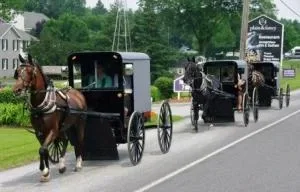
All day long, buggies, like large gray and black beetles, scurry along the roads of Amish Country, obeying most traffic rules
The Amish fundamentally do not use cars, considering them too easy and tempting a way to move into the outside world, from which they expect no good. And although today among not the poorest Americans owning a horse is much more prestigious than some souped-up Mercedes, for the Amish the horse has always been and still remains not a luxury but a means of transportation.
The most common Amish carriages are rectangular cabins. They themselves call these cabins 'buggy' (from the word 'bug', and 'buggy' accordingly is 'little bug'). The modern dictionary already translates 'buggy' as a 'cart' or quite old-fashionedly 'cabriolet', which means in English there is already a well-established name for this means of transportation. But since it is not a Russian cart, nor a French cabriolet, nor a dray, nor a Greek phaeton, nor a tarantass, nor a Polish bryczka, nor a Siberian taratayka, nor a Gypsy kibitz, nor a pram, nor certainly a carriage, and by no means a Makhno-style tachanka, nor a charabanc (also of French origin, by the way), nor a wagon, nor an arba, nor a line cart, nor a bedarka, and not even a jalopy, I will allow myself to keep in my story this nice word 'buggy'. Who knows, maybe I, with the help of the Amish, will make my contribution to the great and mighty.
Amish amazons sometimes ride in two-wheeled carts or open phaetons, but the classic buggy has a rectangular cabin in gray (for the Amish) or black (for the Mennonites) colors.
All day long, buggies, like large gray and black beetles, scurry along the roads of Amish Country, obeying most traffic rules. They boldly dart from the side road onto the highway, start briskly at intersections, do not flinch and pay no attention to the huge cars running alongside them, apparently in their hearts considering them strange and clumsy means of transportation. In parking lots, they park equally alongside cars.
Near one farm, in an open field, we noticed no fewer than fifty unhitched buggies. Whether it was a buggy depot or some repair shop, we never found out.
For individual transportation, the Amish also often use scooters of a special advanced design. They are mainly used by children. Sometimes even very little girls cover quite considerable distances between villages on them. At the same time, they boldly ride on the roadway: there are no special paths for them here (it's not Holland). Sometimes quite grown-up guys also ride scooters. And if you're very lucky, you can see a real milkmaid hurrying from the morning milking on a heavy-duty scooter.
Externally, representatives of different sects in Amish Country hardly differ from each other, just as their life philosophy hardly differs. They all wear very simple clothing (women necessarily long dresses), because the Bible teaches modesty. They, of course, do without jewelry, do not use cosmetics and perfume, and do not wear short haircuts.
In memory of those sad times when on their historical homeland they were persecuted by Prussian soldiers dressed in bright uniforms with wide belts and large buttons, men wear only suspenders instead of belts, and women try in every way to avoid buttons, replacing them with pins and hair clips.
On their heads, women typically wear white bonnets. Men wear straw or black felt hats. The external differences of unmarried, married men and married women are strictly regulated. This includes the shape of hats and bonnets, the color of dresses, and other insignificant details. The colors of clothing are modest. Not by chance do the Amish call themselves "plain people," that is, simple people.
Only married men have the right to wear a beard. There it is, a powerful incentive to procreate! The classic was right: "Beauty will save the world!"
Every weekend from spring to fall, Amish Country fills with gawkers (in modern terms, tourists) coming from nearby cities and states. Being very spiritual people, the Amish at the same time turned out to be very earthly, both in the literal sense, by their occupation, and in the figurative sense, by their ability to do business. Although they are not at all fond of the gazes directed at them from all sides, having accepted their inevitability, they decided to regulate this turbulent flow and extract possible profit from it. For this purpose, the Amish built a special Potemkin farm, where they themselves tell all about their life, give rides in special multi-seat buggies, show their crafts and other achievements of the national economy, well, in short, everything that is supposed to be shown in a Potemkin village.
We also started our day with a visit to this farm, and almost everything I am telling about the Amish we learned on this excursion.
For example, we were surprised to learn that besides horse-drawn transport and scooters, another significant difference between the Amish way of life and that of the civilized part of humanity is the almost complete absence of electricity and telephones in their homes. Moreover, they are not against electricity as such; the whole point, it turns out, is the wires that supply it and, in their opinion, serve as another path from the corrupting outside world. The same applies to pipes supplying gas.
At this point in the guide's story, I couldn't help but ask sarcastically: "Do the Amish use electrical devices and mobile phones without wires, on batteries?" Without being embarrassed, he replied that yes, that is not forbidden. I then spent the whole day hunting for such a shot: an Amish man in a straw hat with a white beard in suspenders, sitting in a buggy with a mobile phone to his ear, but I never saw such a picture. Using mobile phones is already permitted for the Amish, but no one has canceled their manners yet.
Protestantism abolished the magnificent Gothic cathedrals and smaller churches with stained glass windows, ascetic saints, paintings by great and lesser artists, and organ music with angelic children's singing in Latin, which almost no one understood anymore. Protestant churches are always very simple structures: inside there are fundamentally bare walls, benches, and on the tables only the Text – the Bible (necessarily in a language understandable to the parishioners), an object of study and memorization. Having abolished form, as it seemed to them, which had lost content, the Protestants replaced it with another extreme, and, in their opinion, the quintessence of faith in its pure form – content without form.
There are a couple of extremely simple Mennonite churches in the Country of the Amish as well. Here is one of them. We drove up to it when the Saturday service, or more correctly the gathering, had already ended and the parking lot was empty. But don't try to find even the most modest Amish church here – they simply don't exist. The Amish went even further than the Mennonites in this matter: they completely abolished the church, literally following the Bible, for it is written in Scripture: 'The Most High does not live in temples made by hands.' To read the Bible, the Amish take turns gathering weekly in their own homes.
Continued: COUNTRY OF THE AMISH (Part 3)
Mark Krymsky.
Photo by the author.
