
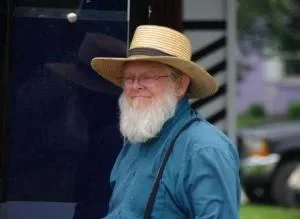
Outwardly, representatives of different sects in Amish Country hardly differ from each other, just as their life philosophy hardly differs.
These people appeared in America three centuries ago and it was no accident that they first settled in Pennsylvania, then still an English overseas colony. Once, the English King Charles II lost a pile of money at cards to his admiral Penn, and when the latter died without being able to repay his son William, he offered payment in kind – conquered but still undeveloped overseas lands.
William, however, was obsessed with the idea of finding a free place on Earth and founding a country where people of any religion or denomination could live with equal rights, and therefore he accepted the king's offer.
Even today there are not many such countries on Earth, but the first was the English overseas colony in America, now the state of Pennsylvania, which means 'Penn's forest country'. The first to whom William Penn offered to move to his country were the Protestants then persecuted in Europe. First came his countrymen, the English Quakers, and founded the colony's largest city, Philadelphia, and many other towns in the area. After them, from Prussia and the German part of Switzerland, began to come those called Amish. Of the many Protestant sects arriving in Pennsylvania at that time, they alone managed to fully preserve their way of life to this day.
William Penn gave the Amish land free of charge in the area of present-day Lancaster (west of Philadelphia, about 100 kilometers inland). From there they gradually began to spread throughout America. Currently, about 250,000 Amish live in the United States. They usually settle in compact communities. Their large communities exist in the midwestern states (Indiana, Kansas), and they also live in Maryland and other states. The largest community (82,000 people) remains the Amish community in Pennsylvania. A nearly identical community to the one in Pennsylvania exists in the neighboring state of Ohio. The places of compact Amish settlement are not administratively demarcated in any state: side by side and mixed with them live other Americans with their own traditions, beliefs, and businesses, so I simply invented the name 'Amish Country'.
One fine Saturday morning in early autumn, my friends and I decided to hit the American backroads towards Amish Country. From Philadelphia to Lancaster leads Route 30, which a century and a half ago first connected the country's east and west coasts. Today it is a very rural, sometimes even one-lane highway.
Near Lancaster, the road begins to gently rise and fall, overcoming picturesque hills (Americans call them 'rolling hills'). On both sides of the road, pastoral views open up of green fields with farms scattered on the hills, grazing cows, and protruding silo towers. This is the first sign that we are entering Amish Country, which they themselves call Farmland.
Suddenly, from a side road, a two-wheeled cart came out and rushed towards us as if from an old Dutch painting, pulled by a lively horse. In the cart sat two ladies dressed in long black dresses matching the horse (one in a white bonnet, the other in a black one) and two little boys (one wore an old-fashioned straw hat, the other held an identical one in his hands). I barely managed to brake, grab the camera I had placed on the dashboard in advance, and press the shutter.
The horse clattering on the asphalt and its riders, paying us no attention at all, as if we, not they, were the ghosts, dashed past and disappeared around the bend. On the highway, only speeding trucks, jeeps, and other monsters of civilization remained. Or did we imagine it?
Soon, at a large intersection, a strange rectangular gray carriage slowed down near us, and from its open rear window a little boy, also in a straw hat, was looking out. As soon as the light turned green, it darted away and instantly vanished. Already from these first encounters with the inhabitants of Amish country, I learned a simple lesson: to get a good shot here, you need to keep the camera constantly on and, most importantly, stay alert.
The further we advanced into the country, the more often we encountered horses we had never seen before on American roads, harnessed to archaic and unusual carriages. In them sat strangely dressed people: men, as a rule, with large beards, wearing straw or black felt hats; women and girls in long simple dresses and white bonnets with high exposed foreheads.
We also began to come across some agricultural vehicles drawn by a pair of horses, driven by men still in those straw hats and black trousers with suspenders.
And when in an open field a sorrel horse appeared, resignedly pulling some ingenious plow, we finally believed and became convinced that all this was not an open-air theater, but simply that we had entered Amish Country.
Those who are today called Amish (after the name of the largest sect) actually consist of Protestant sects that do not differ much from each other, the largest of which are the Old Order Amish (almost like 'Russian Old Believers'), Mennonites, and Brethren. The first of them appeared, the Mennonites (from Menno Simons, the founder of the sect), back in 1530. Unlike other Protestants, for example, they baptized only those who had reached the age of 18. The Old Order Amish (named after Jacob Amman) separated from the Mennonites in 1600 and went even further: they were already against any interference from the outside world in their lives and believed that nothing good could be expected from it.
From the simple biblical values that all Protestants sought to return to, the Amish consider family, honesty, and working the land as paramount. Even in daily life, they still manage to literally follow the Bible, preaching three commandments in everyday life: modesty, simplicity, and submission.
Most of the "oddities" of the Amish way of life are connected with their desire to protect their lives and the lives of their children from the corrupting influence of the outside world. Actually, this is an old philosophical debate about whether progress brings more good or evil. There is still no answer to it, which is why it is philosophical, but the Amish still firmly believe that time can be stopped if not in a single country, then at least in a single community. Nobody here interferes with them, and God help them!
Continued: THE AMISH COUNTRY (part 2)
Mark KRYMSKY.
Author's photo.
