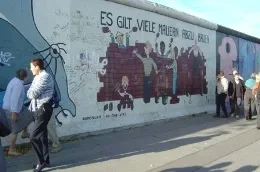
The Berlin Wall has recently been attracting not only tourists
Before World War II, Germans did not know the word "Wessi" – the concept of a "Western German" simply did not exist. And "Ossi" referred to Germans living in the "true" East of Europe – in the Sudetenland, Poland and beyond, as far as Memel (now Klaipėda) and the Austro-Hungarian city of Lemberg. Germans who had been brought to Russia by history were called "Volksdeutsche," and it was believed that they were no longer truly German.
The Second World War ended, the half-contemptuous word "Volksdeutsche" was discredited by the Nazis, and Germany's borders changed beyond recognition. Lemberg and Breslau regained their native names – Lviv and Wrocław; the famous "Ossi" resorts of Marienbad and Karlsbad became the beautiful Czech health resorts of Mariánské Lázně and Karlovy Vary; and the proud Königsberg, birthplace of Immanuel Kant and "bulwark of the Prussian spirit," as Iron Chancellor Otto von Bismarck called it, turned into Russian Kaliningrad. Germany split into two – the workers' and peasants' GDR and the capitalist FRG, with its capital not in ancient Berlin but in Bonn, a small town that, after reunification, once again became what it had always been: a sleepy suburb of bustling Cologne.
From the moment the Berlin Wall was erected, the word "Ossi" came to refer not to Austrians or Sudeten Germans (they were driven from their native lands further west) but to residents of the German Democratic Republic. Those, in turn, coined the word "Wessi." Perhaps out of resentment, or maybe just for balance.
Twenty years ago, the Berlin Wall fell. This happened, as direct participants in its collapse now claim, almost by accident. Politicians of those years recall that Margaret Thatcher sharply opposed the reunification of the two Germanys, seriously fearing a revival of German revanchism. George H. W. Bush, former U.S. President, repeatedly admitted that he learned about the fall of the Wall after the fact, gave no orders on the matter, and generally did not understand why the Germans every year so persistently thanked Americans for help in German reunification. "We helped the Germans after World War II, we protected them from the USSR during the Cold War, but we had absolutely nothing to do with the destruction of the Berlin Wall," Bush emphasized.
Nevertheless, newly re-elected German Chancellor Angela Merkel, speaking before the U.S. Senate and Congress (before her, such an honor had been granted to only one German chancellor – Konrad Adenauer), again thanked Americans for their help in tearing down the Berlin Wall. Well, history is a capricious lady. After all, Germans thank Mikhail Gorbachev for the same thing – and for him, too, according to many witnesses of those events, the fall of the Wall came as a surprise.
"Good old Uncle Kohl," unexpectedly becoming chancellor of all Germans, in a fit of enthusiasm promised his eastern brothers "flourishing landscapes," and the western states adopted the so-called "Solidarity Pact," under which to this day they annually "kick in" billions from their own budgets to five federal states of East Germany for development.
But Germans did not feel much unity at that moment. The "Ossis," stepping through the ruins of the Wall into the "brave new world," felt like tourists in a Western supermarket: everything was so bright and shimmering, shelves were bursting with abundance, and in their pockets rustled Deutsche Marks from the so-called Begrüßungsgeld – "welcome money" handed out by generous Western neighbors to every newly found compatriot from the East. And not everyone rushed for a tour. For example, the same Angela Merkel, according to her, upon hearing the news of the opening of the checkpoint at famous "Checkpoint Charlie," shrugged and went to the sauna with friends. Western Germans, having collected pieces of the Wall as souvenirs, were in no hurry to move into East Germany – it was too dark and uncomfortable there, no "flourishing landscapes," even streetlights were scarce.
Thus, on that first night, "Ossis" and "Wessis" sang, cried, and hugged not at each other's homes, but strictly along the perimeter of the Berlin Wall, listening to the English-language ballad "Wind of Change" by the Scorpions. Despite the multi-voiced chanting of "Wir sind das Volk!" ("We are the people!"), they did not feel like a unified nation. Not for nothing, right after these historic events, a joke appeared: on the night of November 9, 1989, an "Ossi" and a "Wessi" meet on the ruins of the Berlin Wall. The "Ossi" extends his hand and says: "At last we are one people!" The "Wessi," after a moment's thought, also extends his hand and replies: "Yes, and we are, too."
Alas, the invisible divide did not disappear and persists to this day. Over the years, this phenomenon was felt differently: first, Western Germans joyfully helped their Eastern brethren, feeling like philanthropists in the best sense of the word, thereby separating themselves from those they so willingly helped. Later, when the first "Schröder-era crisis" broke out, "Ossis" and "Wessis" often took offense at each other, stereotypes emerged like "Ossis are always complaining about something" and "Wessis have their noses in the air."
Nevertheless, differences – primarily in quality of life – gradually began to fade. Today, the wage level in the East has closely approached that of the West, and in some respects, the federal states of the former GDR have even surpassed their Western neighbors. For instance, the current German Minister of Transport Peter Ramsauer (CSU) announced right after taking office the start of a program to improve the road network... in the Western states. Allegedly, the East has built such wonderful roads that poor "Wessis" can only dream of. Another example: half of all intra-German investment in construction goes to East Germany. At first glance, that's fair. But there are only five Eastern states in the country, and not the largest ones, while there are eleven Western ones.
It is precisely to such arguments that today's supporters of the slogan born in the East and spread to the West resort: "Lasst die Mauer wieder hoch!" – "Build the wall again!" Of course, this is pure utopia, like calls for the revival of the CMEA and the Warsaw Pact. But such slogans once again demonstrate that the division into "Ossis" and "Wessis" is far from overcome. This year, when the 20th anniversary of German unification is celebrated, those who were not even born at the time of the Berlin Wall's fall are receiving passports. But they, too, continue to habitually divide themselves into "Eastern" and "Western" Germans. In the east of the country, what flourishes is not so much the landscape promised by Helmut Kohl, but rather the so-called "Ostalgie": an irrational, inexplicable longing for the "good old days" of the first German state of workers and peasants.
It is noteworthy that this strange ailment affects not so much the older generations of Eastern Germans, but young people who essentially did not live in the GDR. For today's young men and women from eastern Germany, their "former" country is not a bastion of socialism with its "birthmarks" such as total surveillance of everyone by everyone, shootings of those who tried to cross the German-German border, and long queues for scarce goods. The GDR has turned in their minds into a sweet, somewhat patriarchal country with pioneers and "FDJ-ers" (as the German counterparts of the Komsomol were called, from the abbreviation FDJ – Freie Deutsche Jugend or "Free German Youth"), with folk songs and social guarantees, but without unemployment and uncertainty about the future, without neo-Nazism and its opposite – migrant ghettos and an influx of "guest workers"...
Of course, these notions are naive. Unemployment in the GDR certainly existed, but, following the Soviet model, it was masked by useless jobs at meager wages; people were arrested by the hundreds and thousands; the notorious "guest workers" also abounded, but were called "workers from fraternal countries" like Vietnam and Laos... But these debates are for historians, and "Ostalgie" is as irrational as the feeling of gratitude Germans feel towards Bush and Gorbachev...
The omnipotent Ministry for State Security, or "Stasi," has transformed from a fearsome punitive organization into a museum bearing its name and a cleverly arranged café in the Lichtenberg district of East Berlin, called "At the Firm" (the "Firm" was exactly what the Stasi was called in the GDR). When you come here, you see typewriters with interrogation protocols sticking out of them, and at the entrance you are offered to sign a "contract for voluntary cooperation." If you sign, you get a 10% discount on all drinks; if you don't sign, you are still treated, but at full price. The café's motto – "Come to us, or we'll come to you!" – brings a smile, not terror. KGB Colonel Vladimir Putin was enthusiastically received in the Bundestag, where he delivered a speech in pure, almost accent-free German, and the "Stammkneipe" – the pub he visited during his service in Dresden – an enterprising owner turned into almost a museum.
In Berlin, on Alexanderplatz, kiosks are actively selling postcards with an inscription in German but in Russian letters, which in translation reads: "If you can read this, then you are not a stupid Wessi." And at that same "Checkpoint Charlie," enterprising Turks have long been selling ushankas with garish red stars and caps "à la Red Army" – of Soviet design, but often with imperial cockades. Tourists buy them – of course! They also briskly buy stones from the nearest quarry, naively believing they are acquiring "fragments of the Berlin Wall."
For their part, Western Germans rarely venture east. Even West Berliners try not to go to the eastern part of the capital, seriously believing that beyond Friedrichstrasse the asphalt ends and all civilization ends with it. However, in this case, young folks turn out to be more enterprising than their parents, grandparents: recently, among West German youth, a fashion has spread for taking hiking or cycling tours through the eastern states. Finding themselves in the Mecklenburg forests or on the vast, deserted coastline of Heiligendamm, they are touched: "What pristine wilderness!" Actually, in Bavaria or Baden-Württemberg you can find denser forests, and the coastal strip near Bremen or Hamburg is not teeming with people. But there they feel at home, in the bosom of civilization – not like in the "Wild East." Thus, Western Germans also pay tribute to "Ostalgie" – albeit in their own way.
It turns out that the main Berlin Wall – virtual, built solely in the minds of Germans – has not gone anywhere. It has only become lower and allows curious onlookers to peek to the other side without fear of barbed wire, searchlights, and snipers. But it still stands. As an artist once wrote on the real Berlin Wall: "Es gilt viele Mauern abzubauen" ("Many walls need to be dismantled"). Not only stone ones.
Boris ALTNER.