
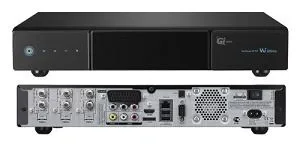
Thus, the first model is known among professionals as having no analogues. Its main advantage over other receivers is its powerful dual-core Broadcom BCM7413 processor, capable of supporting simultaneous operation with three tuners. Although the GI 7799 receiver is equipped with an equally powerful ALi-3606 processor, which is not inferior to the aforementioned one only in terms of frequency parameters.
Also, a significant difference between the receivers under consideration is the tuners included in their package: the GI 9995 is equipped with two high-sensitivity DVB-S2 standard tuners with the ability to replace them with a combined DVB-C/T or install a third one, while the GI 7799 initially has two tuners of terrestrial and satellite broadcast standards (DVB-S2 and DVB-T2), which is one of the key points for choosing this particular receiver and allows us to speak of its resistance to obsolescence.
It should be noted that the developers of both models have done their best to include all sorts of latest technological solutions in their configuration. This also applies to connecting satellite equipment to the global Internet network. However, the GI 9995 surpassed its counterpart by implementing the IEEE 802.11 b/g/n data transmission standard when using a Wi-FI USB adapter, whereas the GI 7799 model does not additionally equip such adapters.
Another difference between the models is the ability to install a SATA hard drive inside the GI 9995 case or record necessary content via the eSATA bus. Whereas in the GI 7799 model, recording content to external storage media is only possible via a USB port.
One cannot fail to mention the presence in the configuration of both models of two card readers that support working with Conax, Viaccess, Irdeto encodings, as well as Common Interface slots that can be used to install licensed CAM modules, which significantly expands the range of viewable channels.
Concluding the comparative analysis, we note that despite the differences, both models deserve the attention of modern receiver users. And such differences in characteristics are significant only for users with increased requirements for satellite equipment.
_