
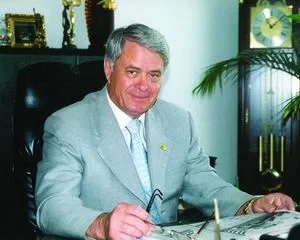
Rector of the European University, Chairman of the Association of Educational Institutions of Ukraine of Non-State Ownership Ivan Timoshenko
- So, it's the month of May, and many school graduates are beginning to think about where to go to study...
- It is very bad if these thoughts come to mind at the same time as the last school bell. You need to choose a future specialty much earlier. Introducing twelve-year school education is certainly a correct step. But for some reason no one thinks about making the main emphasis in senior classes on professional self-determination of schoolchildren. Perhaps this sounds harsh, but I am absolutely convinced: for some, nine grades will be quite enough. His further path is obtaining an applied specialty and realizing himself as a professional precisely in the chosen field. And for others - a direct road to an institute or university.
- Well, so it turns out, the clever ones to the right, the stupid ones to the left?
- Nothing of the sort! For a long time we had an opinion that only higher education guarantees a person's demand as a specialist. That's not entirely true. An excellent professional can be in high demand on the labor market and earn well without having higher education. When choosing a further path, one should proceed not from questions of prestige or fashion, but from one's own knowledge and aspirations.
- And how to help a schoolchild decide on the choice?
- This should be the task of the school - to help decide what exactly the student should focus on. Yes, of course, there are geniuses who equally successfully write poetry, win mathematical olympiads, draw, sing. But the majority still has some preferences, personal qualities that can be useful in the chosen profession or, conversely, turn out to be completely unnecessary. It is bad if the motivation of parents in choosing a specialty is much higher than the motivation of the applicant himself.
- Suppose, by joint efforts, we have decided on the future specialty. Now it remains to choose a university...
- The parents of an applicant face a difficult choice: will their child enter budget-funded or paid education? Incidentally, I fundamentally do not use the expression "free education". Education is generally a very expensive process. Money for the so-called "free" education is allocated by us, the taxpayers. It is no secret - there are excellent state and private educational institutions. At the same time, there are universities that year after year can "boast" of a chronic shortage of applicants - also both state and private. Meanwhile, thanks to some media, it is private universities that are blamed for almost all the sins of our higher education. But judge for yourselves: in our country there are 2.5 million students in total, of whom only 280 thousand study in private universities. So 10% cannot fundamentally affect the situation. Incidentally, another interesting observation: last year the Ministry of Education closed a number of branches of higher educational institutions. So, most of them were branches of state universities.
- What else can you say about the pros and cons of budget and private education?
- I would in principle change the entire system of education financing. As long as budget money for a student's education is allocated to the rector of the university, it is impossible to eradicate abuse and corruption. The rector should be allocated money for repairing the roof and all buildings, for purchasing equipment, for libraries, and partly for teachers' salaries. But for education, the student himself should receive money! And so, after passing a single test across the country and receiving an "educational voucher", he himself chooses the university where he would like to study. In the form of an "educational voucher", a state targeted loan can be issued, which is then repaid over a certain period. Such a system works successfully all over the world. In many countries, educational loans are given on preferential terms or even non-refundable. For example, in Australia they are paid for 30 years and only if the specialist's salary reaches a certain level.
My opinion is that budget-funded education at present to some extent corrupts the student, reduces the motivation to complete education. For example, an applicant, having entered a budget-funded department, studies for two or three years, and then switches to another specialty. Or he simply "fails" the session, "flies out" of the institute, and then recovers and studies again. And he continues to study at our and your expense, at the taxpayers' expense! In Soviet times, this issue worried no one. And now? How much does such "free" education cost our country?
- Well, what should be done while there is no state lending?
- The European University was the first institution of higher education in Ukraine where students began to be given loans for education. And now many private universities seek to pursue the same policy. In addition, at our university there is an opportunity to take a break for a year: go to work, collect the required amount and continue studying. This is how students study in Germany, France, Great Britain.
We still have many parents who believe that while the "child" is studying, one should blow dust particles off him. And God forbid he should go to work! I, on the other hand, am convinced: the sooner a student tries to apply his knowledge in practice, the easier it will be for him to study later - he will already see what needs to be paid attention to, what one needs to know and be able to do today to succeed in business.
Unfortunately, our school teaches mostly theory, not practice. It is just not customary for us to give children the basics of economic knowledge, to instill some life skills! In America, schoolchildren plan their budget, navigate the labor market freely, and work part-time almost all the time. Have you ever wondered why we sometimes have to teach a bachelor for four years? Applicants do not know a foreign language, cannot work with a computer. All over the world, this is taught at school! Until we introduce these subjects into secondary education, we will not be able to bring the levels of specialist training to a common global denominator.
Also, we have seen a phenomenon such as 'smart uselessness': you seem to have an education, and the person is not stupid, but... There is no depth of knowledge, no practical understanding of it, no desire to apply it in practice. Sometimes there is no elementary desire to work at all! That is why I believe: students' work placement is the basis for their smooth, painless entry into the adult business world. You have no idea how our students, having 'smelled business', are eager to work! And here a certain pedagogical difficulty arises: to keep students at the university so that they become real specialists. Higher education is a system of knowledge transfer that has been formed over centuries. The principles of basic training at a classical university have not changed since the time of Lomonosov, when the first enrollment had only 15 students. But developing a powerful practical block is what every university should think about today.
- How is higher education in Ukraine doing today? How accessible is it?
- Let us rely on numbers. There is an indicator in the world such as the education level of a nation. In Soviet times, 160 out of 10,000 people studied at universities. For the current year, the budget provides that this indicator will be 170 people. And if we take into account educational institutions of all forms of ownership of I-IV accreditation levels, then 520 people will become students. There is a huge increase in the level of education. Although, for example, we are far from Japan: there, at the state level, a course has been set for the entire population to receive higher education. The same trend can be seen in Australia, South Korea, and Taiwan.
- Well, are we threatened by the notorious 'overproduction' of accountants and lawyers?
- The so-called 'overproduction' of accountants or lawyers is nonsense! Look: in Spain, there are 300 lawyers per 10,000 population. And they are all in demand! A good specialist with a quality education is always needed. For example, not a single one of our graduates has ever applied to the labor exchange! Today's young people are energetic and assertive, many start working as early as their fifth year. And after gaining their first practical skills and burning their fingers, they draw the right conclusions: what to pay more attention to during further studies, what to study additionally, what new skills may be needed soon.
Moreover, requirements are now changing for professions that were traditionally considered 'simple'. In Taiwan, for example, only a person with a higher education can work as a janitor. This specialist must be able, if necessary, to fix a water faucet, detect a malfunction in electronics, and even deliver a baby! His salary is about $3,000 per month.
In order not to make a mistake about the prospects of a chosen specialty, one can take a closer look at new professions. For example, we were the first to introduce at our university a specialty born at the intersection of two fields of knowledge - medical management. To become such a specialist, you have to be both a doctor and a manager.
I am pleased by the fact that the new generation is distinguished by a practical approach to life and a readiness to constantly learn. The older generation treated studying as a temporary difficulty: learned - passed - forgot. It was implied that with graduation from university, 'educational torments' end. Perhaps you still remember those blessed times when it was practically impossible to fire a young specialist, even if he knew nothing, could do nothing, and did not want to work at all? Now the situation has changed radically: a bad specialist simply will not be hired. And one who has fallen behind and stalled in his development will be mercilessly kicked out. 'Lifelong learning' is not a fashionable slogan of enlightened Europeans, it is a postulate of today's life. If you do not learn new things, you are not just standing still - you are rolling downhill.
Therefore, after literally a couple of years of work, you need to seriously think about getting a second education. Judge for yourself: what kind of accountant is this who does not know law? Or a manager who does not have legal knowledge? The average American manager can boast of 5-10 diplomas. Life sets new and new tasks for us, and in this dynamics lie both difficulties and opportunities. The modern world requires not only new specialties, but also specialists with 21st-century thinking.