
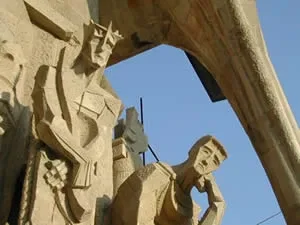
Spanish cultural figures oppose continuation of construction of Sagrada Familia basilica
Construction of the Expiatory Temple of the Holy Family (Temple Expiatori de la Sagrada Familia is the full name of the structure) began in 1882 under the direction of Francisco del Villar. In 1891, Antoni Gaudí became the chief architect of the basilica, by then already famous for his work on the Güell Palace and Casa Vicens (both sites are included in the UNESCO World Heritage list).
The construction of the basilica became a lifelong work for Gaudí — he believed that through the symbolism of the building he could express the quintessence of Christianity. The construction plan was constantly being modified. The architect performed extremely complex calculations to evenly distribute the weight of the building's structures, which have curved forms. Construction dragged on for many years because it was funded by donations.
Antoni Gaudí died in 1926 after being hit by a tram near the Sagrada Familia, and was buried in the basilica's crypt. By that time, he had completed about a quarter of the structure. During the Spanish Civil War in the 1930s, the building model and Gaudí's plans were destroyed. Up to the present day, work to complete the construction has been started and stopped repeatedly. In the 1980s, computer models began to be used to calculate the basilica's structures, and in the 1990s it was decided to finish the building by 2026 – the centenary of Gaudí's death. Since that time, discussions about the advisability of completing the project have begun.
The main argument of opponents of the construction is the careless attitude, in their opinion, of restorers and architects towards Antoni Gaudí's creation. The director of the Reina Sofia museum in Madrid, Manuel Borja-Villel, stated that the basilica is now just 'a caricature of Gaudí's creation.' Moreover, according to the protesters, the Sagrada Familia should have been left as it was when its creator died.
And, it must be admitted, there is a grain of common sense in this: the Expiatory Temple of the Holy Family ceased to be just an architectural structure when Gaudí took it on. The process of its construction, with the constant invention and implementation of new ideas, relates it most of all to literary creativity. After all, no one seriously tries to write the second part of Dostoevsky's 'The Brothers Karamazov' or finish Kafka's 'The Castle.' Although postmodernists, of course, like to play with popular cultural images — suffice it to recall Nedeljko Fabrio's 'The Death of Vronsky.'
Similarly, ideas for restoring the Roman Colosseum or Stonehenge are not taken seriously. Therefore, such projects are limited to amateur reproductions outside the locations of the historical original, like Stonehenge itself, or computer reconstructions in BBC programs.
However, as noted by Lenta.ru, there are cases when the original is replaced by a copy to avoid complete disappearance. For example, the Greek government, concerned about the gradual destruction of the Parthenon, decided to transport many of the remaining original parts of the structure to a museum, and instead, copies made of modern materials have been installed since 1975.
However, on the path of defending 'the purity of the original,' there are also moments that can be curious for purists. For example, it came as almost a shocking revelation for many that the austere marble-white ancient Greek statues, whose images for centuries embodied the standards of beauty and were symbols of classicism, were actually painted in bright colors. And on the other hand — who hasn't tried to find out how Kafka's 'The Castle' was supposed to end according to his plan, reading the previously missed preface with annoyance? Who hasn't invented sequels to favorite books in childhood?
The feeling of incompleteness, the absence of a logical endpoint disturbs many, and of course, there will always be a desire to put that point.