
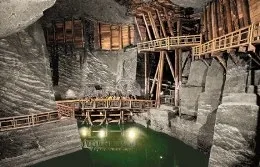
The Salt Mine in Wieliczka, Poland
Let's start, perhaps, with how to get to Wieliczka. The most logical way is from Krakow: after all, the city centers are located 14 kilometers apart as the crow flies. By car, you can take Highway No. 4, part of which includes a street called Wielicka.
There is a wide choice of public transport. First, there are numerous minibuses – both those going directly to Wieliczka and those passing through (they usually have the English words "Salt Mine" on the side – plenty of foreign tourists use them). Like all minibuses, they run frequently but chaotically. If there is a schedule, it is only in the driver's cabin, and guessing the departure point in Krakow is not always easy the first time. It could be one of two small parking lots opposite the shopping gallery near the railway station, or the stop at the main post office, or the "Nowy Kleparz" terminus, or something else (a few years ago, some enterprising company managed to organize the terminus of its minibuses not just anywhere, but in the ambulance station parking lot). The only saving grace is that Wieliczka is close, there are many minibuses, and something will turn up at each spot.
Second, there is the express bus 304 from the railway station, which until recently was the most convenient means of transport, if only for its predictability. Was, because the Krakow authorities, in an effort to save money, decided to reshuffle routes, and now a tourist wanting to get to Wieliczka faces an unplanned tour of the bedroom suburb of Bieżanów.
And third, there are regular buses to the Wieliczka-Rynek station, which are good in every way (inexpensive, fast, obviously not stuck in traffic), except for one thing: their intervals are from one to one and a half hours. However, if you time it right, there will be no problems. I would recommend them.
So, you have made it to Wieliczka. Let's first take a walk around the town itself. It is located in a very hilly area between two ridges of the Wieliczka Upland, so it has two centers – the Upper Market and the Lower Market, also called the Salt Market. The railway platform and minibus stops are located not far from the latter. This area has pleasant old buildings: the town hall building and the so-called Sztygarówka – a house built for the Mining School on the 50th anniversary of Emperor Franz Joseph I's reign, which now houses the district authorities.
If you go up Zamkowa Street to the Upper Market, you cannot miss the Salt Castle, which now houses the Krakow Saltworks Museum. At the end of January 1945, as a result of military operations, the castle was destroyed to its foundations and lay in ruins until 1976, when restoration work finally began. It took 20 years to bring the castle to its current state and open it to tourists.
After the castle, you can go up to the Upper Market with the Przychocki Palace, then turn right onto Górska Street, and another right onto Jan Mikołaj Daniłowicz Street, make almost a full circle and end up in St. Kinga Park, at the mine shaft also named after Daniłowicz. The entrance to the mine is located there.
If Daniłowicz became famous as, in modern terms, an effective manager, then St. Kinga became the heavenly patroness of salt miners. According to legend, when she married Krakow Prince Bolesław the Chaste, she decided to bring as a dowry to her new homeland something that was not there – salt deposits, which were of great value in the Middle Ages. Before leaving for Poland, Kinga threw her engagement ring into a mine in Maramureş given to her by her father, Hungarian King Béla IV. Upon arriving in Polish lands, Kinga ordered a search for salt deposits there. Salt was found, and in the first salt block extracted, Kinga's ring miraculously turned up, having been transported from Hungary together with the salt deposits.
According to modern scholars, the legend has a historical basis: although the salt deposit near Wieliczka had been known since time immemorial, its industrial exploitation began precisely under Bolesław the Chaste, thanks to experienced miners who came with his wife from Hungary. An audiovisual composition with light effects based on this legend, featuring sculptures carved from salt blocks, will be shown to you in one of the mine chambers.
However, first you will need to descend to a depth of 64 meters via the mine shaft, overcoming 380 steps. Local guides like to joke that the return ascent by elevator is guaranteed only with good behavior. This works on tourists: they usually behave decently.
Actually, you cannot enter without a guide: due to the nature of the site, it can only be visited in groups. But if you come on your own, no problem: after buying a ticket (50 zlotys for a Polish-language tour, 65 for a tour in other languages), you should go to the meeting point and wait until 35 individuals like you gather. If 35 people do not gather within an hour, the tour will start without a quorum.
Most tours are conducted in Polish. If that does not suit you, you can try to join a foreign-language group. Currently, tours in English are held at 10:00, 11:00, 11:30, 12:30, 13:45, 15:00, 16:00, 17:00, and in German at 10:45 and 16:00 (in summer they are more frequent). In July and August, tours are also conducted in Russian (usually at 11:15 and 16:15, but it is better to check the time before your trip).
The temperature inside is constant and, according to the mine's official website, is 14 degrees Celsius, so you should dress accordingly.
So we come to the main point – why, actually, one should go to Wieliczka. Here I will resort to the dry and slightly clumsy language of official documents and quote the official description from the UNESCO World Heritage list. The contrast with what you will see there will be all the more striking. So, 'the Wieliczka salt mine is a unique phenomenon in the history of mining, since salt deposits have been exploited here continuously from the 13th to the end of the 20th century.'
The scale of the workings is very large; adits, galleries and chambers with underground lakes form a route over 200 kilometers long on seven levels from 57 to 198 meters below the Earth's surface. The largest collection of original tools and mining equipment has been preserved here, illustrating the development of mining technology from the Middle Ages to the present day. The salt mine was not only a place where the valuable mineral was extracted, but also inspired the creation of magnificent works of art, such as chapels with altars or sculptures made from this unusual material.'
Yes, essentially, all of that is there. Narrow adits, salty walls that you are allowed to lick, equipment that you can try to turn under the supervision of a guide, and salt figures that can only be admired from a respectful distance (due to the fragility of the material). And, of course, the chapels.
The most impressive of them is, of course, the Chapel of St. Kinga. Sometimes you can see a strange sight there – tourists who stand under a chandelier decorated with salt crystals, place their camera on the floor (also tiled with salt), and ask someone to press the button. The secret is that if the camera is placed at a certain point, the chandelier forms a kind of crown around the head. This point, of course, is not found immediately, but experienced guides know about it.
The Chapel of St. Kinga is a kind of culmination of the route; after that, everything goes downhill both figuratively and literally. In my opinion, only the underground lake in the Weimar chamber can compare with the chapel in terms of the power of impression: with appropriate lighting, it, generally shallow, seems completely bottomless.
If you behaved well, the elevator will take you back to where you started your journey. Note that the tourist route is only about 2% of the mine workings. If that's not enough for you and your health allows you to engage in speleotourism, you can try to gather a group of 5 to 10 people and, by prior request, take a four-hour route called 'Off the Tourist Trail'.
Such a walk costs 3.5 times more than a regular tourist one, and here everything is serious: participants sign statements about completing the briefing (which takes about a quarter of the excursion time) and accepting full responsibility for possible consequences of non-compliance. After that, they receive a protective suit, helmet, special miner's lamp, and go into the workings with the obligation not to take cell phones, cameras, or fire-starting devices. In short, if you want to feel like a miner – give it a try.
That precautionary measures are not empty words was proven in Wieliczka in 1992, when the release of groundwater in the Mina cross adit led to a collapse of the roadway and the appearance of cracks in the walls of the Franciscan monastery. A serious threat loomed over the unique monument then, but the water was contained by a dam. And now the danger seems to have passed. Though... the aforementioned official website of the salt mine – or rather, its Russian version – promises Russian tourists a 'pilgrimage tour'. So you'd better hurry before everything there gets broken.
But seriously, the salt mines in Wieliczka must be seen at least once in a lifetime: no description and no photographs can convey the feeling that you will definitely bring up to the surface.
Valery TIKHONOV.
Gazeta.Ru er="0">