
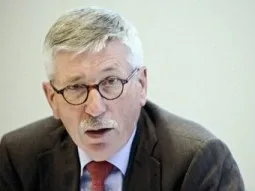
Half of Germans surveyed supported the scandalous politician
The politician's interview stirred up society and sharpened the debate on migrant integration. The main question that came to the fore: can a critical and even partly negative attitude toward migrants, previously rejected on grounds of political correctness, be legitimized by public opinion?
It should be noted right away that in Sarrazin's case, it is best to refrain from value judgments. The topic of immigration in Europe is extremely complex in itself, and the abundance of heterogeneous material makes it possible to justify sometimes opposing points of view. In this particular case, the most important thing is what Sarrazin said and what the reaction in Germany was to his words.
The interview with Thilo Sarrazin appeared in the October issue of the weekly magazine "Lettre International", entitled "Berlin auf der Couch", which was devoted to the economic, social and cultural situation of Berlin 20 years after German reunification. This is noteworthy in itself because "Lettre International" is a kind of elite publication for the "highbrow".
One of the main ideas expressed by Sarrazin was that, given the current dynamics, Berlin as a city faces degradation, largely due to migrants, especially those of Arab and Turkish origin. Due to misguided migration policy, their influx is large but their contribution is small: most Turks and Arabs living in Berlin, according to Thilo Sarrazin, do not perform "any productive function other than trading in fruits and vegetables". The small Turkish eateries springing up in large numbers on Berlin's streets, as Sarrazin noted, cannot become the basis for further development of the city.
The situation is complicated by the fact that Turkish and Arab immigrants bring nothing to the city not only economically but also socially, because many of them do not want to, and sometimes are simply unable due to low educational level, to integrate into German society. At the same time, as Sarrazin notes, their birth rate is significantly higher than that of Germans. "Turks are conquering Germany just as Kosovars conquered Kosovo. I would not object if it were about Eastern European Jews, whose IQ is 15 percent higher than Germans, but I do not like that it is about population groups that do not intend to integrate," Sarrazin said.
"I consider it unacceptable," Sarrazin stated, "when Turkish teenage boys do not obey the teacher because she is a woman, and their culture does not provide for that." Many Turkish and Arab migrants, Sarrazin noted, having lived in Germany for decades, do not know the German language. In primary school classes in Berlin, there are students who speak only Turkish. And even if their parents do not directly reject Germany, in reality they live not in a German but in a Turkish society. At the same time, many migrants are on social welfare. "I am not going to recognize those who live off the state while rejecting that state, do not care about their children's education, and constantly produce new girls in headscarves," concluded the former Berlin finance senator.
Moreover, according to Thilo Sarrazin, the social welfare itself that the state pays to migrants serves as an obvious obstacle to their integration and additionally turns them into dependents. "That same Arab family, which after twenty years of living in Sweden or Germany complains about discrimination and unemployment, integrates perfectly in Chicago," Sarrazin noted. Why is that? Because in the USA, social welfare for migrants is practically absent, and whoever does not work—and thus does not integrate into society—ends up on the street. But in Germany, a migrant family receives a benefit of €1,500, and an uneducated father of the family has no need to plug into the system of production relations. Among Berlin migrants, the number of unemployed is, according to Sarrazin, disproportionately high.
However, not all migrants are like that. As Thilo Sarrazin noted, what has been said applies to a greater extent to Turks and Arabs, as well as people from the former Yugoslavia. As for migrants from Asian or Eastern European countries, they, on the contrary, show an obvious desire to integrate into German society. "Take the Vietnamese: the parents usually do not know German, they trade in cigarettes or run a small kiosk. The second-generation Vietnamese on average have high grades in school and graduate with a better diploma than Germans," Sarrazin noted.
Thilo Sarrazin sees the way out of the current situation Berlin finds itself in primarily in attracting educated migrants. Berlin, in his opinion, must import intelligence, as the authorities of New York did in the 1950s. "We welcome everyone who strives for something and wants to achieve something here. The rest can go somewhere else," Sarrazin declared. "We need to go for quality, not quantity. From a capital of welfare recipients, Berlin should become a capital of elites, as it was in the 1920s," he noted. Berliners themselves, in his view, cannot get out of the hole they are in: from generation to generation, the intellectual level of the city's inhabitants is declining. In addition, the former Berlin finance senator believes there are two more factors hindering the city's development: the leftist spirit of 1968 and the sloppiness and carelessness characteristic of Berliners.
In short, Thilo Sarrazin gave a very harsh interview, and it is not surprising that the reaction to it was also harsh. First of all, from German politicians and businessmen of Turkish origin. One of the leaders of the Greens, Cem Özdemir, said that if he had allowed himself to say something like that and had harmed his comrades so significantly, he would have been forced to leave the party long ago. A major Turkish businessman, Vural Öger, working in tourism, said that Sarrazin's words about Turks are 'savagery and vulgarity.' 'These are the words of a far-right extremist, not a social democrat,' he added. The scandal reached Turkey: the vice president of the Turkish central bank, Ibrahim Turhan, said in an interview with the newspaper Sabah that 'Allah could have given Sarrazin more intelligence.'
A number of German politicians, businessmen, and public figures also reacted negatively to Sarrazin's statements. The Labor Minister of Lower Saxony, Philipp Rösler, who himself has Vietnamese roots, said that the issue of migrants should not be embellished, but Thilo Sarrazin's words steer the discussion in the wrong direction. Moreover, according to him, with his speech, Sarrazin nullified five years of integration policy. Bundestag deputy from the Greens, financial expert Gerhard Schick, called Sarrazin's statements 'vulgar and discriminatory,' adding that a member of the Federal Bank's board should not allow himself such things either in private conversation or, even more so, in the pages of the press.
The General Secretary of the Central Council of Jews in Germany, Stephan Kramer, intervened very sharply in the debate. Kramer stated that Thilo Sarrazin is acting in accordance with the ideological principles of National Socialism. He placed the banker in the same category as Hitler, Göring, and Goebbels, noting that they would have been grateful to him. Finally, it became known that the prosecutor's office has launched a preliminary investigation against Thilo Sarrazin on charges of inciting racial hatred. However, far more serious consequences awaited Sarrazin at the Bundesbank. First of all, the management hastened to officially distance itself from his statements, and the bank's head, Axel Weber, very transparently hinted that Sarrazin should consider personal consequences, i.e., resignation.
Later, curious things came to light: Weber knew about Thilo Sarrazin's interview in advance, tried to prevent its publication and make a number of significant edits, but Sarrazin did as he pleased and gave consent for publication, leaving everything as it was. In other words, a personal conflict was also added to the political scandal. One way or another, Thilo Sarrazin tried to reduce the tension: he said that he did not intend to offend anyone and regretted if his formulations hurt anyone. However, he did not apologize on the merits. Speaking on October 9 at a conference in Berlin, he stated that he 'said everything he wanted to say' and had nothing to add. Moreover, he made it clear that he was not thinking of any resignation and that on Monday, as if nothing had happened, he would return to his office in Frankfurt am Main, where a pile of documents requiring review awaited him on his desk.
At this point, it turned out that Thilo Sarrazin has not only critics but also supporters. For example, publicist Matthias Matussek came to the banker's defense, stating that Sarrazin is a kind of Mephistophelian figure who intends evil but does good. Political scientist Professor Arnulf Baring spoke in a similar vein: 'In this case, no one can refute Sarrazin: Germany indeed experiences serious difficulties with migrants from Turkey and Arab countries. However, in a country of hypocrites and political correctness, they are ready to destroy anyone who speaks the truth out loud.'
A well-known German publicist of Jewish origin, Michael Wolfsohn, stood up for Sarrazin. He criticized the General Secretary of the Central Council of Jews in Germany, Stephan Kramer, for comparing Sarrazin to Hitler, noting that this does not reflect the views of all Jews. Another equally eminent journalist and publicist of Jewish origin, the chairman of the Axel Springer Foundation, Ernst Cramer, stated in the pages of Welt that the General Secretary of the Central Council of Jews, by accusing Sarrazin of adhering to the ideas of National Socialism, only revealed a lack of political knowledge and tact. According to Ernst Cramer, even Sarrazin's worst verbal outbursts are still 'golden words.' Stephan Kramer himself later acknowledged in the pages of Tagesspiegel that the analogy he drew with Nazi leaders was incorrect, but emphasized that he nevertheless continues to consider Sarrazin's statements 'racist.'
For its part, the German agency DPA cited the results of a sociological survey, according to which 51% of surveyed German citizens agreed with Thilo Sarrazin's assertion that Turkish and Arab migrants either do not want or are simply unable to integrate into German society. Only 39% expressed their disagreement. Most of those who disagreed with Sarrazin were among supporters of the Greens, while supporters of the SPD, CDU/CSU, FDP, and the Left Party mostly supported him.
Aleksey DEMYANOV.
Lenta.ru