
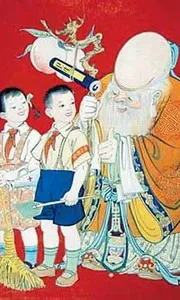
The Chinese believe that every house has a personal deity - the Guardian of the Hearth (Zao Wang), similar to our domovoi
First of all, as it turns out, we guessed right about the drunk grandfather. The fact is that, according to the Chinese, every house has a personal deity - the Guardian of the Hearth (Zao Wang), similar to our domovoi. But there is a significant difference: every year, exactly a week before the New Year holiday, all Zao Wangs go to heaven on an important mission. They must present a report to the Jade Emperor about the behavior of the family entrusted to them in the outgoing year. As a result, the guilty may expect trouble in the new year.
Nobody likes having problems, so a proven method is used - a bribe. Shortly before the departure of the Guardian of the Hearth, they please him in every way - put all sorts of sweets in bowls for him, ply him with wine without mercy, hoping that the appeased Zao Wang will not slander his own. And so that he does not mix anything up while drunk, they give him a cheat sheet - a piece of paper with the inscription: "When you go to heaven, speak only of good deeds." To avoid having to trudge to heaven on foot, they cut out a little horse or a palanquin from paper, a red cord - a bridle is attached to the horse, and water and finely chopped hay are placed.
But then the day comes, and the drunk and well-fed guardians set off for heaven. Some, on the way, stop by the Moon to replenish their supplies. There, as even a one-year-old Chinese child knows, lives the Lunar Hare, who pounds the powder of immortality for the gods in a mortar. But here's the trouble: houses left without gods become easy prey for all sorts of demons, so the orphaned people engage in self-defense - they scare away demons by setting off firecrackers, banging on pots, shouting loudly... But the best thing is to entrust the protection of the house to professionals, so they paste pictures on the doors depicting demon fighters - menshen.
Thus, according to one version, New Year pictures, or in Chinese - nianhua, came into being. They began to be printed in Buddhist and Taoist monasteries back in the 5th-6th centuries AD. Soon it became the most popular form of art. Nianhua can be very different - protective, with New Year's wishes (the most numerous), with images of popular gods, scenes from classical novels, everyday sketches. They are united by only one thing - they are very colorful and extremely kind pictures - there is no place for sadness in the New Year.
For a long time, no one took Chinese folk prints seriously. The lifespan of New Year pictures was clearly measured - one year. For exactly that long they decorated the house (and sometimes the poultry yard and pigsty), and at the next holiday, having received new nianhua as a gift, the old ones were burned so that all the good wishes would reach the gods with the smoke. The first to pay attention to folk art were Russian orientalists. A small collection brought by the botanist V. L. Komarov caused a boom in Russia.
"A small bright picture, like a bomb, fell into our stagnant swamp," - this is how the great orientalist, Academician V. M. Alekseev, describes the situation.
At the end of December, the exhibition "Chinese Folk Picture Nianhua" opened in the State Hermitage in St. Petersburg. Once again, the Hermitage has confirmed its reputation as the best museum in the country. Firstly, the richest - the Hermitage collection of nianhua in terms of quantity (about five thousand) and variety of subjects ranks second in the world after the famous collection of Professor Wang Shucun (PRC). Secondly, the most generous - we have not seen such an exhibition of Chinese folk prints before. There have already been about five exhibitions of nianhua, but the number of pictures there rarely exceeded a couple of dozen.
Here, the entire "Peter's Gallery," which no one had seen before (it opened this year after restoration), is filled with New Year pictures - about ten halls, more than two hundred works.
Thirdly, the most professional. The Hermitage has always been famous for its careful preparation of exhibitions, but here it has outdone itself. The fact is that traditionally, New Year pictures are saturated with Chinese symbolism, and each of them contains an encrypted rebus.
Wishes are usually encrypted on the principle of consonance. In the Chinese language, like in no other, there is a huge number of homophones. Therefore, seeing a deer in a picture, a Chinese person will immediately understand that they wish him to achieve high ranks - the words 'ranks' and 'deer' in Chinese sound the same: 'lu.' Therefore, pictures often contain vases (homophone of the word 'ping') - peace, bats ('fu') - happiness, dogs, butterflies, magpies, lotuses, carps, peonies, etc. It is often difficult even for a Chinese person to decipher a picture; here, however, every picture is carefully attributed, and each is accompanied by a detailed story - the result of many years of work by the exhibition curator M. L. Rudova.
Well, and fourthly, the Hermitage turned out to be the most timely of museums - it is hard to imagine a more well-timed exhibition. If you are in St. Petersburg during the holidays, drop by and take a look. A New Year's mood is guaranteed for at least a couple of days.