
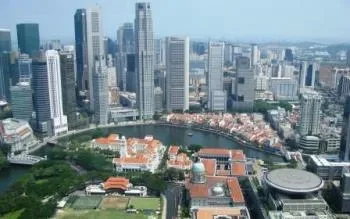
The independent state of Singapore is not yet 50 years old, but the standard of living over this period has risen from poverty, surpassing many developed countries. How did a patch of land the size of Saint Petersburg achieve such phenomenal results?
FILLING OUT the declaration on low and transparent taxes took me about half an hour. The work permit was processed in the same amount of time, without queues or crowding. This level of efficiency of the state apparatus was ensured by a number of strict but fair measures. First of all, it is universal equality before the law (the famous 'zero-level tolerance'). In other words, the poor and the rich, the actor and the homeless are equal before the law. Without exceptions. This was achieved by inviting highly qualified specialists from the field of jurisprudence. And they got the specialists by raising the salaries of state-level employees to the level of salaries in multinational corporations.
A separate page in the history of the island is the fight against corruption. 'Start by putting three of your friends in prison. You know exactly why, and they know why,' is the famous phrase of the legendary Prime Minister Lee Kuan Yew, who assembled a unique team of ministers that led the city to prosperity. Thirty-five years ago, corruption was simply eating away at the local system of government. Everything was decided through bribes. Everyone was equal before the law, but some were more equal. Familiar, isn't it? But the team of young ambitious ministers adopted a package of measures that seriously increased the criminal penalty for bribery. Police officers were replaced by civilian investigators, and the powers of investigative committees were expanded.
The absence of corruption and low taxes led to a mushrooming of new enterprises. At first, these were heavy, polluting industries, but now it is banking, medicine, and robotics. You can open a private enterprise in half an hour, and every tenth resident is a millionaire.
An equally important aspect is the constantly self-improving management system. Suppose you want to make a suggestion for improving some process. They won't throw a greasy old lined notebook labeled 'Complaint Book' at you with contempt. They will listen to you carefully, write down all your comments and suggestions. If they are reasonable, rest assured that the process will soon be streamlined.
CARELESSNESS of the local population is the price the local authorities have to pay. If I have been accustomed since childhood to relying only on myself, Singaporeans know that the government will not abandon them and will always take care of them. This sometimes leads to phenomenal carelessness. Is that good? I don't know yet.
Singapore is a crazy multinational melting pot. The city has four official languages: English, Chinese (Mandarin), Tamil, and Malay. All these nations have contributed to the creation of Singapore. But the main thing is that they all feel like one nation without losing their unique characteristics.
Many things unite Singaporeans, but I think first and foremost it is the love of good food. As my colleague said: 'If you like the local cuisine, you will love this place; if not, you will soon leave.' Where else in one place can you try Malay, Indian, Chinese, Filipino, Indonesian, Korean, and Japanese cuisines? And that's not a complete list! Every Singaporean loves to discuss where and what food is. The first question when I returned from a trip to Myanmar was: 'So, how was the food there?' I never paid much attention to local cuisines before unless they were world-famous (like French). In Singapore, the approach to travel is different: if you haven't tried the local cuisine, you haven't been to the country; no one will be interested in your stories about the sights.
Another ingredient of the local 'national glue' is the army. Every citizen upon reaching 18 years of age must serve 22 or 24 months either in the Singapore Armed Forces (SAF), the Singapore Police Force (SPF), or the Singapore Civil Defence Force (SCDF). This is not sweeping lawns and painting grass; service is serious teamwork, uniting people of different nationalities (the platoon is mixed). And it's not two camps—officers and soldiers—but one team.
An important point is local social housing, an analogue of our Khrushchev-era apartments. A building must be occupied approximately in proportion to the number of nationalities living in the city, according to the policy of integration of nationalities. Thus, ethnic neighborhoods do not appear (except for historical ones like Little India or Chinatown) and ethnic conflicts do not arise.
FORTY YEARS ago, Singapore started with the development of industrial production: a huge port, oil refining, and an electronics manufacturing center. Today, the economy has reoriented toward innovative and knowledge-intensive products. This is primarily based on the high quality of local education. Singaporean universities consistently lead in Asian rankings, and the National University of Singapore consistently ranks in the top 50 world universities. Bioinformatics, robotics, and computational linguistics are actively developing.
An important point: most Singaporeans complain about their fate, because they have no pensions, and you can often see an old grandmother cleaning a restaurant. But apparently, locals do not notice that they have to pay several times less for education at one of the best universities in the world than foreigners. And the government actively encourages saving throughout life. It advises where and how to invest money. I think this is more noticeable to me from the outside, and this level of care is much better than 250 dollars a month in old age.
Internet, mobile communication and the latest gadgets are everywhere. I was a bit surprised that the woman cleaning my apartment had a cooler phone than mine. Such a level of information environment dictates a completely special level of internet services. Find out the schedule of the nearest bus? Easy! Transfer money, pay taxes, buy an electronic ticket, top up your metro card? No problem! Register your business online? In half an hour!
In Singapore, there are almost no old dilapidated houses. The humid climate and small territory dictate their own rules in construction. Everywhere there are brand new, shining skyscrapers. I myself live on the 29th floor and I must say it's amazing. A cool breeze and a unique view of the city center are magical.
But housing prices are fantastically high. Renting an apartment in the center can easily exceed $3,000 per month. Therefore, locals prefer to live on the outskirts (or on a tropical island in neighboring Malaysia), renting out their apartments to expats. The first question asked by a neighbor after meeting was: "How much do you pay per month?" Everyone is constantly looking for something better and cheaper.
Land for housing is usually leased for 99 years. Usually it doesn't even come to that term – the house may be demolished much earlier. Residents may be given a discount or compensation, but not equal to the real value of the apartment.
Getting social housing now is very difficult. Only a young couple, preferably with higher education (local eugenics policy), can count on an apartment. And the prices for such apartments are also substantial.
I especially want to highlight the parks and recreation areas. Everything is thought out at the highest level, with special paths for the disabled, areas for children and for sports everywhere. The city seems very green, despite the very limited territory. Often, on the roofs of buildings, there are small gardens where it is very cozy to spend time.
Singaporeans are literally obsessed with a healthy lifestyle, so there is always someone working out on the playgrounds. There are many sports sections, but the most popular, in my opinion, are rock climbing and running. There is a lot of water space here. Pools are popular, but, to my surprise, many locals cannot swim. Swimming in the ocean due to the port is not recommended, but you can always find someone splashing near the shore.
Read the continuation of the article:
SINGAPORE: THE CITY OF FINES
Alexander MAKAROV,
Singapore.