
IA "Rosbalt" publishes the impressions of a person who recently visited the DPRK - a tourist who had the opportunity to see quite a lot with his own eyes. At the same time, he is fully aware that much remained behind the scenes. It should be noted that, contrary to popular belief, it is possible to go to the DPRK as a tourist, only the visa application procedure is quite lengthy.
The situation in North Korea and the mood of Koreans cannot be understood without having at least a general idea of Korean history.
Korea is a small country bordering China, Russia, and Japan by sea. The entire history of the state was largely determined by attempts to rely on one of its great neighbors and the dramatic disappointments that followed... The current Korean regime emerged on the wave of Korean resistance to Japanese annexation in the early 20th century. The annexation was carried out under a far-fetched pretext, and attempts by Koreans to appeal to international organizations ended in complete failure - the Hague Conference did not stand up for Korea. For Koreans this was a bitter disappointment, and one of their representatives committed suicide right in the hall where the conference was held...
The Japanese occupation regime was very harsh, Korean history was consistently erased, valuables and antiques were exported from the country, and Koreans were forced to change their names to Japanese ones. In essence, the Japanese wanted to prove both to themselves and to the Koreans that there was no independent community - Korea - but only "unfinished Japanese" who had to be returned to the bosom of Japan as an inferior race... Attempts at resistance were brutally suppressed, and dissidents were subjected to monstrous torture in prisons.
One of the episodes of that time, described in Korean literature: a Korean schoolgirl went out among demonstrators against the occupation with a Korean flag in her hands, a Japanese soldier cut off her hand, she grabbed the flag with her other hand, and her second hand was also cut off.
Kim Il Sung - the first "great leader" of the country - came from a family all of whose members, and above all his father, fought against the Japanese. He himself came to power on the wave of resistance to the Japanese that ended in victory. Socialism seemed a natural choice for representatives of the national liberation movement in the 1940s. This choice led to a new war - with the Americans and the subsequent division of the country. Few people know that the American invasion of Korea took place under the UN flag. That is, it was as if international forces were "restoring order" in Korea, although in practice the invasion was purely American. The results of restoring order: after carpet bombing, not a single undamaged house remained in Pyongyang.
Thus, on rivers of blood and suffering, the DPRK emerged within its current borders. And it is not surprising that the main Korean idea became the idea of Juche - self-reliance. According to official data, the population of the DPRK has grown by several million over the past ten years and now amounts to 24 million 600 thousand people.
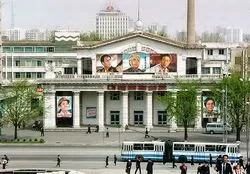
Pyongyang, a city on the large Taedong River, has been built from scratch with tall block houses and large public buildings - palaces of learning, sports, and arts. Some of them are built in the national style. There are also examples of purely modern architecture in the city. The main attractions are the grandiose monuments in honor of the Juche idea, the Workers' Party of Korea, and the leaders - Kim Il Sung and Kim Jong Il. The glorification and praise of the "great leaders" certainly looks strange to us, to say the least. The city is very clean, green, and, in our opinion, rather deserted: there are few cars and little street trade in the city.
Koreans do not march in formation to the barbershop. Just like us, in the evenings they stroll along the embankments, sit on benches in courtyards, children play on playgrounds - the same as ours. The Pyongyang metro is a replica of the Moscow metro of the 1950s. And in general, the feeling of traveling to the past does not leave the streets of Pyongyang: large portraits of leaders, pioneers with red neckerchiefs, women in skirts no shorter than the knee.
The country's main economic problem is the lack of energy resources. Oil and petroleum products are purchased at high prices, and there are problems with electricity. Therefore, evening Pyongyang plunges into darkness: light is on only in the windows of houses and on the most central streets. The collapse of the socialist camp dealt a huge blow to the country's economy, and, as Koreans say, the standard of living has fallen very much compared with the early eighties. Nevertheless, the situation is now gradually beginning to improve.
Koreans claim that the country has solved the housing problem: all families are provided with separate housing, as a rule, an apartment, part of a house, or a house in a village. True, no one hides that amenities in these houses are very problematic - often they are just concrete boxes.
No one hides the difficulties with food either: products are distributed by ration cards, and every patch of land in the country has been plowed and cultivated. As Koreans say, everyone participates in seasonal agricultural work - city dwellers, students, and senior schoolchildren.
According to them, Koreans can personally own only two hundred square meters - there is little land suitable for agriculture in the country.
There are many children on the streets - they say that on average a family has three. All children go to kindergartens and school. After school, some enter an institute (there are about 300 across Korea), some go to work. Military service is mandatory for men and lasts four to five years. Students enter the army after finishing the institute.
Here it should be noted that in the last decade the country has seen a modification of the Juche policy into the Songun policy. The Songun policy defines that the main pillar of the state is the army. This transformation is linked to increased pressure on the country from the United States. American policy, in the Koreans' view, is very simplistic: the first stage is organizing a slanderous campaign against the country, the second stage is invasion under the pretext of bringing democracy, usually under an international flag. North Koreans resist the former rather clumsily; as for the latter, the Korean military gives the impression of people prepared to solve tasks of any complexity.
It is said that when a domestic conflict arose in the joint responsibility zone of the DPRK and South Korea (the 38th parallel) between military personnel – North Koreans and Americans (the Americans decided to cut down a poplar planted by North Koreans), as a result of a brief forceful skirmish without weapons, the Americans instantly suffered casualties, despite overwhelming numerical superiority. This is believable – the People's Army soldiers undergo rigorous military training and genuinely master martial arts (taekwondo).
As the Koreans say, taekwondo training is generally compulsory already in school. Moreover, the Koreans themselves, having a sad historical experience, take their combat skills seriously. In general, the North Korean army is very different from the relaxed European and American military.
In Korea there is a very strong urge for the unification of the northern and southern parts. There are masses of South Koreans in Pyongyang. Five years ago, North and South Korea signed an agreement according to which unification should take place without the intervention of foreign states, by their own efforts, and this agreement is regarded as an important political milestone. North Koreans believe that the Chinese scheme could be tried: one state, two systems. Overall, one gets the impression that if it were not for the American presence in South Korea, the country would have united long ago.
Noticeable is the North Koreans' interest in the Chinese economic experience. And although, when answering questions, North Koreans say that it is unlikely that the introduction of private property will occur in the coming years, the impression formed is different. Documents have been signed on the creation of the country's first special economic zone – with investments of South Korean capital. By the way, not only the Workers' Party of Korea operates in the country, but also several others, one of which is religious.
Digressing from politics – North Korea is a very beautiful country with picturesque mountains overgrown with pines and acacias. The country has wonderful resorts – both in the mountains and by the sea. Here, the country treats the surviving historical monuments with extreme care, including the active Buddhist monastery.
Will the DPRK be able to transform and adapt to the changed world? One very much wants to believe this, for otherwise the country faces another bloody meat grinder, of which there have already been too many in Korean history.