
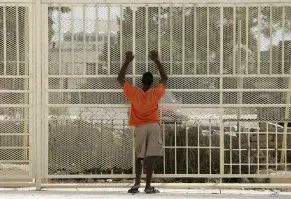
Human rights activists believe that Schengen has become a real catastrophe for thousands of refugees
Lampedusa does not welcome guests
For the inhabitants of Europe, the Schengen Agreement has become an unconditional boon: the abolition of customs duties spurred trade, the abolition of visas revived tourism – the Old Continent turned into a kind of "common home". At the same time, the external borders of this "home" began to resemble fortress walls. Refugees from troubled states were particularly unlucky.
"Amnesty International criticizes many things," emphasizes Cristina Weise, head of the Italian branch of this human rights organization. "But above all, we are concerned about the treatment of African 'boat refugees' – those who risk their lives crossing the Mediterranean Sea in flimsy boats only to be deported to Libya, a country that knows no migration law."
In essence, AI's main complaint is directed against Italy, which since May 6, 2009, has introduced a rule according to which such refugees are sent to neighboring Libya without further ado – a corresponding agreement with Libyan dictator Muammar Gaddafi was adopted at the beginning of last year and cost the Italian government a considerable sum.
But the Italian government presented the conclusion of this agreement as a success – particularly pleased with it is the leader of the right-wing populist party Lega Nord, Interior Minister Roberto Maroni. "The policy of deporting illegal migrants directly from the border is very successful. The Italian government will continue it without the slightest hesitation," he emphasized in response to accusations from human rights activists.
It must be acknowledged that this line of conduct proved very effective. The number of "boat migrants" sharply decreased in 2009-2010: a rumor spread among Africans that after a highly dangerous and entirely illegal voyage to the coveted shores of Europe, they would now be greeted not by a refugee camp, which for many was almost the ultimate dream, but by deportation to Libya – a country whose leader, at the word "democracy," reportedly literally reaches for his pistol.
As a result, the famous refugee camp on the Italian island of Lampedusa, where every "illegal" who sailed to Italy ended up until May of last year, has emptied. "It's just an unreal feeling, there's no other word for it," admits Paola Silvino, deputy director of the camp. "On some days, up to one and a half thousand people would gather here, but now it's just us hanging around. A completely different impression."
Lampedusa is one of the "showcase" camps: it is known for many scandalous stories and has always attracted press attention. Now it has become quiet here, to the delight of the Italian government.
"The fact that the camp on Lampedusa has emptied is not at all positive," asserts Laura Boldrini, press secretary of the UN High Commissioner for Refugees (UNHCR). "It would be good news only if we knew that all its potential 'residents' stayed at home and that they are doing well there."
But the "illegals" continue to strive across the sea to Europe – even if their numbers have decreased. But now they (those who survive) are sent to camps on the mainland or, as already mentioned, simply deported to Libya – directly on Italian Coast Guard boats that pick them up at sea.
Europe locked up?
Since the European border protection agency Frontex started operating within the EU, its activities have been constantly criticized by human rights activists – primarily for its lack of transparency.
"All refugees are sent back indiscriminately – neither identification nor interviews about the reasons that prompted them to flee their countries are conducted," emphasizes Laura Boldrini. "Such a 'sentence' without the right to appeal is used simply for everyone – including those who really need protection." According to her, there are witnesses confirming that many refugees are not even given the opportunity to apply for political asylum – which is a direct violation of the Geneva Convention on Refugees.
"Among the illegals, there are many asylum seekers," states the UN High Commissioner's press secretary. "75% of those who arrived by sea in Italy in 2008 applied, and half of them were recognized." That is, we are talking about people who fled wars, persecution by authorities, or criminal or terrorist groups. "If these people can no longer come to Europe – for us, this is not a victory over illegal migration, but a failure of democracy," emphasizes Boldrini.
Just a few days ago, the Libyan authorities forced UNHCR to close its office in that country. Nothing is known about how refugees are treated there. Human rights activists speak of real concentration camps, but this cannot be verified. Many countries in southern Europe have already followed Italy's example – first and foremost, Malta. The smallest country in the European Union was not particularly welcoming to refugees before either – and one can understand it.
With a population of 402 thousand people and an area of only 316 square kilometers, Malta found itself directly on the path of "boat migrants" from Africa to Europe. Joining the EU, it unexpectedly became a "desired haven" for tens of thousands of illegals, while its Community neighbors did not even bother to help it. No one had counted on such a flow, so illegal refugees landing on Malta were sent to a camp for at least a year and a half, and their conditions of detention were very harsh. After all, Malta even imports fresh water – there is not a single source on the island.
Maltese live off tourism, and what tourist would come to the island knowing that it is overflowing with African refugees, who can be encountered literally at every step? The crime situation in the country has sharply deteriorated: on the one hand, many illegals have taken up thievery, on the other – attacks by locals on uninvited guests have become more frequent.
“In most European countries, asylum seekers arrive at a camp and then they are transferred somewhere else,” complains Maltese Foreign Minister Carmelo Mifsud Bonnici, “but we can’t manage that, we are an island. A small island with huge problems provoked by refugees. This is a real human dilemma.”
An illustration of this is the Safi Detention Center refugee camp, designed for at most a couple of hundred people, but currently housing more than three thousand 'residents'. Dilapidated barracks, vacant lots fenced off with heavy grilles, next to them a cemetery of wooden cayuco boats on which refugees usually cross the sea. It is terrible to talk about the hygienic conditions. And all this, as the Maltese Interior Minister assures, is not because the island's residents hate refugees. There is simply no space or funds to provide them with normal conditions. However, this cannot be explained to the refugees who have ended up here.
Malta, Italy, Spain and Greece – every year thousands of people strive to reach them. Only hundreds reach the desired shores – some die on the long journey across the African continent, some drown at sea, some turn back. Little is known about the daily tragedies on the southern borders of Europe. Nevertheless, as research shows, currently in African countries 13 million people are ready to take the risk and head to the European Union as illegal refugees.
The myth of the 'promised Europe' continues to exist – if only because it is necessary for those for whom smuggling illegals into the EU is a profitable business. Alas, these people face almost no threat – as a rule, neither they nor their bosses even end up in an ordinary European prison, let alone the Maltese Safi camp or the 'hospitable' camps of the Libyan dictator.
Boris NEMIROVSKY.
IA Rosbalt