
The New7Wonders project emerged because the classical list of the Seven Wonders of the World (the grand monuments of the Hellenistic world), created in the 3rd century BC, has turned into an abstraction nowadays. Of its wonders, only the Great Pyramid of Giza (Egypt) remains. Long lost are the Hanging Gardens of Babylon (present-day Iraq), the Temple of Artemis at Ephesus (modern Turkey), the Statue of Zeus at Olympia (located in Olympia, Ancient Greece), the Mausoleum at Halicarnassus (now the city of Bodrum in Turkey), the Colossus of Rhodes (on the island of Rhodes, off the coast of modern Turkey), and the Lighthouse of Alexandria on the island of Pharos (Egypt).
The project to choose new wonders of the world was launched back in 2004, when the list consisted of two hundred architectural monuments and world attractions. A year later, the list was reduced to 77 sites, and in January 2006, a new list was approved, containing only 21 monuments.
Only the Great Pyramid of Giza made it into the new list from the classical wonders, which is quite understandable since all the others, as noted, have not survived to the present day. The UNESCO-approved list excluded such world-famous architectural monuments as the Leaning Tower of Pisa, the Empire State Building skyscraper in New York, and London's Big Ben. Naturally, the map of Kyiv and Ukraine as a whole are not represented in this list at all.
You can vote for the candidates on the official project website www.new7wonders.com, which also has a Russian-language segment. To do this, you need to register, choose a voting method, and then select seven of your candidates. By paying two dollars, you can also get a personal certificate confirming participation in the 'New Seven Wonders' project.
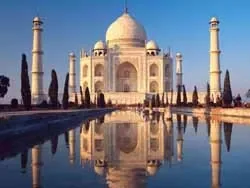
More than 20 million people worldwide have already voted on the project website. Currently leading are India's Taj Mahal, the Great Wall of China, and the Peruvian Inca city of Machu Picchu. The new list of seven wonders of the world will be announced on July 7, 2007, in the Portuguese capital Lisbon. According to UNESCO representatives, the funds raised through the voting will be used for the restoration of world heritage monuments.
A Few Words About the Candidates
I don't want to use the hackneyed word 'political correctness'. We just have to give credit to the UNESCO commission that compiled the shortlist of candidates for the title of new wonder of the world. The list of 21 structures represents all regions of the world except Central Asia (it is quite likely that this gap would have been filled by the ancient Buddha statues in Afghanistan's Bamiyan if the Taliban had not destroyed them in 2001).
Europe is represented by the largest number of wonders: the Acropolis of Athens, the Alhambra fortress in Spain, the Bavarian castle Neuschwanstein, the Roman Colosseum, the British Stonehenge, and (of course) the Eiffel Tower. North America is represented by the Statue of Liberty in New York and the ancient Mayan city of Chichen Itza (Yucatan Peninsula, present-day Mexico). South America is represented by the 'lost Inca city' of Machu Picchu and the Christ the Redeemer statue in Rio de Janeiro, Brazil. The Asia-Pacific region is represented by Cambodia's Angkor Wat temple city and Japan's Kiyomizu-dera temple. Australia and Oceania are also represented by two wonders: the Sydney Opera House and the stone statues of Easter Island. South Asia is represented by the Taj Mahal in India, and Black Africa by the Malian city-fortress Timbuktu. The Middle East is not forgotten: the Egyptian pyramids and the rock-carved Nabataean city of Petra (present-day Jordan) are nominated. Turkey, which claims to be a bridge between East and West (for which its greatest writer Orhan Pamuk received the Nobel Prize in Literature in 2006), is represented by the Hagia Sophia, also known as the Byzantine church of Saint Sophia. Of course, the Great Wall of China could not be omitted. The shortlist also includes the ensemble of Red Square with the Kremlin and Saint Basil's Cathedral.
It is also evident to the naked eye that the compilers of the list of candidate wonders sought to maintain a balance between tradition and progress: the list includes works of ancient lost civilizations such as Chichen Itza, the statues of Easter Island, and the pyramids, alongside wonders of the industrial era like the Statue of Liberty, the Eiffel Tower, and the Sydney Opera House.
UNESCO gives no reason to suspect any bias: each candidate wonder unconditionally deserves to be included in the final list of seven. There are emotional symbols (the Statue of Liberty, the Kremlin), places of worship (Angkor Wat, Kiyomizu-dera), monuments of imperial power (the Alhambra, the Great Wall of China), enigmatic works (the statues of Easter Island), and those that evoke mixed feelings (the Eiffel Tower) for aesthetic reasons, Neuschwanstein and the Colosseum because of their past. But all of these are undoubtedly magnificent creations of human genius, brilliant examples of architecture, sculpture, and engineering.
Without being able to write in any detail about each of these structures (although we would like to, especially some), we offer the reader only the briefest information about them (see below).